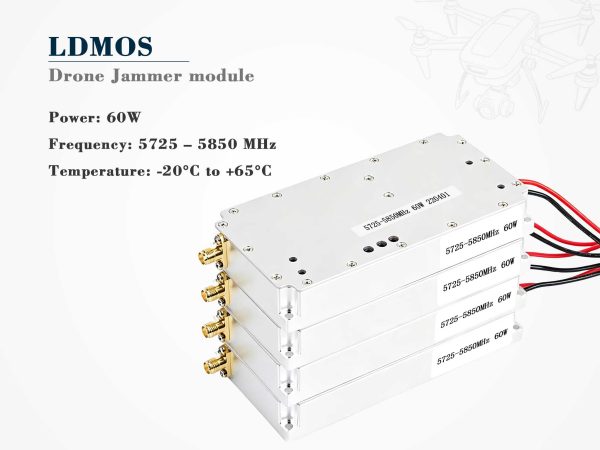
60W 400‑470MHz Drone Jammer Module – VHF/UHF Band
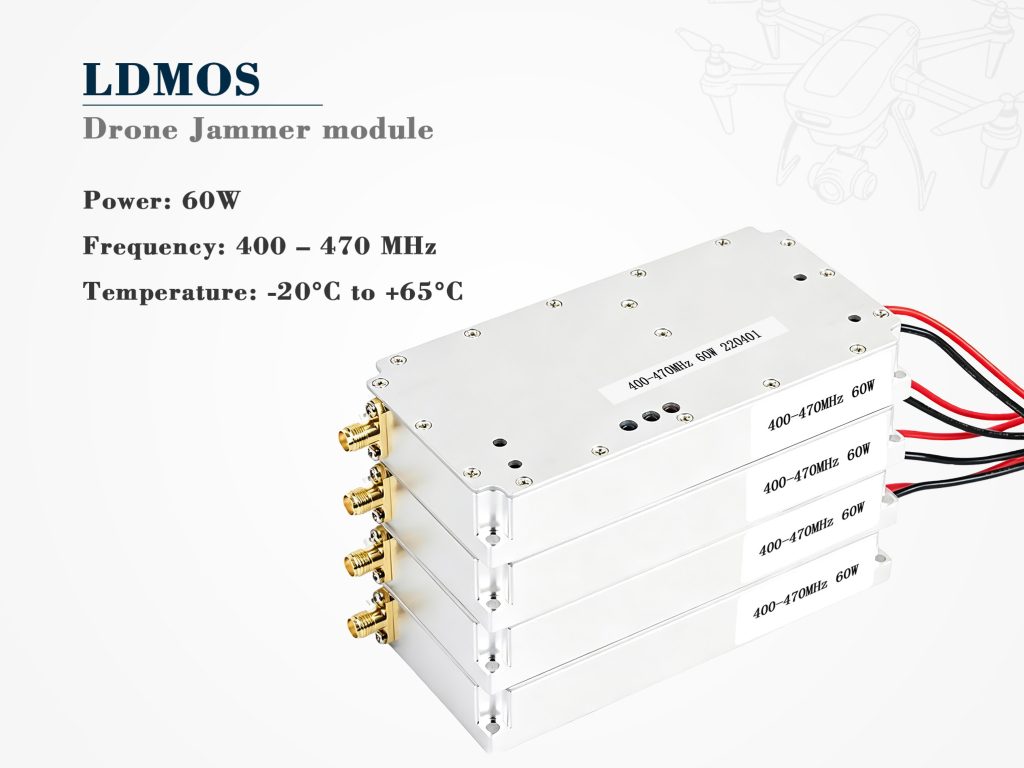
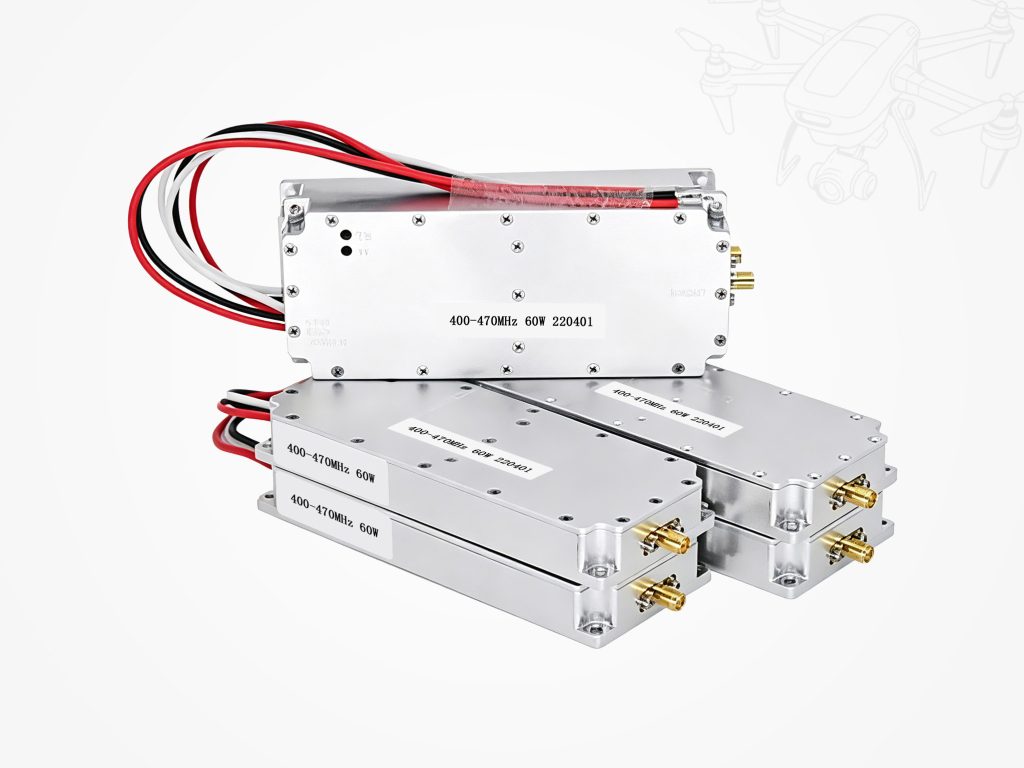
60W drone jammer module for 400–470MHz with built‑in analog sweep. DC 12–14V, 13A, SMA out, compact 138×50×17mm. For UHF drone control jamming.
Technical Specifications
| Parameter | Specification | Notes |
| Frequency range | 400 – 470 MHz | Full 70 MHz coverage |
| Output power | 60W (typical) | Measured at 50Ω load, 13.8V supply |
| Supply voltage | DC 12V – 14V | Nominal 13.8V recommended |
| Current draw | ≤ 13.0A | At maximum output power |
| Modulation source | Built‑in high‑speed analog sweep | VCO‑based, no external generator |
| Analog scan speed | > 50 MHz/ms | Covers band in < 1.5 ms |
| Input / output impedance | 50Ω (RF output) | Control input is high‑impedance TTL |
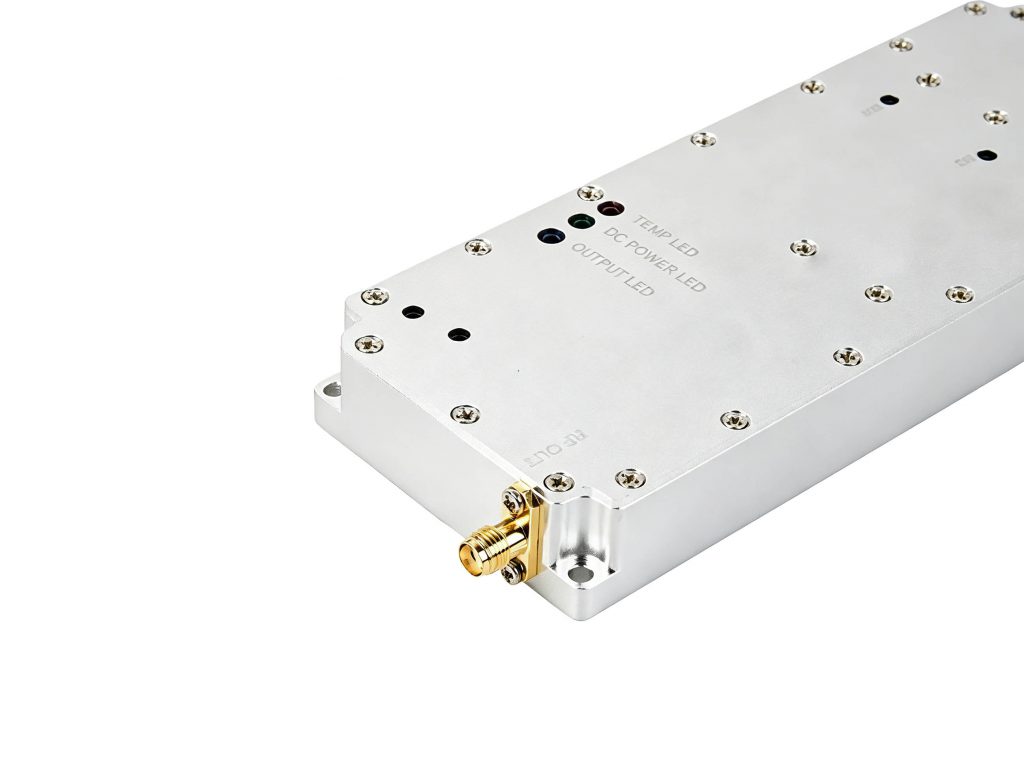
| Protection LEDs | Over‑temp & over‑current (internal) | No external LED pins – protection is automatic |
| Operating temperature | -20°C to +65°C | Ambient, with adequate heatsinking |
| Dimensions (L×W×H) | 138 × 50.5 × 17 mm | Excluding connectors and mounting tabs |
| Weight | 0.22 kg | Approximately |
| Base material | Aluminium alloy | Provides thermal spread and structural strength |
Product Details
The Low‑Band Threat You Can’t Ignore
When people talk about drone jamming, they usually focus on 2.4GHz and 5.8GHz – the flashy frequencies that handle video and Wi‑Fi‑style control. But here’s what many overlook: a huge chunk of commercial, industrial, and even military drones rely on the 400–470MHz band for their primary command and control links. Why? Because lower frequencies travel further, punch through foliage and buildings better, and consume less power on the drone side – all of which are critical for long‑range missions.
This drone jammer module addresses that often‑neglected slice of spectrum head‑on. It delivers 60W of swept interference across 400–470MHz, effectively blinding the command link that keeps the drone in the air. Knock out the control link, and the drone either falls back to a failsafe return‑to‑home – which you can also jam – or simply drops.
60W in the UHF Band – a Different Kind of Reach
The physics of lower frequencies mean this 60W module actually gives you comparable – and in some cases better – effective range than an 80W 5.8GHz module. At 400–470MHz, signals bend around obstacles and travel further over terrain. With a decent antenna (say, a 6‑8dBi collinear or Yagi), you’re looking at effective jamming out to 1.5 kilometres or more in open areas, and still respectable distances in urban environments where higher bands would struggle.
The module draws about 13A at 12–14V DC, which works out to roughly 170W of input power. Efficiency is ≥40%, meaning you get that 60W of RF output with about 100W of waste heat – noticeably less thermal burden than our 80W units. That’s a real advantage for portable and battery‑powered systems where every watt of heat matters.
Built for a Different Voltage World
One thing that sets this module apart is its supply voltage range: DC 12V–14V, not the 24‑29V common to our higher‑frequency modules. That makes it a natural fit for 12V battery systems – the kind you find in vehicles, portable power stations, and standard 3‑cell Li‑Po packs (nominal 11.1‑12.6V). You can run it directly off a car’s electrical system without needing a boost converter, which simplifies integration and improves reliability.
Current draw is 13A at full tilt, so you’ll need a supply capable of delivering at least 15A continuous to give yourself headroom. A 12V lead‑acid battery, a 3‑cell Li‑Po pack, or a 12V industrial power supply all work perfectly. Just make sure your wiring is thick enough – 13A is no joke, and voltage drop on undersized cables will hurt performance.
Compact and Lightweight – a Surprise for This Power Class
At 138 × 50.5 × 17mm and just 0.22kg, this module is remarkably compact for 60W of RF output. It’s actually smaller and lighter than many 20W modules we’ve seen on the market. The slim profile makes it easy to slide into tight enclosures – handheld jammer guns, backpack systems, and vehicle‑mounted setups all benefit from this form factor.
The aluminium baseplate provides structural support and thermal spreading, and the mounting holes let you secure it to a heatsink or directly to your chassis. Despite its small size, this module is built to handle professional deployment conditions.
Control – Same Simple Philosophy
We’ve kept the control interface consistent with our other modules: +5V or floating = on, grounded = off. You can drive it from a 3.3V or 5V GPIO, a toggle switch, or a relay. No protocols, no configuration, no fuss.
The RF output is a standard SMA female connector, compatible with any 50Ω antenna. And since the module has its own built‑in high‑speed analog sweep source, you don’t need to feed it an external signal – just power and an antenna, and it’s ready to jam.
The 400–470MHz Band – What’s Actually Out There?
This band covers several critical segments. 400–420MHz is often used by military and government UAVs. 420–450MHz is a popular amateur radio band, and some drone manufacturers use it for long‑range telemetry. 450–470MHz is heavily used for commercial and industrial control links, including many agriculture and surveying drones. By sweeping the entire 70MHz range, this module catches all of them – no matter which specific channel the drone is using.
The sweep speed exceeds 50MHz per millisecond, so the full 400–470MHz range is covered in under 1.5 milliseconds. Any drone using frequency‑hopping or spread‑spectrum in this band will find itself without a stable link within fractions of a second.
Thermal Management – More Forgiving, but Still Important
At 40% efficiency, this drone jammer module generates about 100W of heat at full output – significantly less than the 170W from our 80W units. That makes it more forgiving in terms of cooling requirements. Without a heatsink, you might get 15‑20 seconds of operation before over‑temperature protection kicks in. With a modest passive heatsink (say, 120×80×30mm), you can run a 50% duty cycle – 30 seconds on, 30 seconds off. Add a fan, and continuous operation is achievable without heroic cooling efforts.
The internal over‑temp and over‑current protection are there to prevent damage, but they’re not a substitute for proper thermal design. If you plan to run this module continuously, we still recommend a fan‑cooled heatsink to keep junction temperatures comfortably within spec.
Who Needs This Drone Jammer Module?
If your counter‑UAS system currently only covers 2.4GHz and 5.8GHz, you have a blind spot – and drone operators know it. Many long‑range drones use 400‑470MHz specifically because they expect jammers to focus on the higher bands. This module closes that gap. It’s ideal for border security, critical infrastructure protection, military applications, and any environment where drones might operate beyond visual line‑of‑sight.
It’s also a great choice for integrators building multi‑band jamming systems. Pair it with our 2.4GHz and 5.8GHz modules, and you’ve got comprehensive coverage across the most commonly used drone frequencies.
A Note on Antennas
At 400–470MHz, antennas are physically larger than their 2.4GHz or 5.8GHz counterparts – a quarter‑wave whip is about 17cm, and a half‑wave is 34cm. Plan your enclosure accordingly. The output impedance is 50Ω, so you can use standard UHF antennas with SMA or SMA‑to‑BNC adapters. For directional applications, a small Yagi or log‑periodic antenna works well and gives you extra gain for longer reach.
Frequently Asked Questions
Case Studies
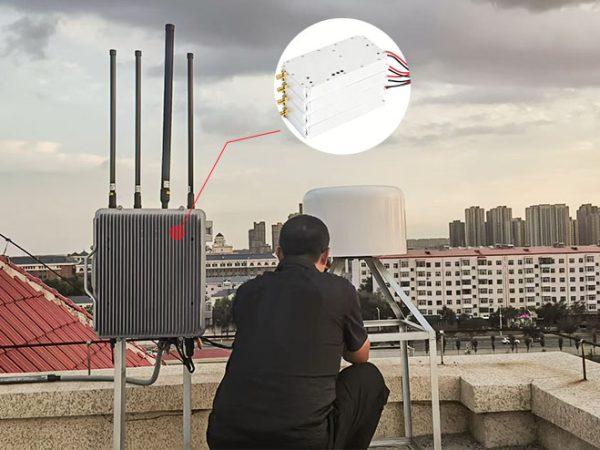
Heilongjiang Weather Center Completes Anti-Drone System Upgrade with Three High-Power Drone Jammer Modules

Tangshan Chem Plant Sealed Drone Gaps With 3 GaN Wideband Modules

How a National Prison Integrated Our Drone Jamming Module Into Their Fixed Counter-Drone System

Integrating Core RF Power: OEM Drone Jamming Module for Oil Refinery Security | Case Study
Send Us a Message
Related Products
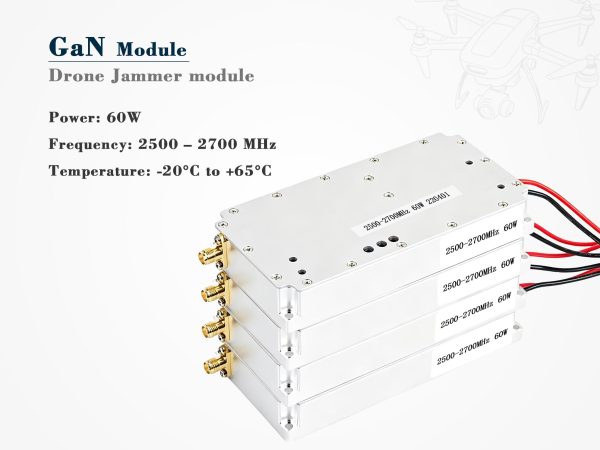
60W 2500–2700MHz GaN Drone Jammer Module
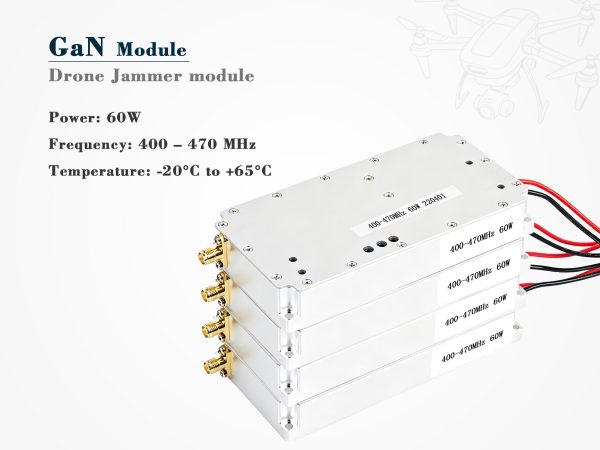
60W GaN Drone Jammer Module 400-470MHz
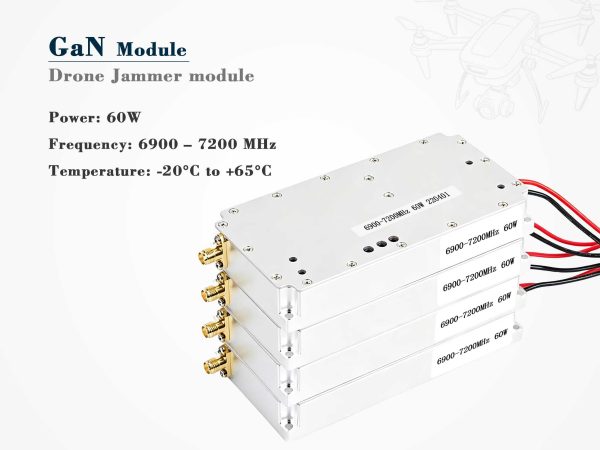
60W GaN Jamming Module: Compact 6900–7200MHz Counter-Drone Power