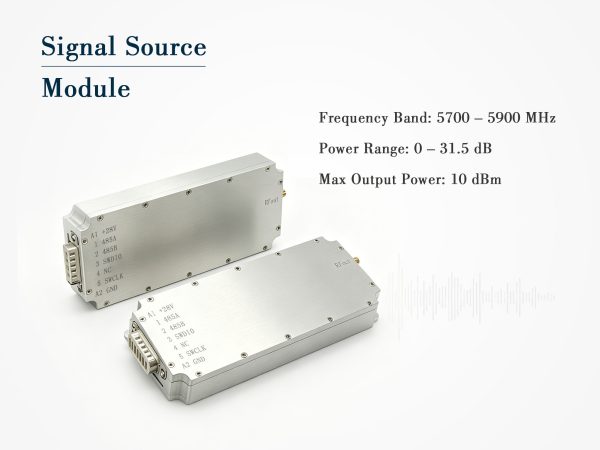
Digital Signal Source Module: DC-1600MHz, 10dBm, RS485
Compact digital signal source module covers DC-1600MHz, +10dBm output, 0.5dB step attenuation, RS485 control, SMA female, 188x98x18.5mm, 0.4kg. Ideal for test systems.
In production test lines, it can act as a stimulus for receiver boards, providing a calibrated level to verify sensitivity and selectivity. In research labs, it can generate test tones for filter characterisation or amplifier gain compression measurements. For field engineers, its compact size and low power draw make it suitable for portable test kits powered by 24 V batteries. It also works well as a local oscillator replacement in legacy systems where space is constrained. Moreover, because the module supports RS485, you can integrate it into industrial IoT gateways and remotely adjust output levels.
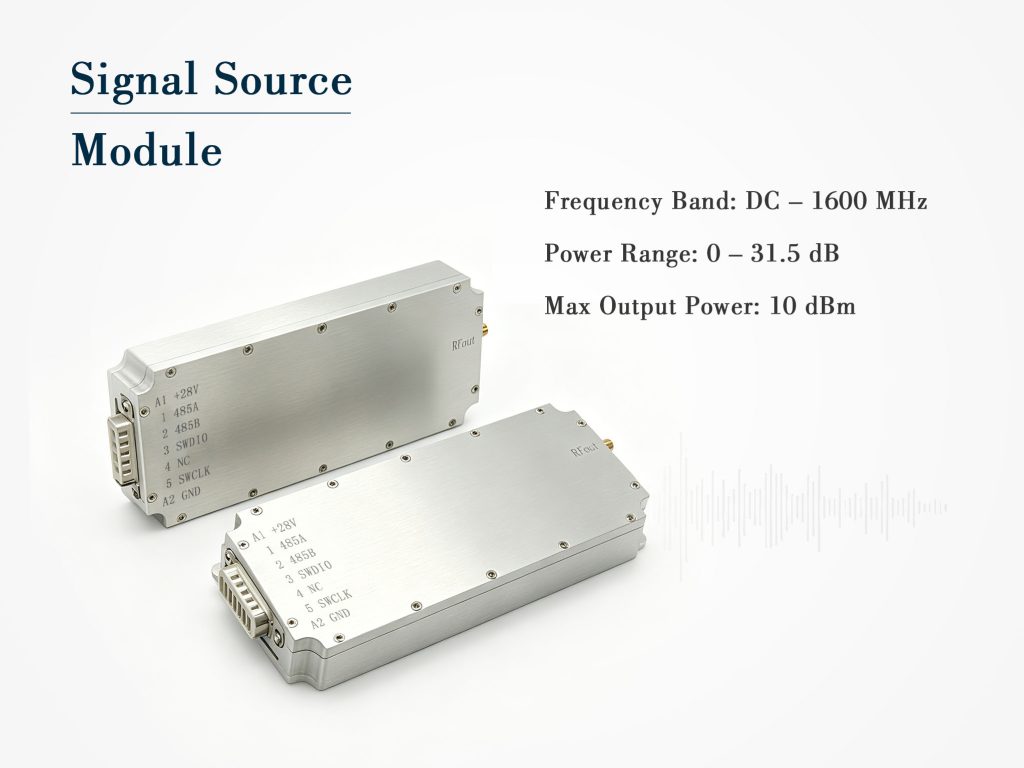
Technical Specifications
| Parameter | Typical Value |
| Signal Type | Digital Signal Source |
| Operating Frequency | DC ~ 1600 MHz |
| Maximum Output Power | +10 dBm |
| Output VSWR | ≤ 2.0 |
| Operating Voltage | DC 24 V ~ 29 V |
| Maximum Current | 400 mA @ 28 V |
| Attenuation Range | 0 ~ 31.5 dB |
| Attenuation Step | 0.5 dB |
| RF Connector | SMA Female |
| Power/Control Connector | 7W2 |
| Control Interface | RS485 |
| Dimensions | 188 x 98 x 18.5 mm |
| Weight | 0.4 kg |
Product Details
Overview
In modern RF and microwave testing, having a dependable, programmable signal source is essential. This digital signal source module fills that need with a solid set of specifications. It covers DC to 1600 MHz, which includes LF, HF, VHF and UHF bands, so it is useful for a broad spectrum of applications. The maximum output power is +10 dBm, a level that is high enough to drive many receivers and amplifiers yet low enough to prevent damage to sensitive inputs. More importantly, the built-in digital step attenuator gives you a 31.5 dB adjustment range in 0.5 dB increments, enabling precise level setting for calibration, sensitivity testing, and emulation of real-world signal conditions. All these features are housed in a slim, lightweight enclosure that does not consume much panel space.
Key Electrical Characteristics
Performance starts with the RF chain. The output VSWR is specified at ≤2.0 across the entire operating band, meaning that reflections are kept low and power delivery is predictable regardless of the load impedance. This is particularly important when you connect the module to antennas, filters, or mismatched DUTs. The signal type is digital source, which typically offers good spectral purity and fast switching compared to analogue VCOs. The power adjustment range (0–31.5 dB) combined with 0.5 dB steps allows you to run receiver AGC tests or measure dynamic range with confidence. Every step is repeatable, so your automated scripts will produce consistent results over many runs. The operating voltage range of 24 V to 29 V DC, with maximum current 400 mA at 28 V, makes it compatible with standard industrial power supplies and battery systems with a DC-DC converter.
Control and Power Integration
Communication with this digital signal source module is handled through RS485, a robust differential bus that supports long cable runs and multiple nodes. This is a clear benefit for systems that require synchronised sources or distributed signal generation. You can daisy-chain several modules and address each one individually, reducing the number of controller ports needed. The 7W2 connector combines DC power and control signals in one rugged connector, which simplifies wiring and improves reliability in vibration-prone environments. From a software perspective, the protocol is straightforward; you can send simple commands to set attenuation and enable/disable the output. The module powers up in a known state, so system initialisation is predictable.
Mechanical and Connector Details
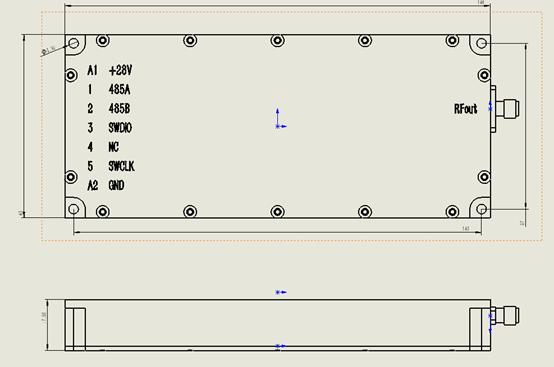
The module measures 188 x 98 x 18.5 mm, a footprint that fits easily into standard 19-inch rack sub-racks or custom housings. Its low profile—less than 20 mm—allows stacking with other boards. The weight is only 0.4 kg, so mounting brackets or chassis rails do not need extra reinforcement. The RF output is via an SMA female connector, which is the de facto standard for laboratory and production RF cables. SMA connectors offer good repeatability up to 18 GHz, so for 1600 MHz they are more than adequate. The 7W2 power/control connector is a hybrid D-sub type that carries both power and low-speed control signals, reducing the number of separate cables and preventing accidental misconnection. This thoughtful connector choice improves system tidiness and reduces installation time.
Practical Applications
You will find this digital signal source module useful in many scenarios. In production test lines, it can act as a stimulus for receiver boards, providing a calibrated level to verify sensitivity and selectivity. In research labs, it can generate test tones for filter characterisation or amplifier gain compression measurements. For field engineers, its compact size and low power draw make it suitable for portable test kits powered by 24 V batteries. It also works well as a local oscillator replacement in legacy systems where space is constrained. Moreover, because the module supports RS485, you can integrate it into industrial IoT gateways and remotely adjust output levels. The 0.5 dB step size is particularly valuable for emulating fading or path loss in wireless link simulations.
Why Choose This Module
Compared to general-purpose signal generators that are bulky and expensive, this digital signal source module offers a focused set of capabilities at a much lower system integration cost. It does not force you to pay for unnecessary features like large touch screens or built-in modulation. Instead, it gives you exactly what you need: a controlled RF source with precise attenuation and a reliable digital interface. The rugged design and wide voltage tolerance add to its appeal in harsh environments. With the 7W2 connector and SMA output, cabling is standardised and replacement parts are easy to find. If your project demands a small, programmable signal source that can be embedded into larger systems, this module is a strong candidate.
Frequently Asked Questions
Case Studies
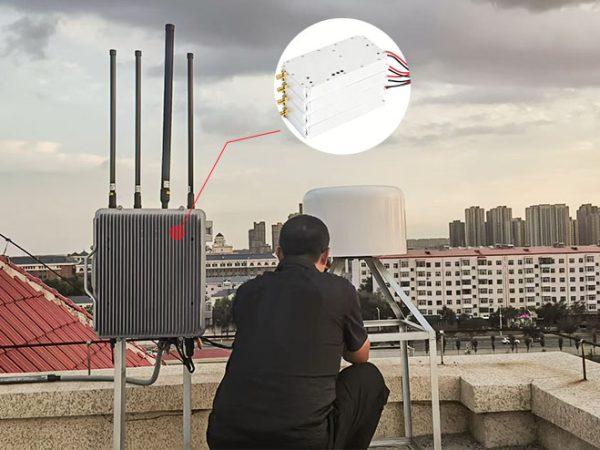
Heilongjiang Weather Center Completes Anti-Drone System Upgrade with Three High-Power Drone Jammer Modules

Tangshan Chem Plant Sealed Drone Gaps With 3 GaN Wideband Modules

How a National Prison Integrated Our Drone Jamming Module Into Their Fixed Counter-Drone System

Integrating Core RF Power: OEM Drone Jamming Module for Oil Refinery Security | Case Study
Send Us a Message
Related Products
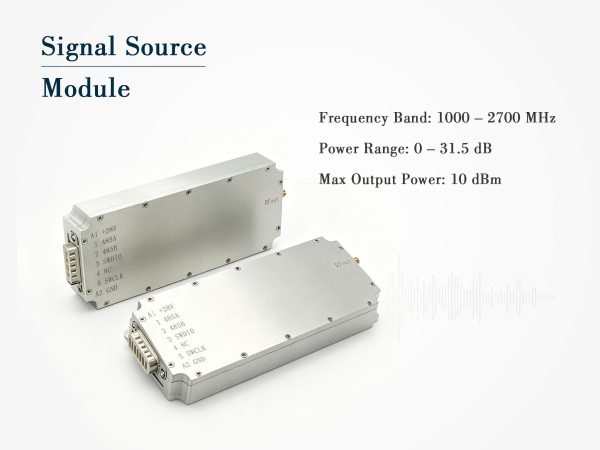
Wideband Signal Source Module – 1000 to 2700MHz, 10dBm with Digital Attenuator
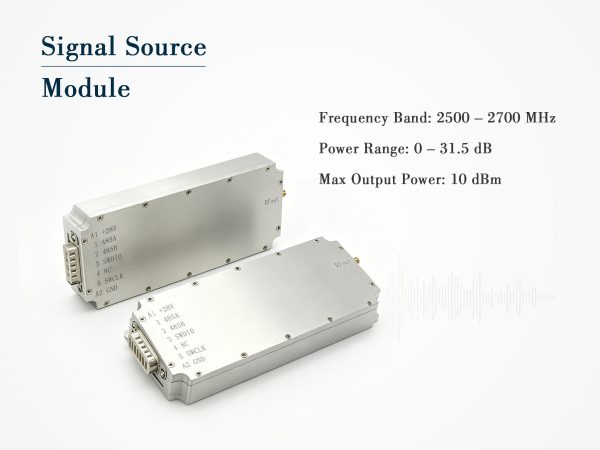
Compact Signal Source Module – 2500–2700MHz, 10dBm with Digital Attenuation
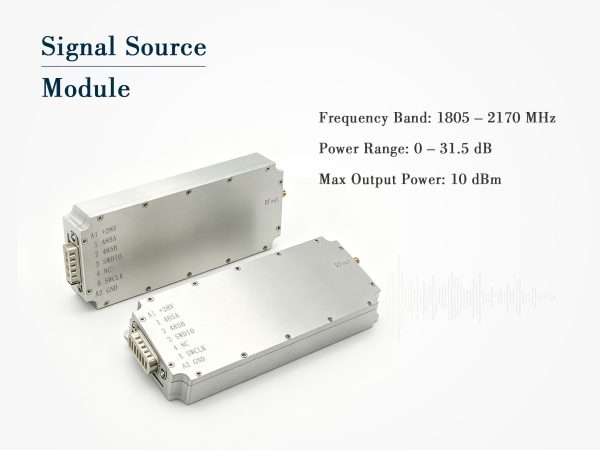
Digital Signal Source Module 1805-2170MHz