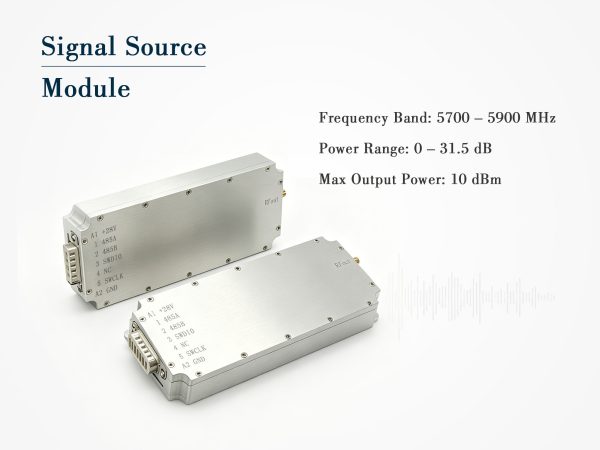
4800-5000MHz Signal Source Module | 0.5dB Step RS485
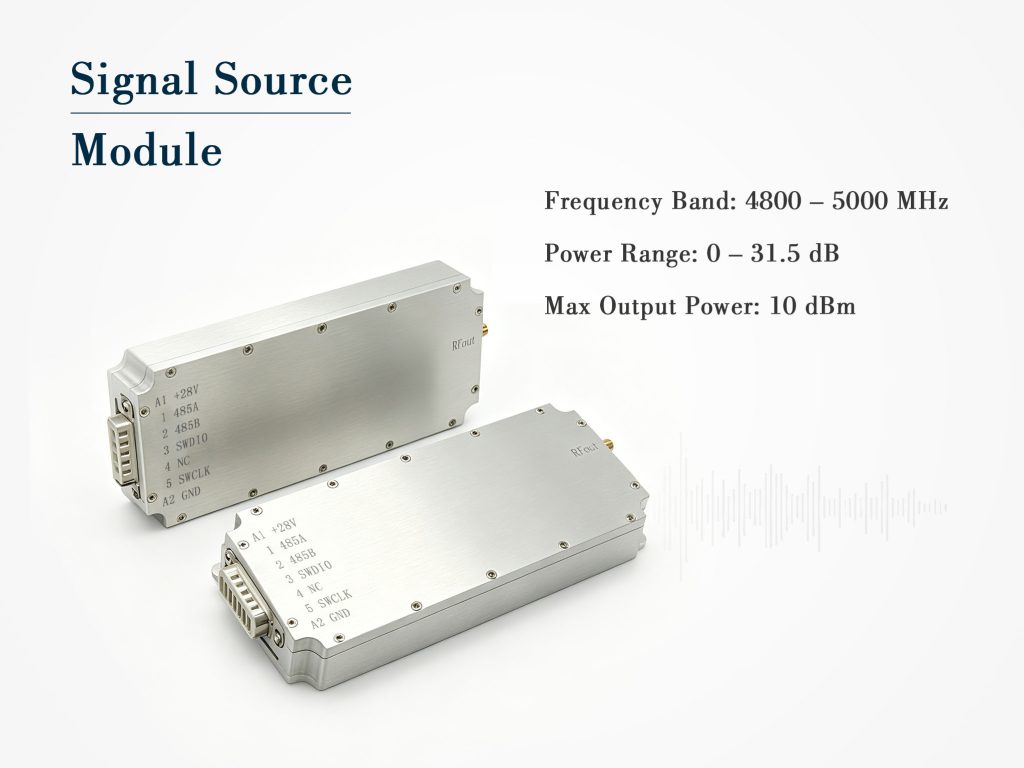
4800-5000MHz digital signal source module, +10dBm output, 0.5dB power step, RS485 control, SMA female, 7W2 connector, compact 146x63x17.5mm design.
5G NR n79 and private 5G
Industrial sensing and radar
Automated test equipment
R&D and university labs
Production line calibration
Technical Specifications
| Parameter | Typical Value |
| Frequency Range | 4800 – 5000 MHz |
| Signal Type | Digital signal source |
| Max Output Power | +10 dBm |
| Output VSWR | ≤ 2.0 |
| Power Adjustment Range | 0 – 31.5 dB (0.5 dB step) |
| Control Interface | RS485 |
| Supply Voltage | 12 – 29 V DC |
| Max Current | 200 mA @ 28 V |
| Output Connector | SMA female |
| Power/Control Connector | 7W2 |
| Dimensions | 146 × 63 × 17.5 mm |
| Weight | 0.21 kg |
Product Details
If you’ve spent any time working around 5 GHz, you already know how unforgiving the band can be. Cable losses pile up fast, connectors get picky, and a signal that looks clean on a spectrum analyzer can fall apart the moment the temperature shifts. That’s exactly why we built this digital signal source module to be predictable, programmable, and physically tiny — so it can sit right at the point where you need the signal, not three meters of coax away.
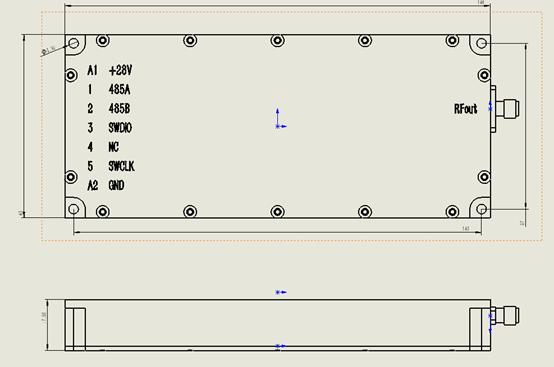
The signal source module covers 4800 MHz to 5000 MHz, a frequency range that’s increasingly important for 5G NR n79 testing, private network deployments, and advanced wireless R&D. It delivers a continuous wave tone up to +10 dBm, and you can attenuate it across a full 31.5 dB window in half-dB steps. That level of resolution might seem like a small detail, until you’re trying to characterize a receiver’s error vector magnitude at the edge of its dynamic range and every tenth of a dB changes the result.
Why the control interface matters as much as the RF performance
We use RS485 for a reason. It’s differential, noise-immune, and it daisy-chains cleanly — no USB hubs, no driver nightmares, no ground loops. You send a short ASCII command, the signal source module responds. You can string up to 32 of these on the same twisted pair, give each a unique address, and sweep them in parallel. The 7W2 mixed D-sub connector ties the RS485 data lines and the DC power supply (12 V to 29 V) into a single compact plug, so the only RF cable leaving the module is the SMA you intend to measure. At 28 V the whole thing draws 200 mA, so you can run it off a battery, a PLC rail, or a lab supply without a second thought.
Small box, serious stability
Dimensions are 146 × 63 × 17.5 mm, weight is 0.21 kg. You can mount it inside a shielded test enclosure, tape it to a drone payload frame for field testing, or screw it into a production jig that runs 24/7. The SMA female output keeps connections standard, and with an output VSWR of ≤2.0, the module tolerates imperfect loads gracefully — no oscillation, no sudden power dips. The digital synthesis core keeps phase noise low and frequency drift to a minimum, so you can run hour-long soak tests without the signal wandering off.
Where it fits your workflow
-
5G NR n79 and private 5G: Generate a clean test tone for receiver sensitivity checks, antenna calibration, or power amplifier linearity sweeps.
-
Industrial sensing and radar: The 4.8–5.0 GHz range is used by multiple industrial radar and level-sensing applications. Use the module as a known reference for system validation.
-
Automated test equipment: Script it over RS485, embed it in a rack, and let your test executive step power levels without human intervention.
-
R&D and university labs: Give students a hands-on, programmable 5 GHz source that doesn’t require a six-figure vector generator to explore antenna patterns, mixer conversion loss, or filter skirts.
-
Production line calibration: Replace manual attenuator tweaking with digital commands and collect repeatable pass/fail data shift after shift.
The entire signal source module feels like it was designed by people who actually use test equipment: no unnecessary menus, no fan noise, just a solid metal housing and the connectors you need. If your project demands a stable, fine-stepped CW source at 5 GHz, this is the kind of tool that turns a messy bench into a clean measurement setup.
Frequently Asked Questions
Case Studies
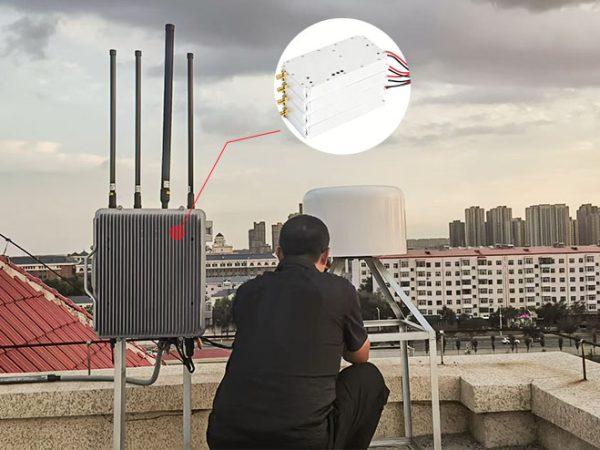
Heilongjiang Weather Center Completes Anti-Drone System Upgrade with Three High-Power Drone Jammer Modules
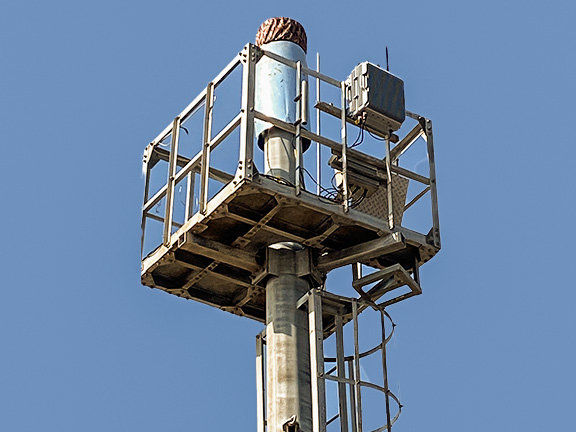
Tangshan Chem Plant Sealed Drone Gaps With 3 GaN Wideband Modules
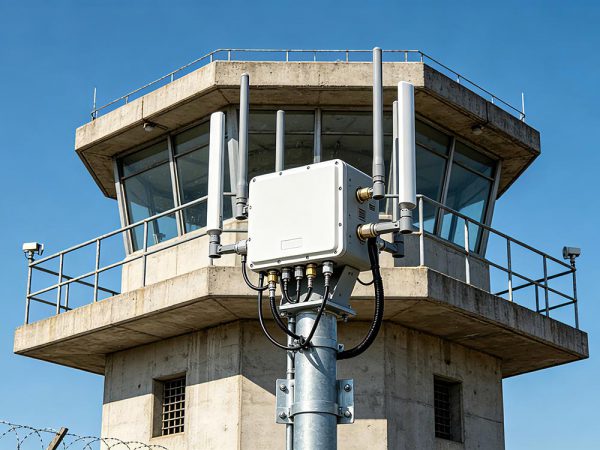
How a National Prison Integrated Our Drone Jamming Module Into Their Fixed Counter-Drone System
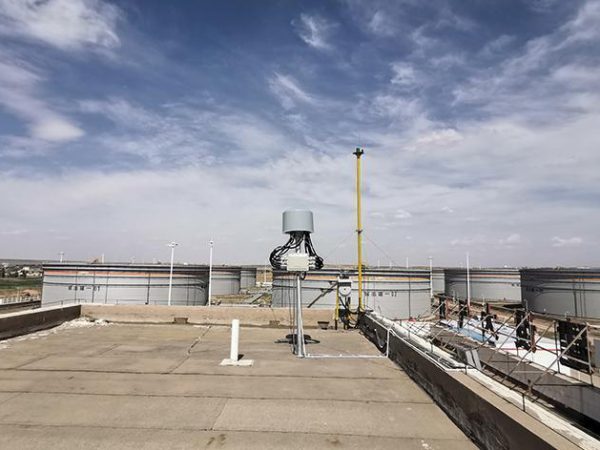
Integrating Core RF Power: OEM Drone Jamming Module for Oil Refinery Security | Case Study
Send Us a Message
Related Products
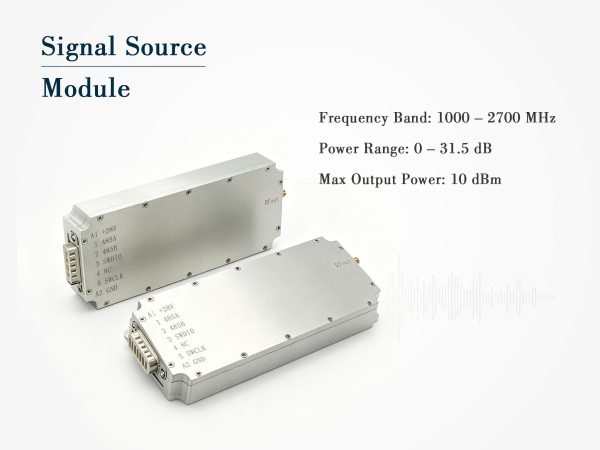
Wideband Signal Source Module – 1000 to 2700MHz, 10dBm with Digital Attenuator
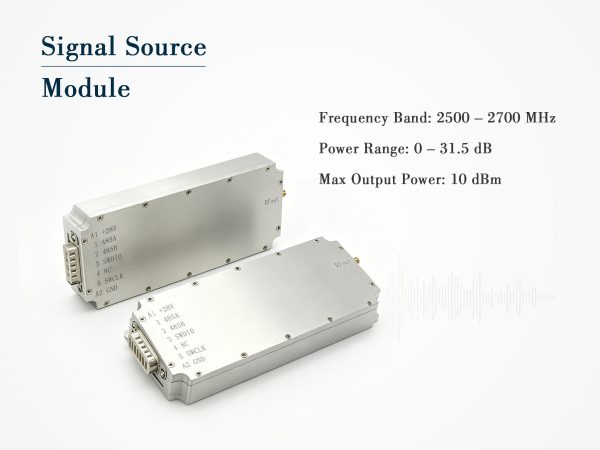
Compact Signal Source Module – 2500–2700MHz, 10dBm with Digital Attenuation
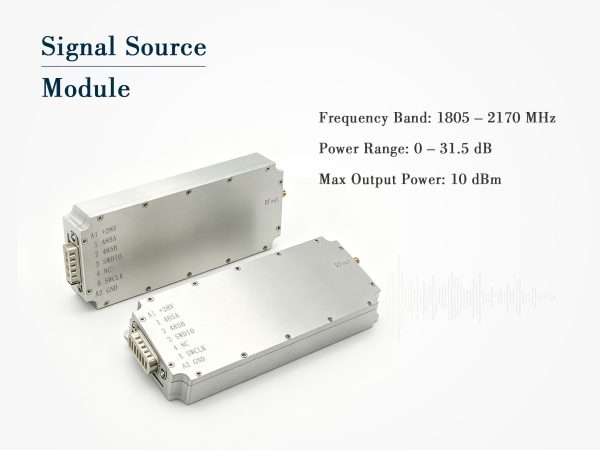
Digital Signal Source Module 1805-2170MHz