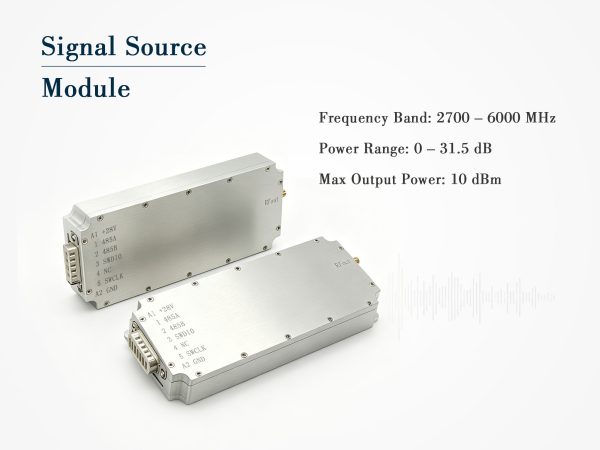
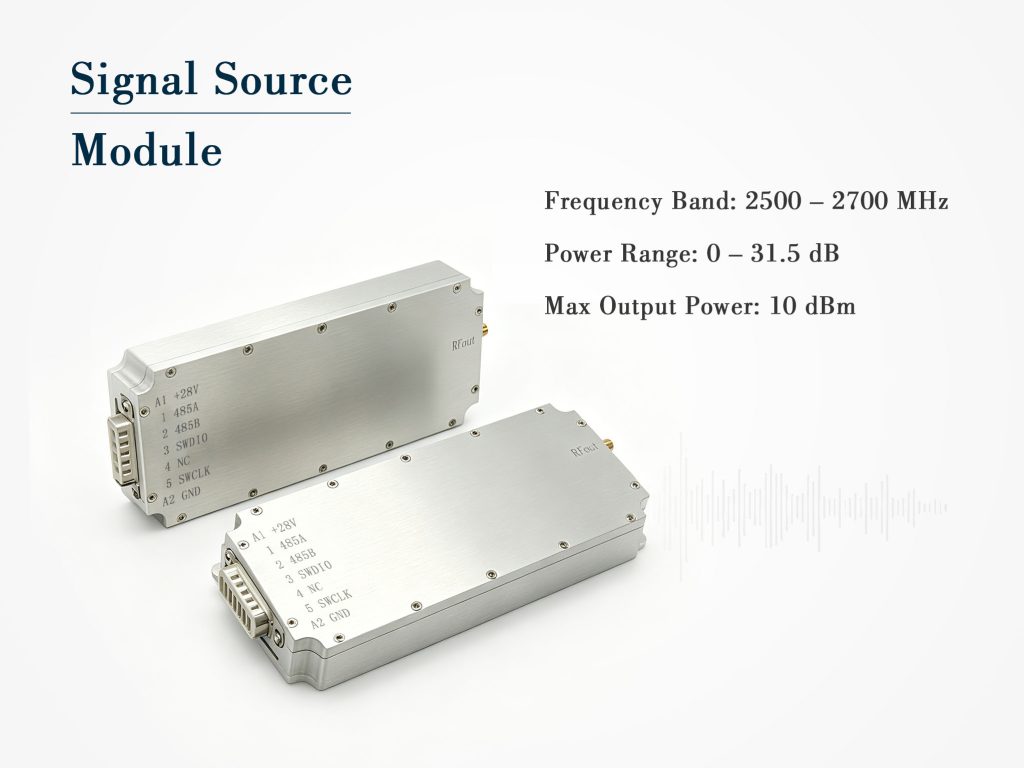
Compact Signal Source Module – 2500–2700MHz, 10dBm with Digital Attenuation
Rugged signal source module with 2500–2700MHz, 10dBm output, 0–31.5dB attenuation, RS485 control, 12–29V DC, SMA female. Ideal for test systems and OEM integration.
Who Benefits from This Module?
Test engineers – use it as a local oscillator substitute or a CW source for receiver selectivity tests.
System integrators – embed it into jammers, repeaters, or signal distribution frames.
Maintenance crews – carry it as a portable reference for field troubleshooting of 2.6GHz links.
Technical Specifications
| Parameter | Typical Value |
| Signal type | Digital signal source |
| Frequency range | 2500~2700MHz |
| Max output power | 10dBm |
| Output VSWR | ≤2.0 |
| Operating voltage | DC12V~29V |
| Max current (28V) | 200mA |
| Attenuation range | 0~31.5dB |
| Attenuation step | 0.5dB |
| Output connector | SMA female |
| Power/control connector | 7W2 |
| Control interface | RS485 |
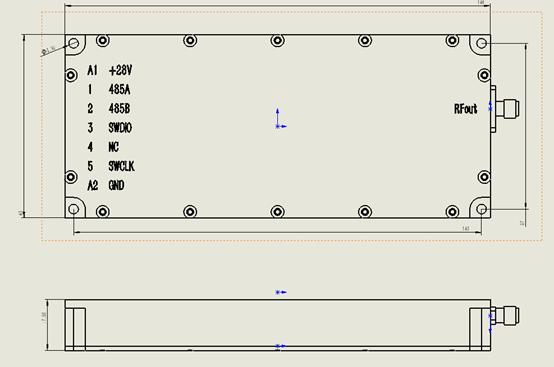
| Dimensions (mm) | 146*63*17.5 |
| Weight | 0.21kg |
Product Details
Reliable RF Core for Demanding Environments
This signal source module delivers a stable digital output across the 2500–2700MHz band, covering critical S-band applications including satellite communications, mobile backhaul, and spectrum monitoring. With a maximum output of +10dBm and a voltage supply range from 12V to 29V DC, it fits seamlessly into both bench-top setups and field-deployed equipment. The module draws only 200mA at 28V, making it power-efficient for battery-operated systems.
What sets this signal source module apart is its built-in precision attenuator – 0 to 31.5dB in 0.5dB steps. You get fine-grained level control without external pads or variable gain amplifiers. Whether you are calibrating receivers or simulating fading channels, this level of granularity saves board space and reduces bill-of-materials complexity.
Mechanical and Interface Design
Housed in a compact 146×63×17.5mm aluminium enclosure, this signal source module weighs just 0.21kg. The SMA female output connector ensures reliable mating with standard test cables, while the 7W2 hybrid connector handles both power supply and control signals in a single lockable interface. For remote operation, the RS485 bus supports multi-drop configurations – ideal for automated test racks where several modules share a common controller.
The output VSWR is maintained at ≤2.0, guaranteeing good load matching even when driving unknown antenna impedances or filter inputs. This low reflection characteristic minimises measurement uncertainties, so you can trust the level accuracy during critical gain-loss tests.
Who Benefits from This Signal Source Module?
-
Test engineers – use it as a local oscillator substitute or a CW source for receiver selectivity tests.
-
System integrators – embed it into jammers, repeaters, or signal distribution frames.
-
Maintenance crews – carry it as a portable reference for field troubleshooting of 2.6GHz links.
Because the operating voltage spans a wide 12–29V range, you can power it directly from vehicle batteries, PoE converters, or standard lab supplies without extra regulators. The RS485 command set is simple and documented, allowing quick integration with PLCs, Arduino controllers, or PC-based software.
Performance You Can Count On
Thermal stability is a core strength. The 0.5dB step attenuator uses monolithic digital attenuator ICs with low insertion-loss variation over temperature. Even when the ambient temperature shifts, the output power remains within ±0.3dB of the set value. This repeatability reduces the need for frequent recalibration, saving operational downtime.
The module also features reverse polarity protection and over-current shut-down on the DC input – small touches that prevent costly damage from wiring errors. For system-level reliability, all RF traces are 50Ω microstrip lines with gold-plated pads, ensuring consistent phase and magnitude response across the entire 2500–2700MHz window.
Integration Made Straightforward
Getting started is as simple as connecting a 28V supply, attaching an antenna or load to the SMA port, and sending ASCII commands over RS485. The baud rate is configurable up to 115200, and the module responds with status bytes for power level, temperature, and fault conditions. You can also save a power-on default attenuation value in its non-volatile memory – no need to reprogram after every power cycle.
For multi-module systems, each unit has a unique address (set via software), so you can individually adjust levels without bus contention. This feature is particularly valuable in phased-array calibration or MIMO test beds where multiple signal source modules work in parallel.
Real-World Applications
We have seen customers use this signal source module for:
-
Production testing of 5G NR n7 and n38 band filters.
-
Simulating Doppler-shifted carriers in satellite ground-station mock-ups.
-
Driving mixer LO ports in spectrum analyser front-end upgrades.
-
Emergency beacon testing in aviation transponders.
The 0.21kg weight and slim profile make it easy to mount on DIN rails, chassis walls, or even inside handheld enclosures. Optional heatsink pads are available for high-duty-cycle operation above 25°C ambient, though the default conduction cooling suffices for most indoor use.
Ordering and Custom Options
Standard units ship with the 7W2 mating plug and a quick-start guide. For volume orders, we offer custom attenuation ranges (e.g., 0–60dB) and alternate connector types (N-type or TNC). Firmware can be tailored for specific baud rates or proprietary handshake protocols – contact our applications team for details.
In short, this signal source module combines a broad tuning range, precise step attenuation, rugged mechanics, and a flexible interface, all at a competitive price point. It is not the cheapest on the market, but it is the most dependable in its class for professional RF work.
Frequently Asked Questions
Case Studies
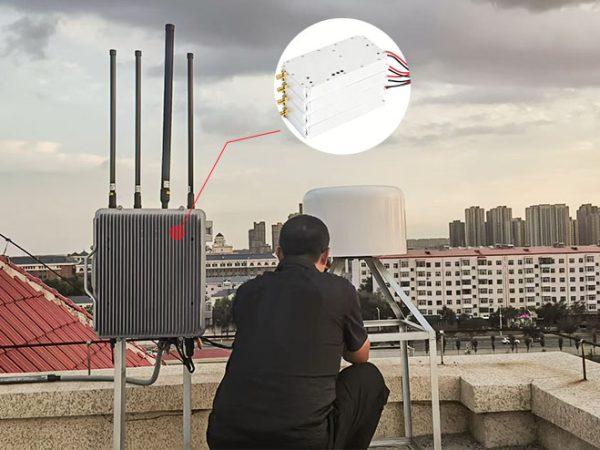
Heilongjiang Weather Center Completes Anti-Drone System Upgrade with Three High-Power Drone Jammer Modules

Tangshan Chem Plant Sealed Drone Gaps With 3 GaN Wideband Modules

How a National Prison Integrated Our Drone Jamming Module Into Their Fixed Counter-Drone System

Integrating Core RF Power: OEM Drone Jamming Module for Oil Refinery Security | Case Study
Send Us a Message
Related Products
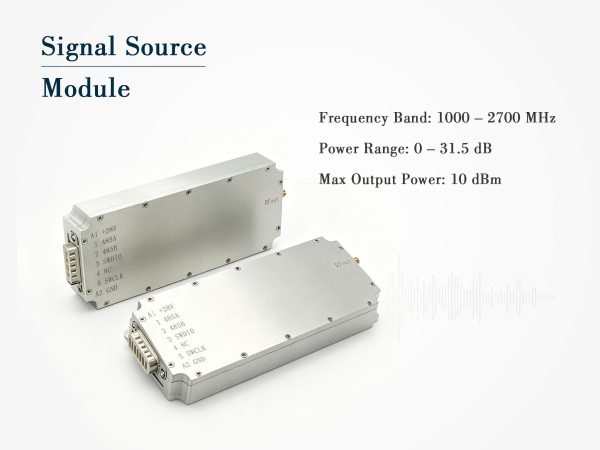
Wideband Signal Source Module – 1000 to 2700MHz, 10dBm with Digital Attenuator
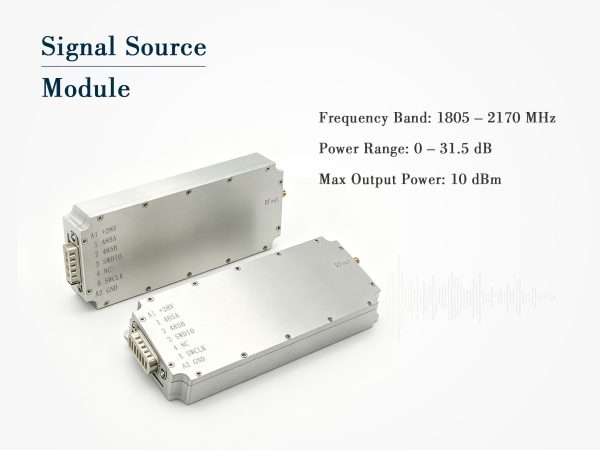
Digital Signal Source Module 1805-2170MHz
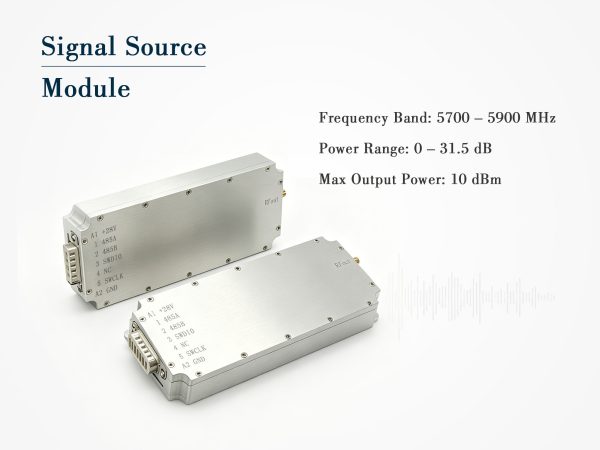
Digital Signal Source Module – 5700–5900MHz, 10dBm