
100W GaN Wideband Amplifier Module: 1500–4000 MHz Performance in a Compact Package
100W GaN wideband amplifier, 1500–4000 MHz, 50±3 dB gain, 30% efficiency, 28-30V, 0.75kg, rugged design. Ideal for general-purpose RF test and comms.
It works well as a driver for high-power test systems, as a boost stage for communication repeaters, and as a general-purpose gain block for R&D experiments. The instantaneous bandwidth means you can sweep frequencies or hop channels without re-tuning the bias or matching networks – a significant time saver during characterisation.
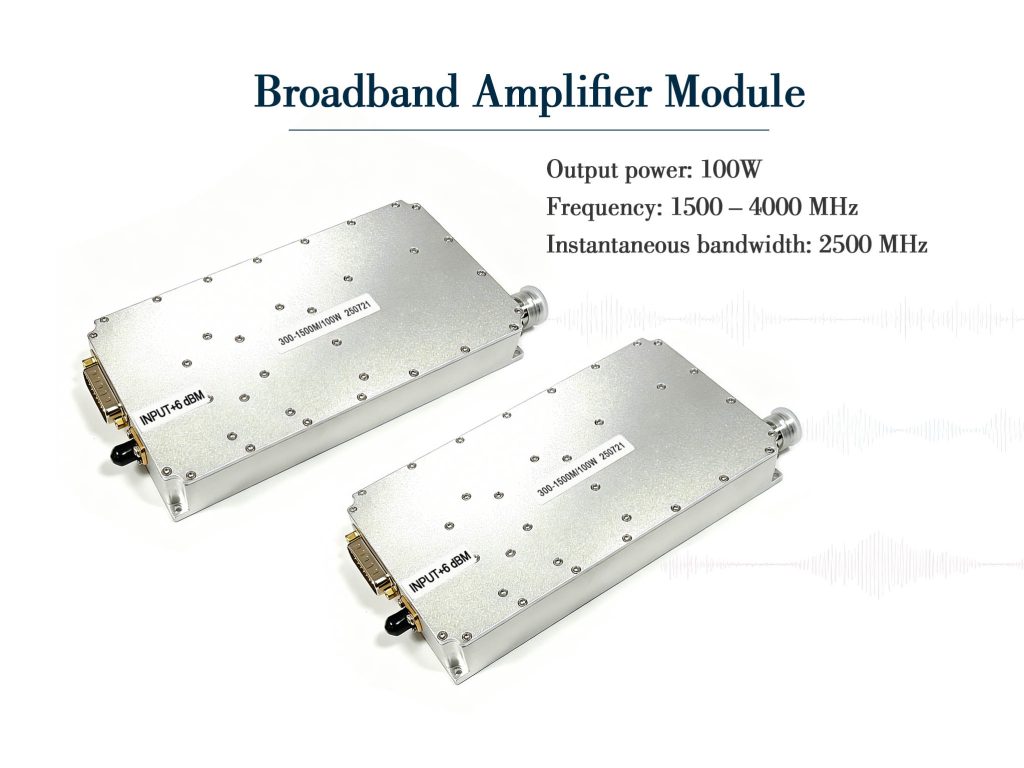
Technical Specifications
| Parameter | Value |
| Frequency range | 1500 – 4000 MHz |
| Bandwidth | 2500 MHz (typical) |
| Peak output power (CW) | 100 W (typical) |
| Input power (drive) | -2 ±3 dBm (typical) |
| Max input without damage | 5 dBm |
| Power gain (at 0 dBm in) | 50 ±3 dB (typical) |
| Gain flatness | ±3.5 dB (max, full band) |
| Efficiency | 30% (typical) |
| Harmonics @100W | ≥10 dBc |
| Spurious level | ≥60 dBc |
| Input / Output VSWR | ≤2:1 |
| Operating voltage | 28 – 30 VDC |
| Current @100W | 10.5 A (typical) |
| Mass | 0.75 kg |
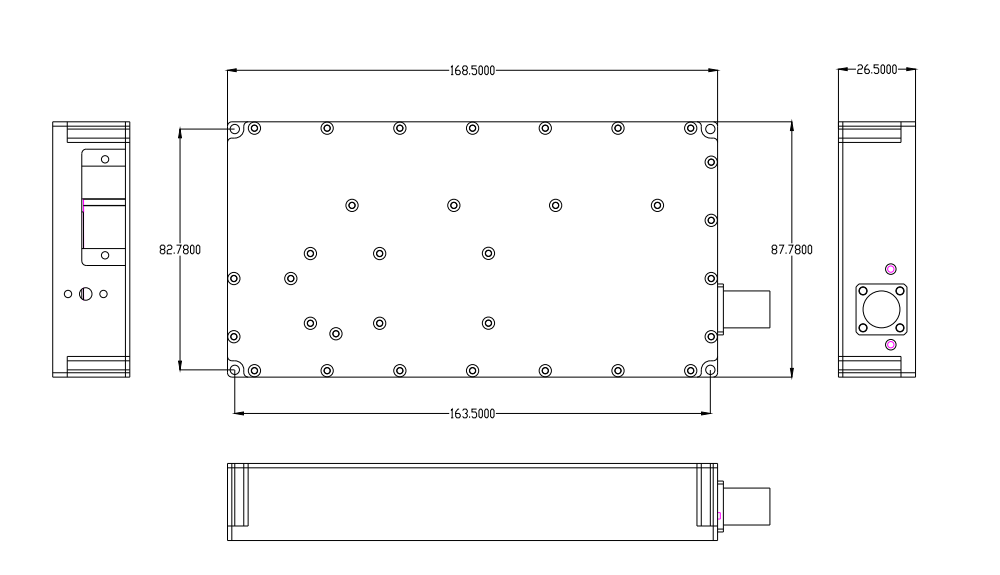
| Dimensions | 168.5 × 82.8 × 26.5 mm |
Product Details
When a project calls for wide instantaneous bandwidth and solid output power across the entire 1.5 to 4 GHz range, the component selection often gets tricky. Many amplifiers cover either the lower L-band or the upper S-band, but rarely both with a single module. This 100W GaN-based unit changes that picture – it delivers a full 2500 MHz of usable bandwidth without tuning or switching.
Built Around GaN-on-SiC for Real-World Reliability
The heart of this broadband amplifier module is a Class AB GaN design grown on silicon carbide substrate. That material choice matters because SiC handles heat far better than conventional silicon. The die attaches to a copper sub-carrier, and a patented thermal management scheme pulls heat away efficiently. The result is a module that holds its rated performance even when the baseplate reaches 50°C – a common condition in crowded racks or outdoor enclosures.
Electrical Performance That Stays Predictable
With a 28–30V DC supply, this unit delivers 100 W CW peak output power typical, drawing about 10.5 A at that level. The power gain sits at 50 ± 3 dB when driven with 0 dBm input, and the gain flatness stays within ±3.5 dB across the whole band – a fairly tight window for such a wide span. Harmonics are better than 10 dBc below the carrier at full power, and spurious emissions are suppressed by at least 60 dBc, which keeps the output clean for sensitive measurement or transmission paths.
Input and output VSWR are both specified at ≤2:1, making it easy to integrate into 50‑ohm systems without needing external isolators or pads. The maximum safe input power is 5 dBm, so a small attenuator or a controlled drive stage is recommended to protect the front end.
Mechanical Design for System Integration
Size and weight often become deciding factors when you have to fit multiple stages into a limited footprint. This module measures 168.5 × 82.8 × 26.5 mm and weighs only 0.75 kg. That is surprisingly light for a 100‑watt brick, and the slim profile allows vertical or horizontal mounting in test stations, UAV payloads, or portable transceivers. The housing is ruggedised for vibration and temperature cycling, so it suits both lab use and field deployments.
Where This Broadband Amplifier Module Excels
Because it covers 1500–4000 MHz in one go, this unit saves you from switching between narrowband pallets. It works well as a driver for high-power test systems, as a boost stage for communication repeaters, and as a general-purpose gain block for R&D experiments. The instantaneous bandwidth means you can sweep frequencies or hop channels without re-tuning the bias or matching networks – a significant time saver during characterisation.
Efficiency and Thermal Considerations
Efficiency is rated at 30% typical at 100 W output. That is respectable for a linear Class AB design, especially given the octave-plus bandwidth. The copper carrier and improved thermal path keep the junction temperatures within safe limits, but forced-air cooling or a cold plate is still advisable for continuous CW operation. The current draw stays fairly stable over the band, so your power supply does not see wild fluctuations.
Practical Usage Tips
For best results, keep the input drive around -2 to +1 dBm (the typical range is -2 ±3 dBm). The broadband amplifier module is not internally matched for a specific narrow sub‑band – it is a true wideband design – so external filtering may be needed if your application requires harmonic rejection beyond what the module provides. The 50‑ohm I/O ports are standard SMA or similar connectors, and the DC feed should be bypassed with a low-ESR capacitor close to the pins to avoid low-frequency oscillations.
Why Choose This Over Competing Designs
Many wideband amplifiers in this power class are either larger, heavier, or less efficient. Some use LDMOS technology that drops gain at the high end. This GaN alternative maintains flat gain and output power across the entire range, with no performance valleys. The rugged construction and thermal headroom give it a longer operational life, especially in pulsed or high-duty-cycle applications.
Final Verdict
This broadband amplifier module bridges the gap between laboratory flexibility and field-ready robustness. It is not the cheapest option on the shelf, but the combination of bandwidth, power, and compactness makes it a cost-effective solution when system integration complexity and downtime are factored in. For engineers who need a dependable 100‑W block from 1500 to 4000 MHz, this unit deserves a close look.
Frequently Asked Questions
Case Studies
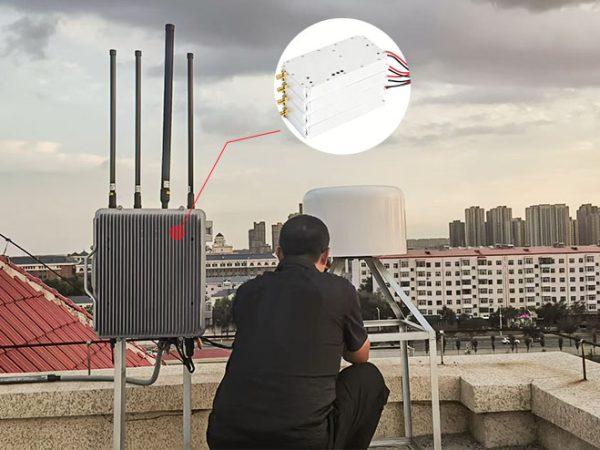
Heilongjiang Weather Center Completes Anti-Drone System Upgrade with Three High-Power Drone Jammer Modules

Tangshan Chem Plant Sealed Drone Gaps With 3 GaN Wideband Modules

How a National Prison Integrated Our Drone Jamming Module Into Their Fixed Counter-Drone System

Integrating Core RF Power: OEM Drone Jamming Module for Oil Refinery Security | Case Study
Send Us a Message
Related Products

High-Power 100W GaN Broadband Amplifier Module 3-5 GHz
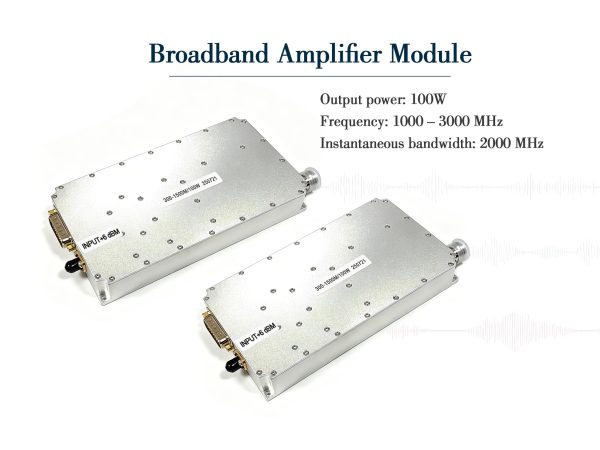
100W GaN Broadband Amplifier Module 1–3 GHz

100W Broadband Amp Module – 20 to 600 MHz Wideband Power for HF/VHF/UHF