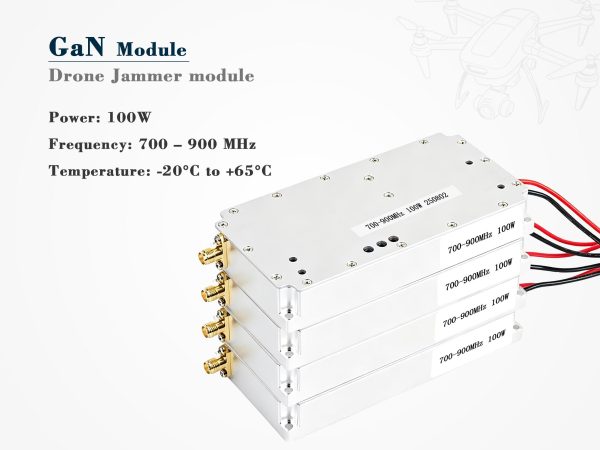
100W Drone Jammer Module 840-1000MHz
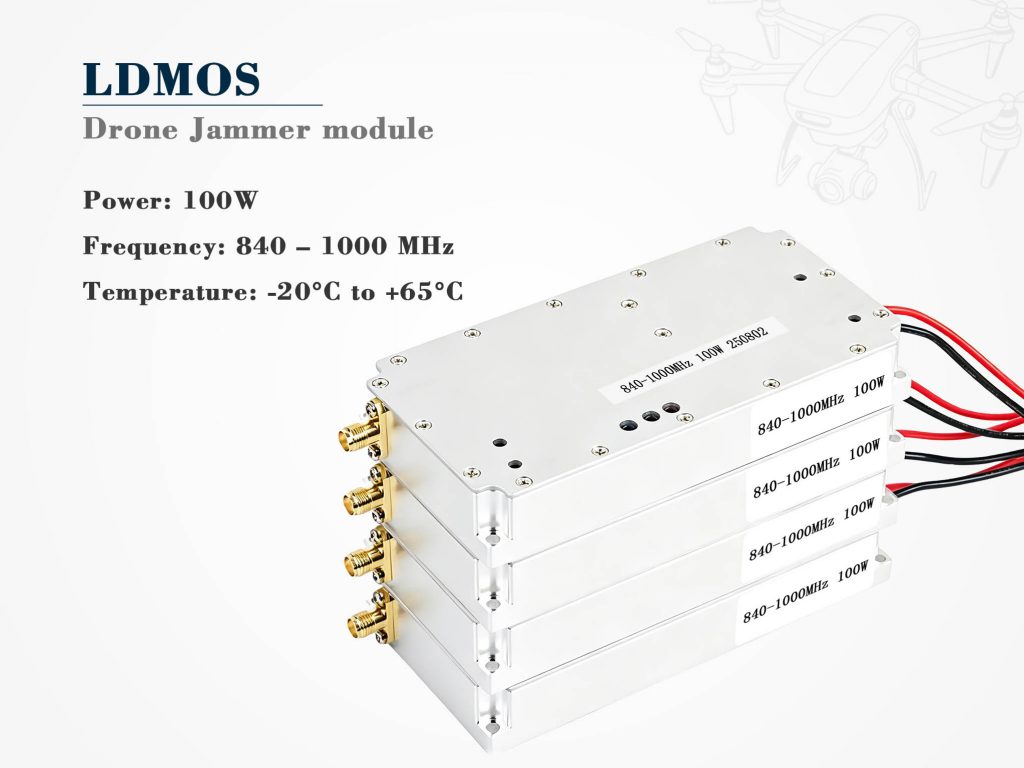
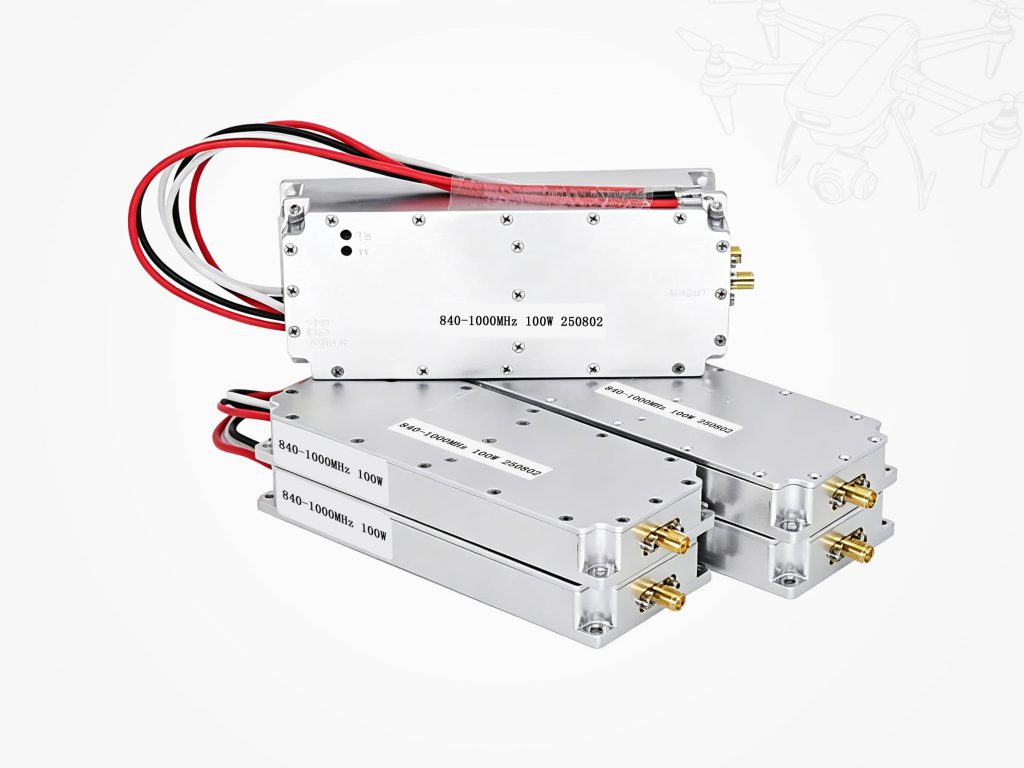
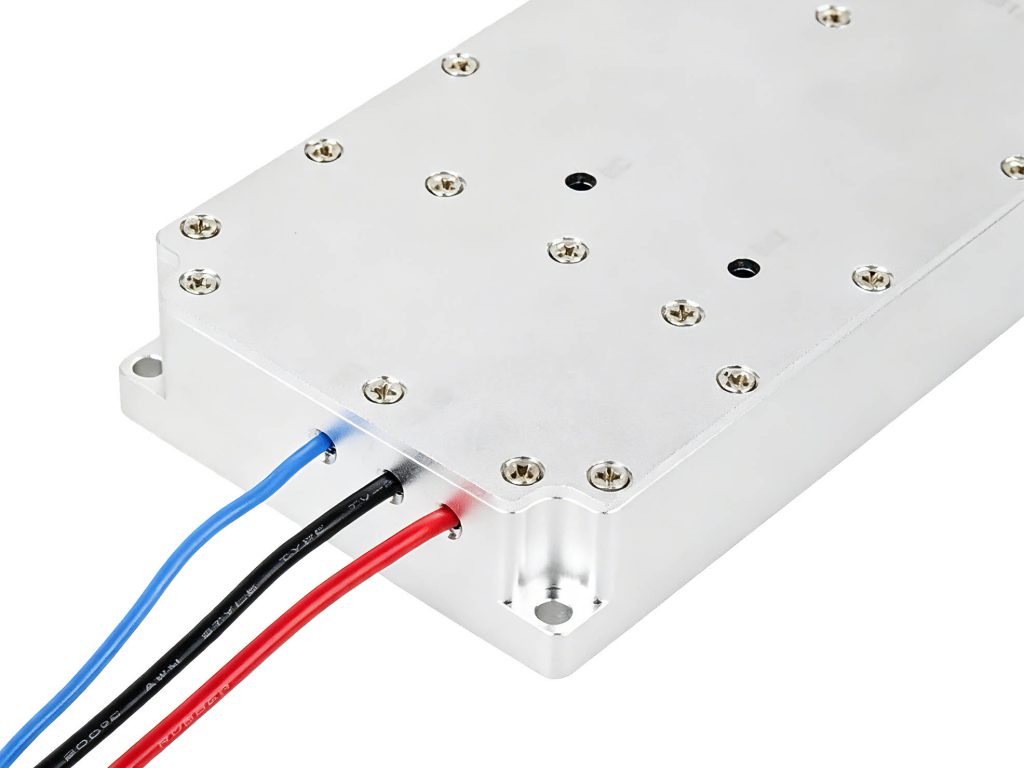
100W drone jammer module (840–1000MHz), 50±1dBm output, 28–32V DC, ≤9.2A, built-in high-speed noise source, N-female connector, 800g. Customizable sweep speed for C-UAS.
Technical Specifications
| Parameter | Specification | Notes |
| Frequency range | 840 – 1000 MHz | Instantaneous wideband |
| Output power | 100 W (50 ± 1 dBm) | At N-female connector, any modulation |
| Supply voltage | 28 – 32 V DC | Nominal 28 V |
| Current draw | ≤ 9.2 A | At 100 W output |
| Modulation source | Built-in high-speed noise | Custom VCO, DDS, SDR on request |
| Analog scan speed | 270 kHz (default) | Customizable 100 – 500 kHz |
| Input / output impedance | 50 Ω | N-female output |
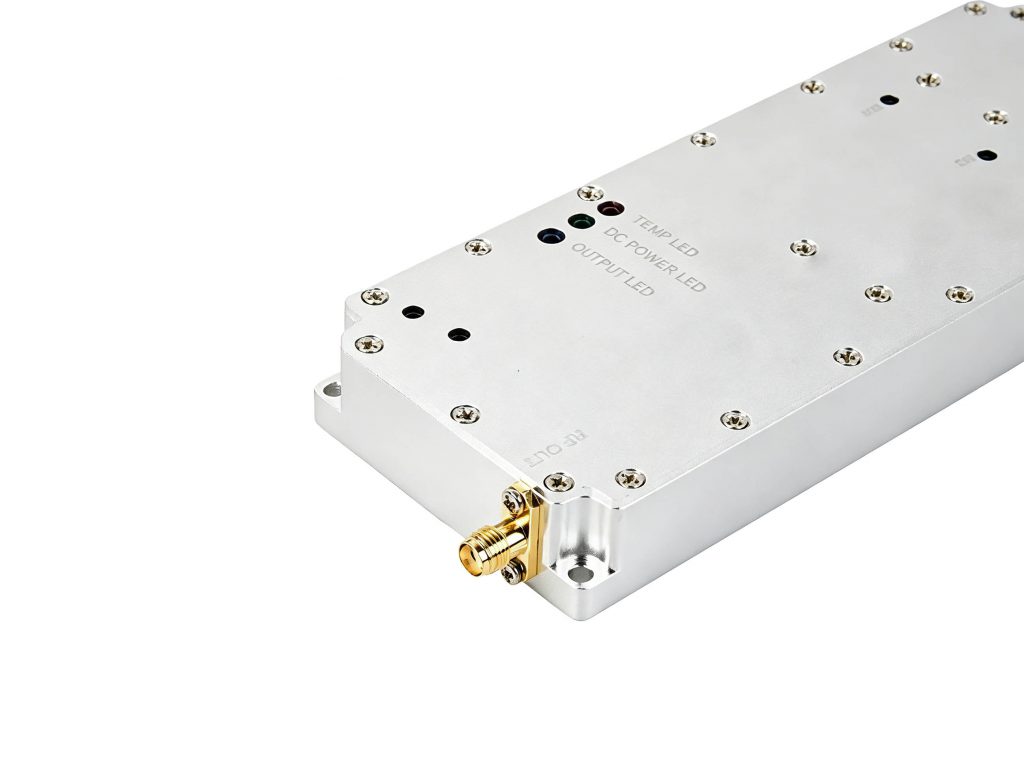
| Protection LEDs | Power, overvoltage, overtemperature | Hard-wired trip indicators |
| Operating temperature | -20 to +65 °C | Baseplate temperature |
| Dimensions (L×W×H) | 150 × 80 × 22 mm | Custom form factors supported |
| Weight | 800 g | Module only, no cables |
| Base material | High-conductivity metal substrate | Integrated thermal management |
Product Details
If you’ve already tinkered with mid-power jammers, you know the wall they hit once a drone drifts beyond a few hundred meters. This 100-watt drone jammer module covers 840 to 1000 MHz and is built to punch through that wall. It ships with a built-in high-speed noise modulator, so you get a flat, dense barrage straight out of the box, no outboard generator needed. The module uses a heavy-duty N-female connector instead of the usual SMA precisely because at this power level every fraction of a decibel counts.
But raw wattage isn’t the whole story. The module is laid out on a thermally engineered metal substrate that drags heat away from the power stage fast enough to keep it stable during long-duration sweeps or locked-on continuous-wave jamming. And because the current draw sits at ≤9.2 A on a 28 V rail, you’ll want to pair it with a serious battery or AC-DC supply, but that’s the trade-off for a clean 50 dBm at the output port.
Field Behavior You Can Count On
The module’s frequency span deliberately overlaps the most stubborn drone telemetry and video downlinks that live between 840 MHz and 1000 MHz. What makes it genuinely useful in the field isn’t just the 50 dBm output; it’s that the power stays flat across the entire band. There’s no narrow peak you have to baby-sit with constant retuning. Enable the internal noise source, set your sweep limits if needed, and the module blankets the whole slice without giving the target a clean hop channel.
Thermal design was clearly prioritized. The power transistors aren’t sitting on a generic FR4 board hoping for the best. The substrate pulls heat straight into the enclosure wall or a dedicated cold plate, which is why the module can sustain full power at 65°C baseplate temperature without folding back. The LEDs aren’t just cosmetic either – the over-voltage and over-temperature lines are hard-wired to the power stage, so they trip before anything gets close to its limit.
Integrating the Drone Jammer Module Into Your C-UAS Setup
The move from an SMA to an N-female connector isn’t arbitrary. At 100 W, connector loss becomes non-trivial, and the N interface gives you a solid, repeatable mate with low insertion loss. Most integrators bolt the module directly to a chassis or a finned heatsink using the mounting holes in the baseplate. With an 800 g module mass, it’s still manageable for fixed-site units, vehicle-mounted masts, or transportable pelican-case systems. It’s not pocket-sized, but for a 100-watt amplifier-moderator combo that covers a 160 MHz instantaneous bandwidth, the footprint is remarkably compact.
One detail that often gets overlooked: the module ships with the noise source enabled by default. If you’re running a more sophisticated cognitive jamming scheme, you can disable it and feed an external SDR or DDS source through the modulation input. The power stage doesn’t care whether it’s noise, a chirp, or a deceptive protocol packet – it just amplifies whatever you give it to 50 dBm and ships it to the antenna.
Customization Beyond the Datasheet
While the catalog module hits the most requested target band, nearly every deployment has its own waveform and mechanical constraints. Common adaptations we handle include:
-
Sweep rates anywhere from 100 kHz to 500 kHz to match specific hopping sequences.
-
Modulation source swaps: replace the internal noise board with a VCO for swept-tone jamming, a DDS for precision chirps, or an SDR pass-through for protocol-aware jamming.
-
Mechanical re-packaging: need the module in a 1U rack tray or a cylindrical housing for a mast? Envelope and mounting can be reworked.
-
Extended low-end or high-end frequency coverage, re-tuning matching networks for adjacent bands when volume warrants it.
Every custom unit still goes through full-band load-pull and thermal cycling, so you’re never getting a one-off prototype that hasn’t been stressed.
Frequently Asked Questions
Case Studies
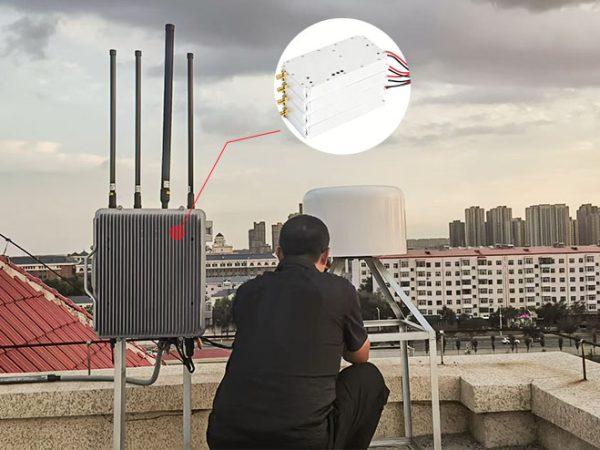
Heilongjiang Weather Center Completes Anti-Drone System Upgrade with Three High-Power Drone Jammer Modules
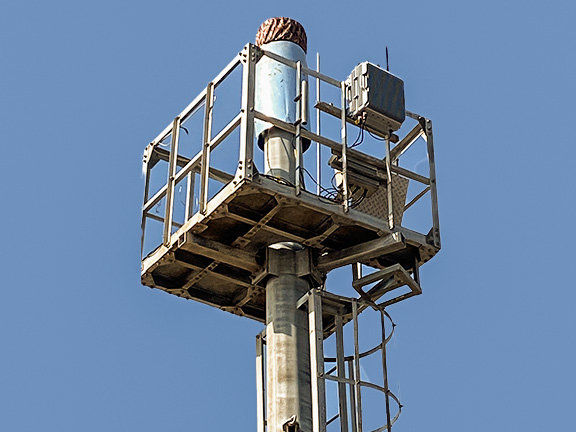
Tangshan Chem Plant Sealed Drone Gaps With 3 GaN Wideband Modules
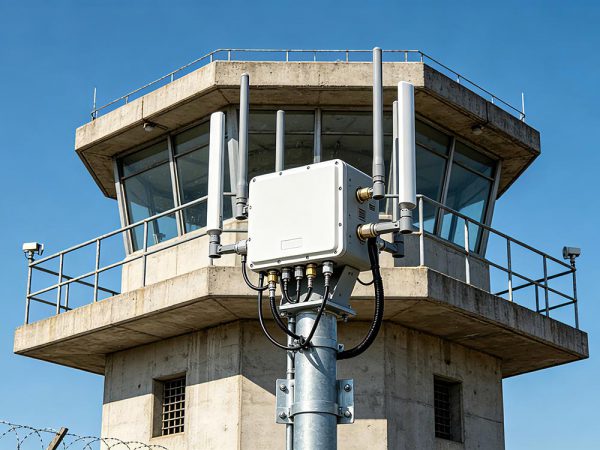
How a National Prison Integrated Our Drone Jamming Module Into Their Fixed Counter-Drone System
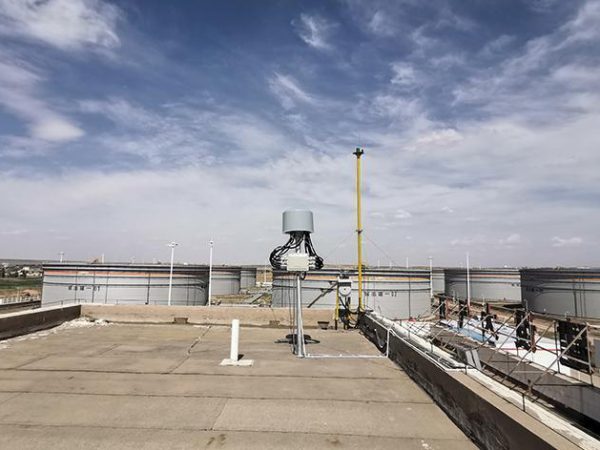
Integrating Core RF Power: OEM Drone Jamming Module for Oil Refinery Security | Case Study
Send Us a Message
Related Products
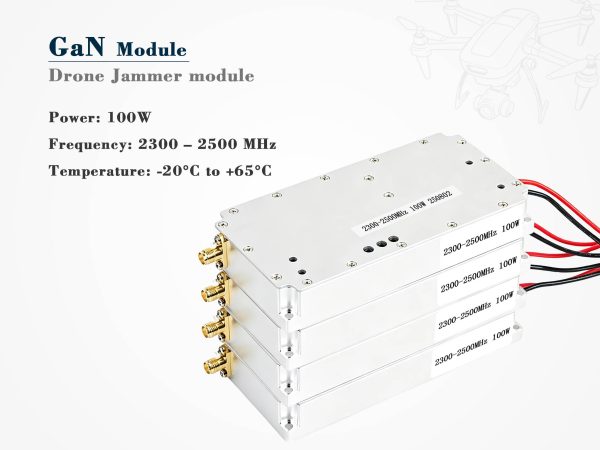
2300–2500 MHz 100W GaN Counter-UAV Module
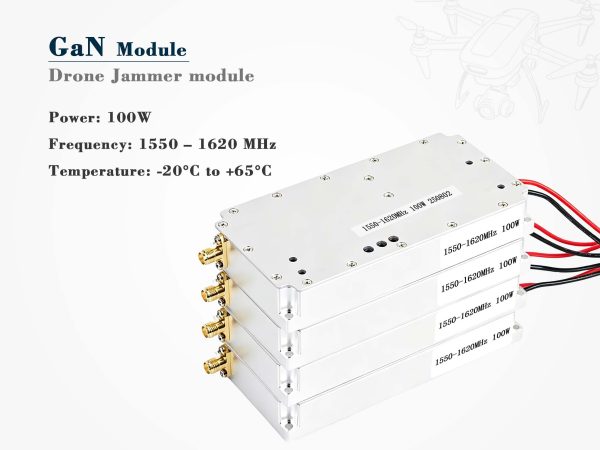
100W GaN Drone Jamming Module 1550–1620MHz
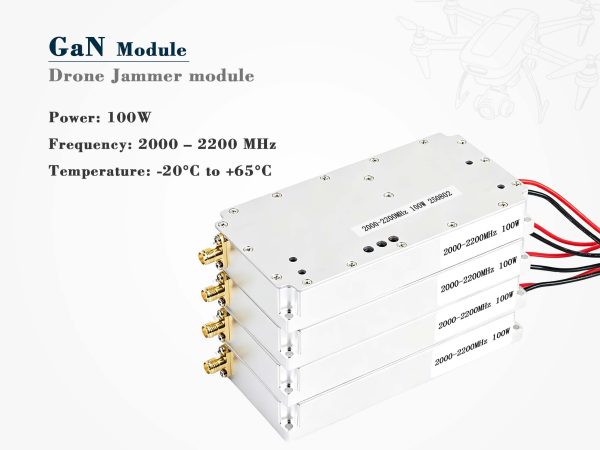
100W 2000–2200MHz GaN Analog Drone Interference Module