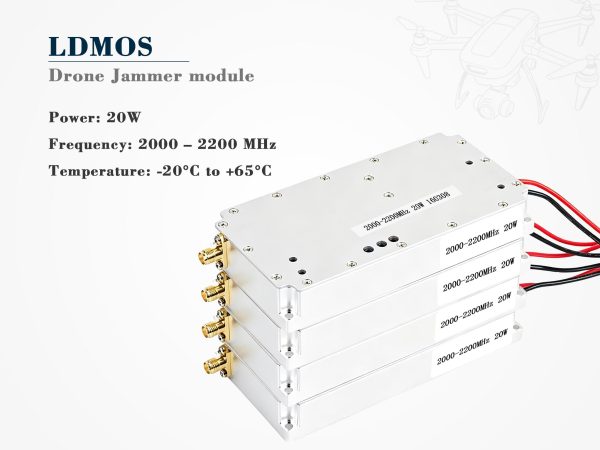
20W UAV Jammer Module: 2200-2400MHz LDMOS Module
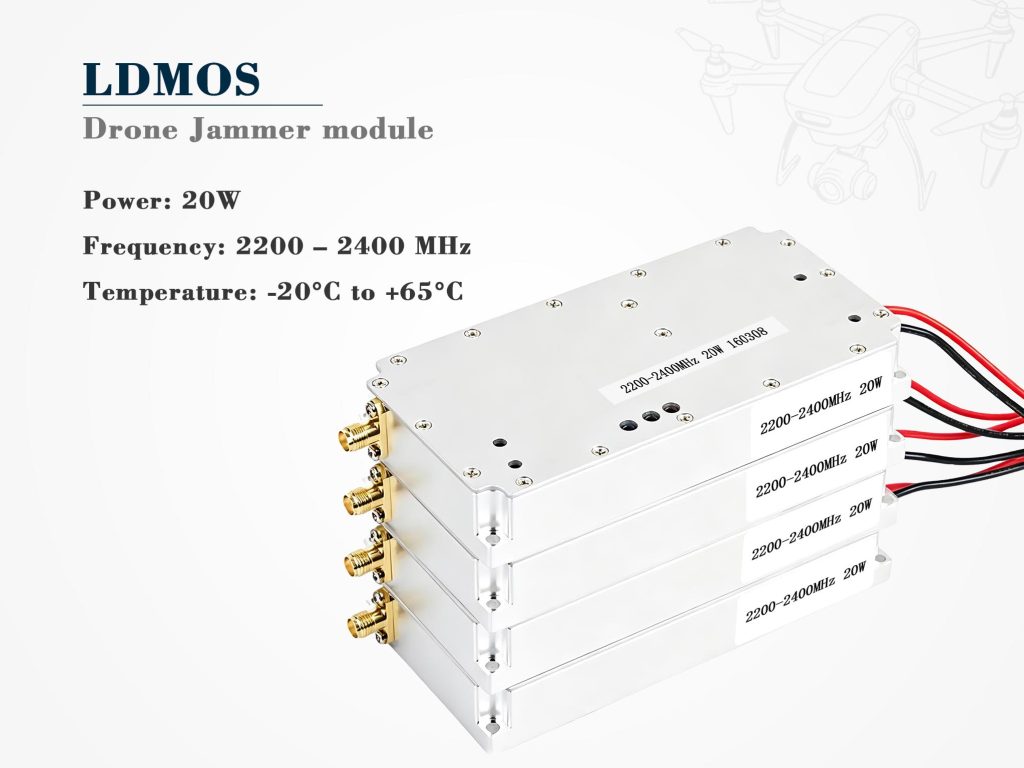
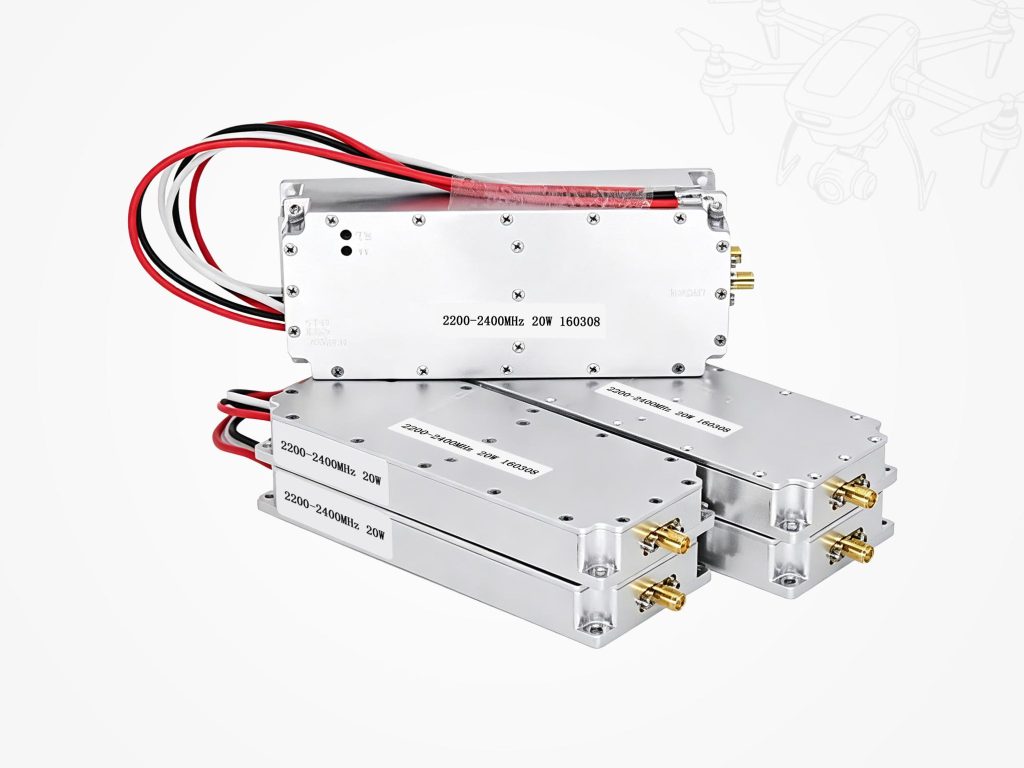
20W UAV jammer module covers 2200–2400MHz, 20W output, 24–29V DC, built-in high-speed sweep source, SMA female output, compact 115.5×46.5×21mm, -20 to +65°C.
Technical Specifications
| Parameter | Specification | Notes |
| Frequency range | 2200~2400MHz | Typical UAV control/video band |
| Output power | 20W | Typical at 24–29V DC |
| Supply voltage | DC24V~29V | Regulated supply recommended |
| Current draw | ≤2.5A | At full output |
| Modulation source | Built-in high-speed sweep source | Analog modulation |
| Analog scan speed | High-speed analog sweep | Continuous across full band |
| Input / output impedance | 50Ω | SMA female output |
| Protection LEDs | Not specified | Status LED optional; verify with supplier |
| Operating temperature | -20~+65°C | Derate at high temperature |
| Dimensions (L×W×H) | 115.5×46.5×21mm | Compact module |
| Weight | 0.21kg | Aluminum base |
| Base material | Aluminum | Good thermal conductivity |
Product Details
The 20W UAV jammer module is a fully integrated analog countermeasure board built around an LDMOS final amplifier. It covers 2200–2400MHz and produces 20W of RF output from a compact package. Because the module includes a high-speed sweep source, it can operate as a standalone jammer without an external signal generator. This design reduces integration time for fixed, vehicle, and portable anti-drone systems. The board runs from a 24–29V DC supply and uses simple logic-level control, making it easy to key on and off in the field.
RF Performance
The RF transmit chain operates from 2200MHz to 2400MHz, which covers many commercial UAV control and video links. Output power is rated at 20W with an output VSWR of ≤2.0. This tolerance allows the amplifier to work with moderately mismatched antennas, although a matched antenna is recommended for long-term use. Efficiency is ≥40%, so the 20W UAV jammer module wastes less energy as heat than many comparable LDMOS designs. The RF connector is SMA female, and the input/output impedance is 50 ohms. For extra protection in harsh field conditions, a circulator or isolator can be added externally.
Built-in Analog Sweep Source
A key feature of this 20W UAV jammer module is the internal high-speed analog sweep source. It continuously sweeps across the full 2200–2400MHz band, generating dense interference without needing a separate DDS, VCO, or software-defined radio. This analog approach creates a smooth RF envelope and is particularly effective against drones that use fixed-frequency or hopping links. Because the source is already inside the module, system developers only need to supply DC power and a control signal. Once enabled, the module immediately begins RF output.
Power and Control
The 20W UAV jammer module accepts DC24V–29V and draws no more than 2.5A at maximum output. A regulated supply with at least 3A capacity is recommended to prevent voltage droop. Switching control is simple: +5V or a floating pin enables the output, while grounding the control pin disables it. This logic works with microcontrollers, mechanical switches, and external relays. No serial commands or software are required. Users should verify polarity and antenna connection before applying power.
Thermal and Mechanical Integration
At 20W output and ≥40% efficiency, the module dissipates about 30W as heat. The aluminum base should be mounted to a heatsink or metal chassis with thermal compound. Dimensions are 115.5×46.5×21mm, and the total weight is 0.21kg, so the module can fit into compact enclosures. In bench testing, use a heatsink with airflow. In field installations, ensure the enclosure has adequate ventilation. The operating temperature range is -20°C to +65°C; sustained high-temperature use may require derating or improved cooling.
Typical Applications
This 20W UAV jammer module is suitable for authorized counter-UAV and security projects, including fixed-site protection, convoy escort, perimeter defense, and portable jammer kits. It can be paired with directional or omnidirectional antennas that cover 2200–2400MHz. For wide-area coverage, directional antennas are usually more effective because they concentrate the 20W output into a narrower beam. Multiple modules can be combined to cover additional drone frequency bands, but thermal spacing and RF isolation should be planned carefully.
Operating Notes
Always connect a 50-ohm antenna or load before enabling the module. RF exposure near the antenna can be hazardous, so follow local safety rules. Operation may be restricted by national spectrum regulations. The 20W UAV jammer module is intended for professional use only. After installation, check output VSWR and supply current to confirm normal operation.
For system integrators, the 20W UAV jammer module offers a balance of power, size, and control simplicity. The built-in sweep source eliminates the need for external RF generation, and the LDMOS output stage provides repeatable 20W performance across 2200–2400MHz. With proper cooling and antenna matching, it can serve as a reliable core for counter-UAV deployments.
Frequently Asked Questions
Case Studies
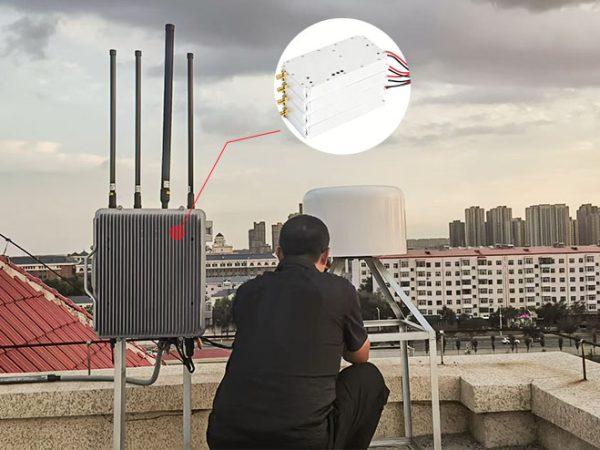
Heilongjiang Weather Center Completes Anti-Drone System Upgrade with Three High-Power Drone Jammer Modules

Tangshan Chem Plant Sealed Drone Gaps With 3 GaN Wideband Modules

How a National Prison Integrated Our Drone Jamming Module Into Their Fixed Counter-Drone System

Integrating Core RF Power: OEM Drone Jamming Module for Oil Refinery Security | Case Study
Send Us a Message
Related Products
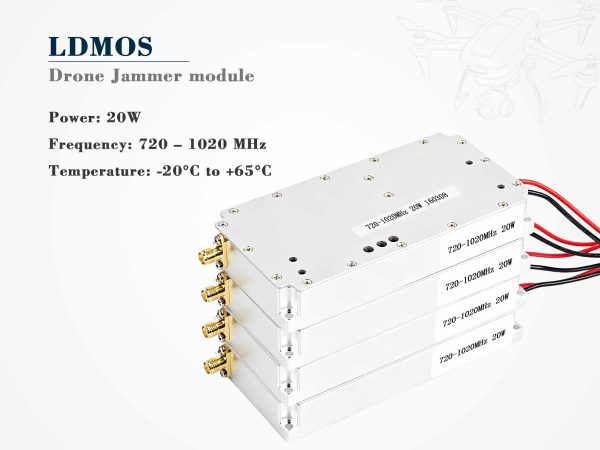
20W 720–1020MHz UAV Jammer Module | LDMOS Analog
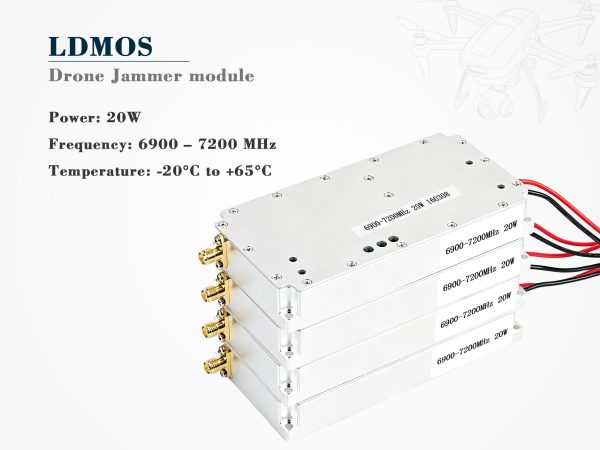
Powerful 20W LDMOS Drone Jammer Module for 6.9–7.2 GHz
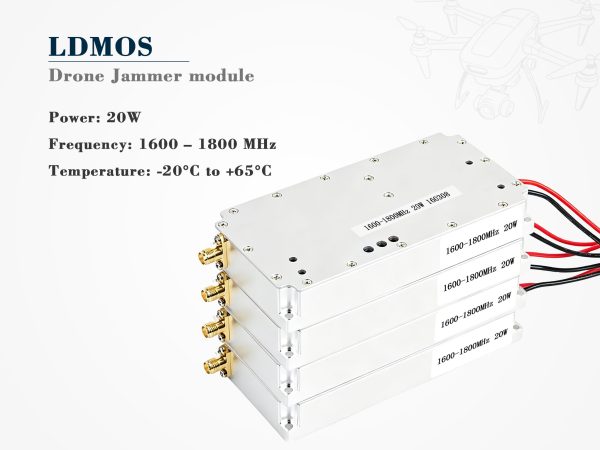
Powerful 20W Anti Drone Module 1600–1800MHz