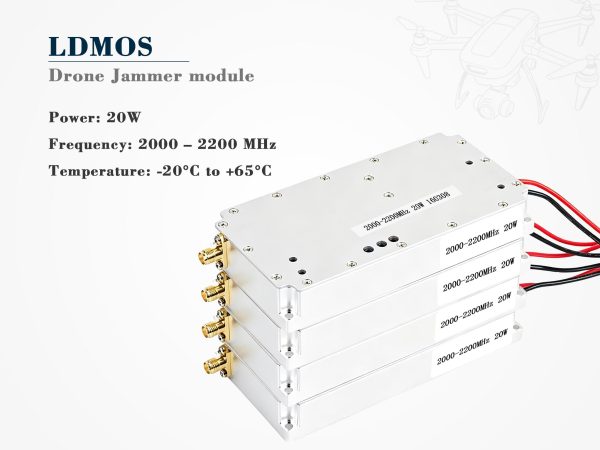
Powerful 20W LDMOS Drone Jammer Module for 6.9–7.2 GHz
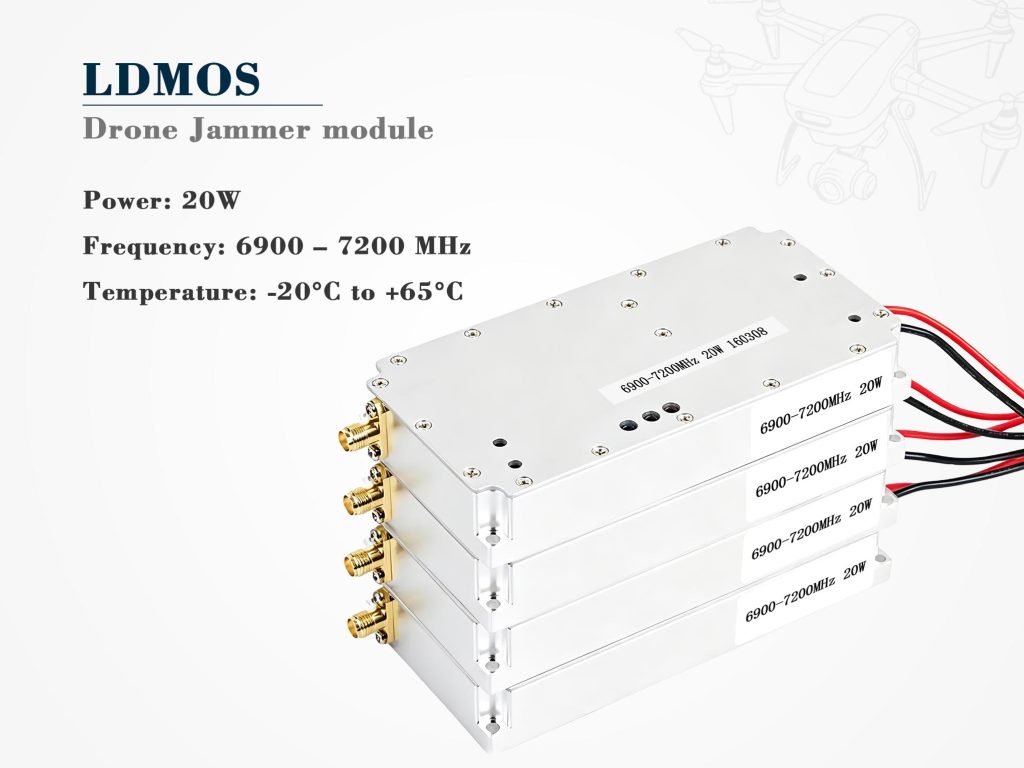
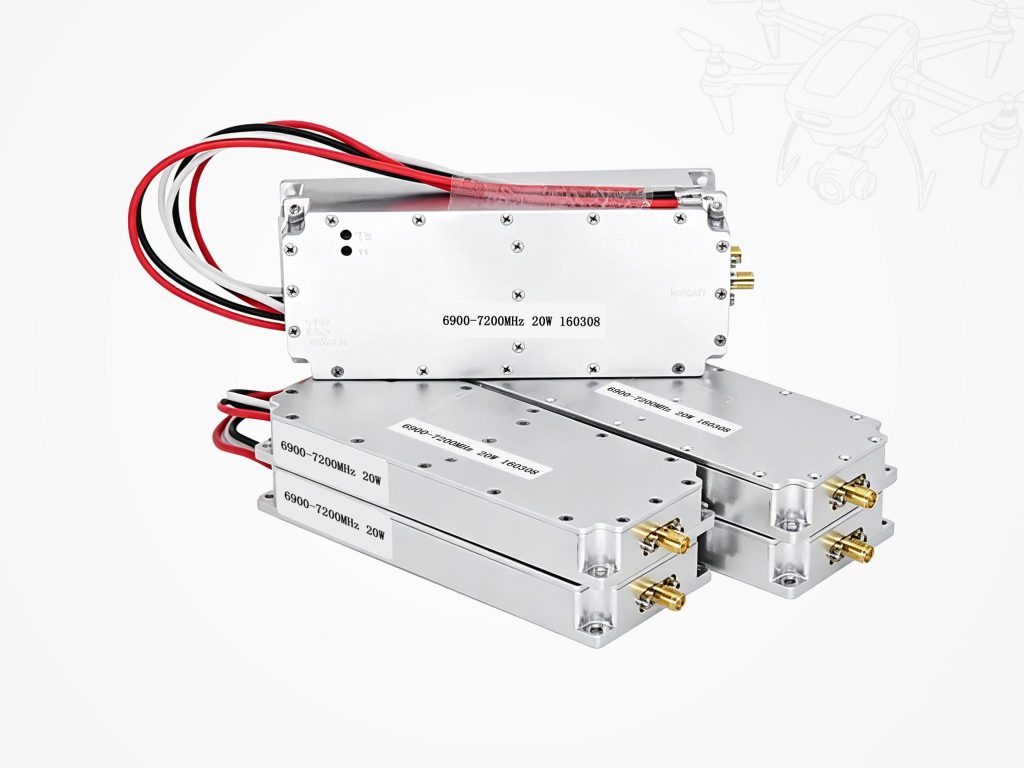
20W LDMOS drone jammer module covering 6900–7200MHz with built-in high-speed sweep source, 24–29V DC input, SMA female output, and over-voltage/temperature protection.
Technical Specifications
| Parameter | Specification | Notes |
| Frequency range | 6900–7200 MHz | Covers full band without gaps |
| Output power | 20 W typical | LDMOS final stage |
| Supply voltage | DC 24 V–29 V | 28 V nominal recommended |
| Current draw | ≤2.5 A max | At full output |
| Modulation source | Built-in high-speed sweep source | Analog sweep, no external generator needed |
| Analog scan speed | Fixed internal high-speed sweep | Specific rate not published; covers band rapidly |
| Input / output impedance | 50 Ω | SMA female output connector |
| Protection LEDs | Power, over-voltage, over-temperature | Visual status indicators |
| Operating temperature | -20°C to +65°C | Requires adequate heatsinking at upper limit |
| Dimensions (L×W×H) | 115.5 × 46.5 × 21 mm | Compact module |
| Weight | 0.21 kg | Lightweight for portable or vehicle use |
| Base material | Aluminum alloy housing / RF PCB | Not officially listed; aluminum assumed |
Product Details
The 20W LDMOS drone jammer module delivers 20 watts of continuous RF output from 6900 MHz to 7200 MHz. It uses an LDMOS final amplifier stage paired with an internal high-speed analog sweep source. That combination removes the need for an external signal generator and gives you fast full-band coverage against C-band drone links.
Key Hardware Features
This 20W LDMOS drone jammer module is built around a single SMA female output and a compact aluminum housing. It operates from a 24–29 V DC rail and draws a maximum of 2.5 A at full output. Typical efficiency is at least 40%, which keeps heat load manageable in small enclosures. The module measures 115.5 × 46.5 × 21 mm and weighs only 0.21 kg. These dimensions allow direct mounting into drone detection trailers, portable cases, or fixed mast installations. A 50-ohm match is required on the output port; the specified output VSWR is ≤2.0. For continuous duty, bolt the baseplate to a metal heatsink or use forced air across the housing.
Why LDMOS Matters Here
LDMOS devices are known for high gain, ruggedness, and good thermal stability in the 6–7 GHz range. This is why the 20W LDMOS drone jammer module can run at 40% efficiency while maintaining a small footprint. Compared with GaAs boards of similar output, the LDMOS stage tolerates brief VSWR mismatches better during antenna swapping or connector wear.
Integrated Sweep Source and RF Behavior
The built-in high-speed sweeping source generates an analog modulation pattern that repeatedly covers 6900–7200 MHz. Because the sweep source lives on the same board as the LDMOS final stage, the 20W LDMOS drone jammer module starts producing broadband energy as soon as the control line enables the RF chain. There is no need to load external waveform tables or connect a separate DDS. The sweep speed is fixed by the internal circuit and is intended to defeat frequency-hopping receivers that operate inside the band. Output power remains stable across the specified range when the antenna VSWR stays below 2.0. Higher reflected power can stress the LDMOS transistor and reduce long-term reliability.
Power, Switching, and Protection
A simple logic-level control switches the module. Apply +5 V or leave the control pin floating to turn the RF output on. Ground the pin to turn it off. This behavior works with most drone detection systems, PLC outputs, or manual switches. At full output, current draw is 2.5 A, so select a DC supply with at least 30% current margin. The board includes three LED indicators for power, over-voltage, and over-temperature. If an over-temperature event occurs, remove DC power and check the heatsink interface before restarting. The module is specified for operation from -20°C to +65°C, but the upper limit assumes adequate cooling. At high ambient temperatures, reduce duty cycle or improve airflow.
Applications for the 20W LDMOS Drone Jammer Module
This module is designed for counter-UAS missions where drones rely on 6900–7200 MHz control, telemetry, or video links. It can be used in fixed perimeter protection, vehicle-mounted systems, or temporary event security. Because the analog sweep covers the entire band quickly, the module is effective against simple and moderately agile frequency-hopping signals. Pair it with a detection radar or RF receiver that provides a trigger signal, and the module can operate in burst mode to reduce power consumption and thermal stress. The compact size also supports multi-module arrays for higher effective radiated power when connected to directional antennas.
Integration Notes
Always connect a 50-ohm antenna or dummy load before enabling the module. The SMA female port is not intended for open-circuit operation at 20 W. Use high-quality coaxial cable with low loss at 7 GHz to avoid unnecessary attenuation. Keep DC wiring short and add a soft-start supply if possible. The aluminum housing offers basic shielding, but mount the module away from sensitive receivers and digital control lines. For best results, place the module inside a screened enclosure and use feedthrough capacitors on the DC lines.
Summary
The 20W LDMOS drone jammer module is a compact, efficient RF source for 6900–7200 MHz counter-drone applications. Its integrated sweep generator, simple logic control, and protection LEDs reduce development time and make field deployment straightforward. With proper heatsinking and a matched 50-ohm load, the module delivers reliable output for fixed, vehicle, and portable jamming systems.
Frequently Asked Questions
Case Studies
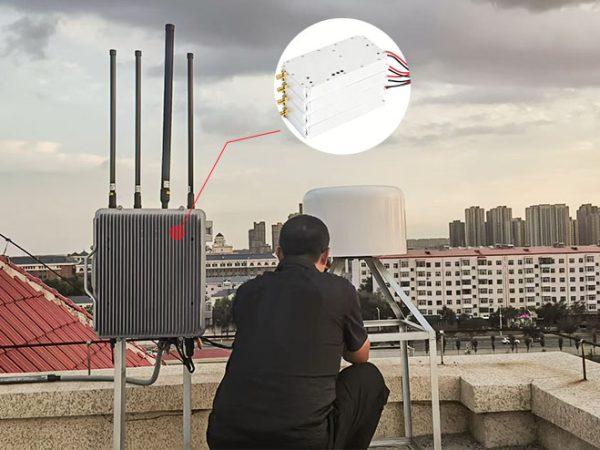
Heilongjiang Weather Center Completes Anti-Drone System Upgrade with Three High-Power Drone Jammer Modules

Tangshan Chem Plant Sealed Drone Gaps With 3 GaN Wideband Modules

How a National Prison Integrated Our Drone Jamming Module Into Their Fixed Counter-Drone System

Integrating Core RF Power: OEM Drone Jamming Module for Oil Refinery Security | Case Study
Send Us a Message
Related Products
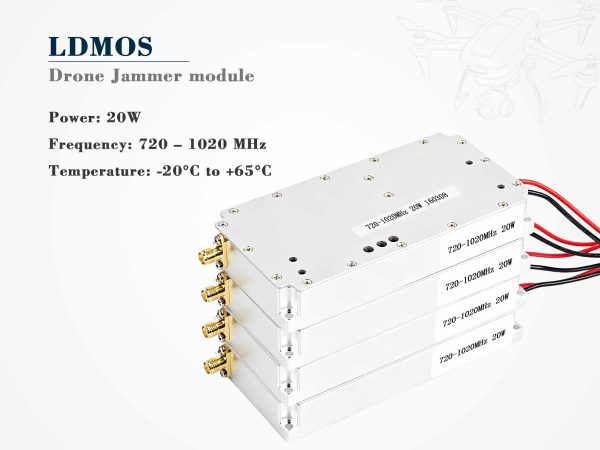
20W 720–1020MHz UAV Jammer Module | LDMOS Analog
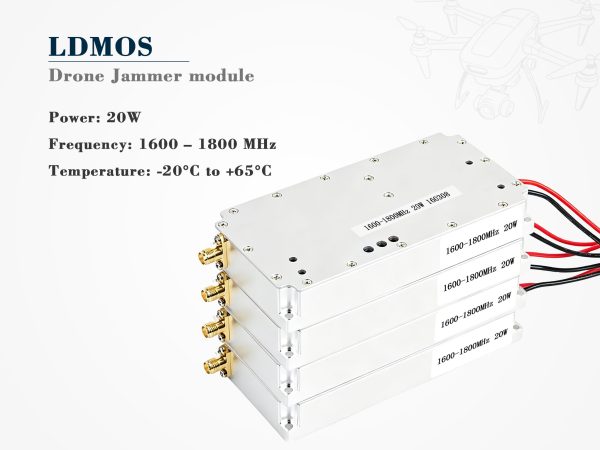
Powerful 20W Anti Drone Module 1600–1800MHz
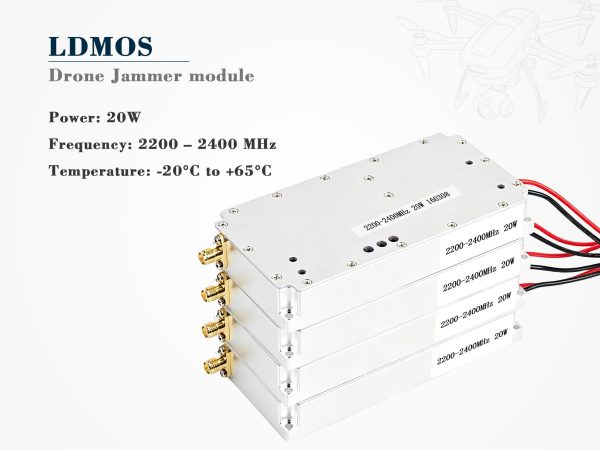
20W UAV Jammer Module: 2200-2400MHz LDMOS Module