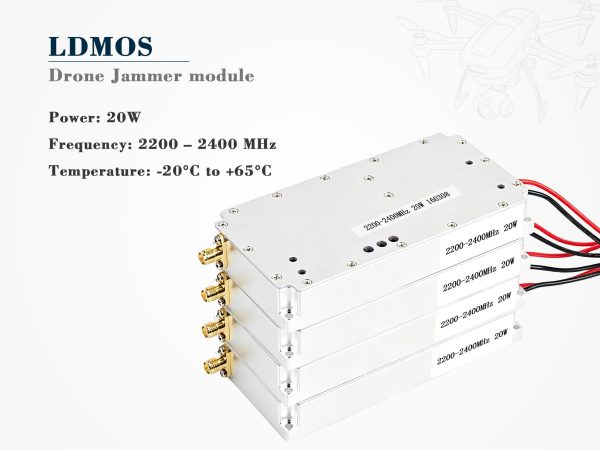
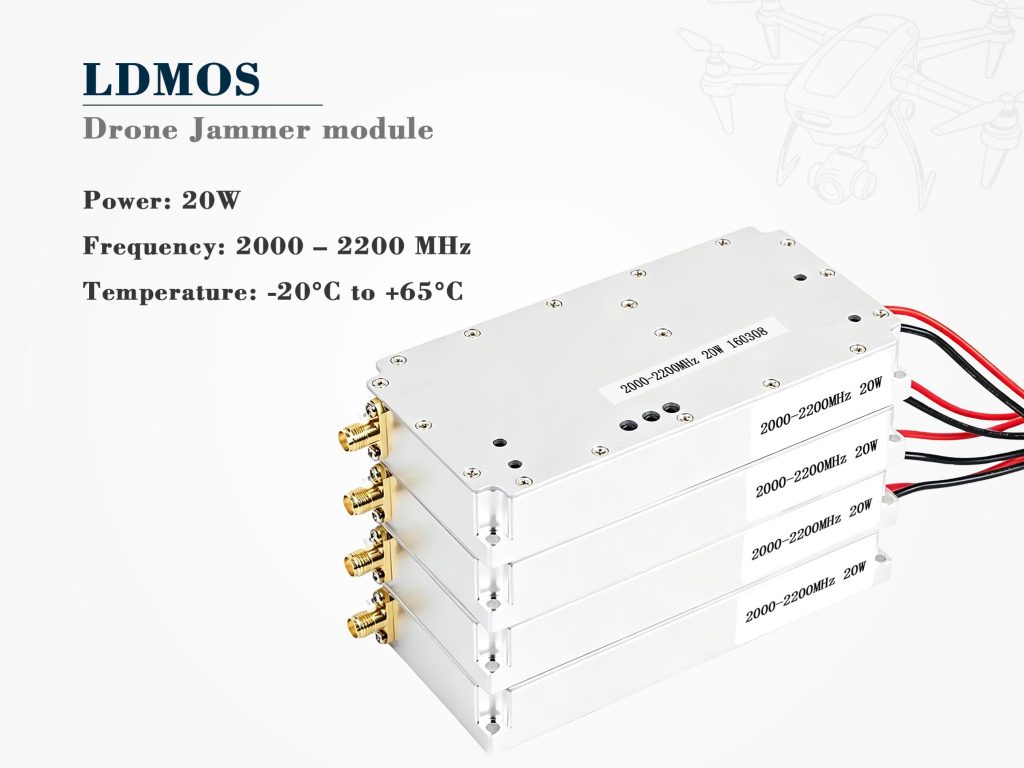
High-Power 20W Drone Jammer Module 2000~2200MHz
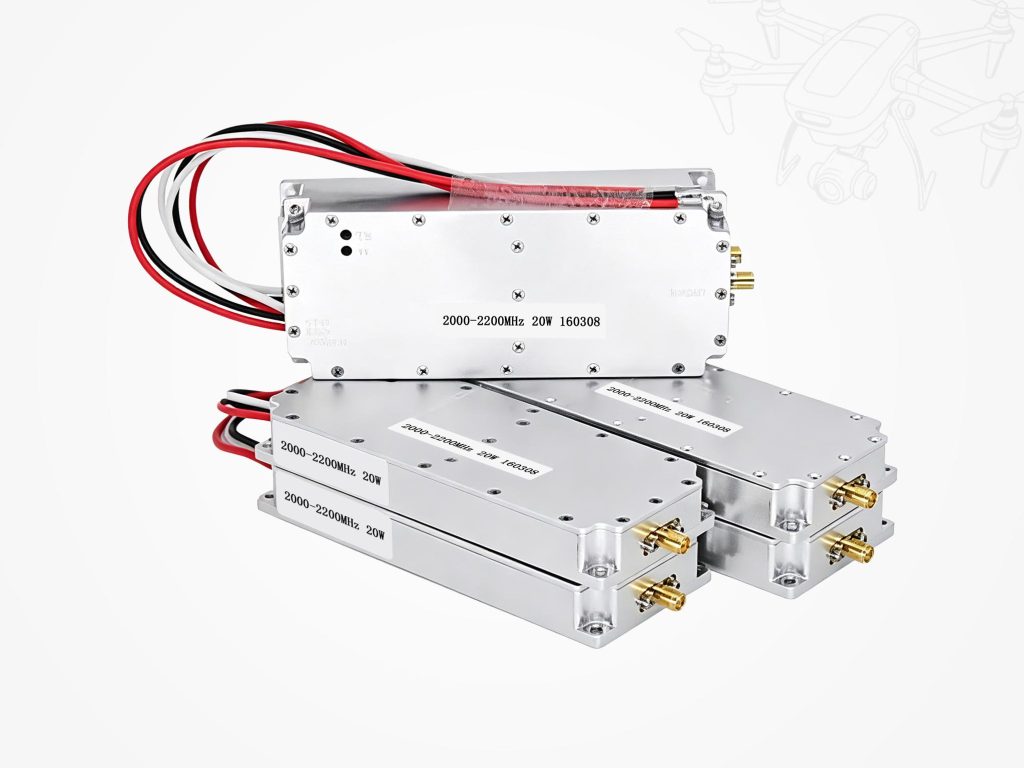
20W drone jammer module covering 2000~2200MHz. 24-29V DC, built-in fast sweep source, 2.5A max, compact 115.5x46.5x21mm. Ideal for anti-UAS deployments.
Technical Specifications
| Parameter | Specification | Notes |
| Frequency range | 2000–2200 MHz | Covers drone control, telemetry & analog FPV channels |
| Output power | 20 W (43 dBm) typical | Measured at saturated output, ≤2.0 VSWR |
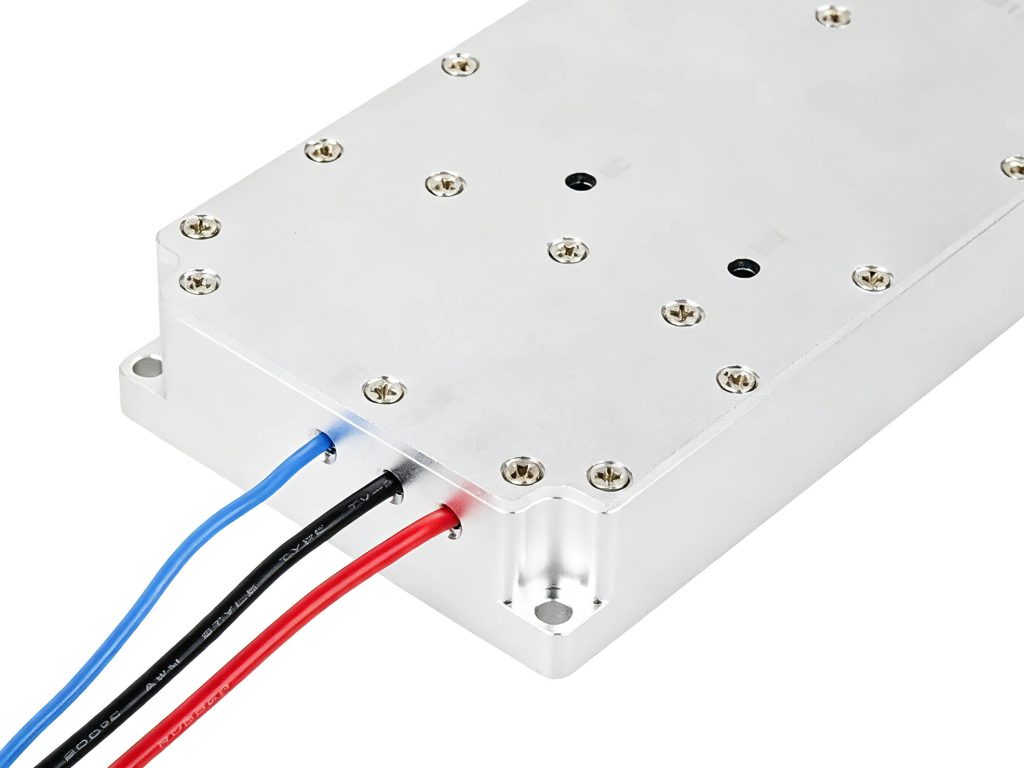
| Supply voltage | 24–29 V DC | 28 V nominal recommended |
| Current draw | ≤2.5 A | At 28 V, full 20 W output |
| Modulation source | Built‑in high‑speed analog sweep | No external generator required |
| Analog scan speed | Fast sweep, rate configurable | Modulation bandwidth typically up to 20 MHz |
| Input / output impedance | 50 Ω | Output VSWR ≤2.0:1 |
| Protection LEDs | None (optional on request) | Status indication can be added |
| Operating temperature | -20 °C to +65 °C | Baseplate conduction cooled |
| Dimensions (L×W×H) | 115.5 × 46.5 × 21 mm | SMA‑female connector extends length slightly |
| Weight | 0.21 kg | Net weight, module only |
| Base material | Anodized aluminum alloy | Serves as heat spreader and mounting base |
Product Details
Introduction to the High-Power 20W Drone Jammer Module 2000~2200MHz
The 20W drone jammer module 2000~2200MHz is a self-contained RF disruption engine built for modern counter-unmanned aircraft system (C-UAS) applications. Unlike setups requiring an external signal generator, this unit integrates a high-speed analog sweep source directly onto the pallet, making it a true turnkey jamming building block. With a clean 20‑watt saturated output and a compact footprint, it addresses a critical slice of spectrum where many commercial drones still operate their control and video links.
Why the 2000–2200 MHz Band Demands a Dedicated Jammer Module
While 2.4 GHz ISM often gets all the attention, a growing number of drones use frequency-hopping telemetry and digital video downlinks between 2.0 and 2.2 GHz. The 20W drone jammer module 2000~2200MHz zeroes in on exactly this window. If you rely on a wideband barrage jammer alone, you risk wasting power outside the threat band. Pairing this module with a directional antenna, concentrates energy where it matters most – denying both command‑and‑control and FPV feeds without collateral interference on adjacent services.
Core Hardware Features and the Built‑in Sweep Source
One standout element is the integrated modulation source. Traditional analog jamming modules demand an external function generator to produce a swept tone. The 20W drone jammer module 2000~2200MHz eliminates that complexity. The onboard circuit generates a fast analog frequency sweep, modulating the carrier to create a dense interference curtain. Power efficiency exceeds 40%, and the output stage uses an LDMOS transistor biased for rugged linearity – a design choice that keeps thermal stress low even during continuous key‑down operation.
For power, the module accepts a wide DC rail from 24 V to 29 V. Maximum current draw sits at 2.5 A, so a standard industrial 28 V supply is more than sufficient. The output VSWR protection holds reflections to ≤2.0:1, safeguarding the final stage when antennas are operated in non‑ideal environments.
Control and Integration into a Security Ecosystem
System integrators will appreciate the straightforward TTL‑compatible on/off logic. Leave the control pin floating or pull it to +5 V to activate the 20W drone jammer module 2000~2200MHz; grounding the pin immediately silences the RF output. This makes it trivial to mate with radar‑triggered kill switches, optical detection processors, or manual console buttons. The SMA‑female output connector further simplifies cabling, and the module’s 115.5 × 46.5 × 21 mm chassis slips easily into NEMA enclosures or mobile mast payloads.
Before deploying any jamming device, always check local spectrum regulations. Bodies like the FCC and ETSI strictly limit intentional radiators. The 20W drone jammer module 2000~2200MHz is designed exclusively for authorized government, military, and critical infrastructure protection entities that hold the necessary legal clearances.
Thermal Design and Long‑Term Reliability
Sustained 20‑watt RF generation creates heat, which is why the baseplate is machined from anodized aluminum. That material pulls thermal energy away from the LDMOS die and spreads it evenly across the module’s footprint. Combined with the ≥40% efficiency, the 20W drone jammer module 2000~2200MHz can operate in ambient temperatures from -20 °C to +65 °C without a fan – passive conduction is normally enough when bolted to a metallic bulkhead. For outdoor fixed sites, a small heat sink or forced airflow extends duty cycle margins even further.
Deployment Scenarios and Practical Considerations
This module is not a finished consumer device; it is an OEM‑grade building block. Common use cases include:
-
Prison perimeter denial – preventing contraband drone deliveries.
-
Airport critical asset protection – augmenting radar with RF interdiction.
-
Military convoy C-UAS – mounting the 20W drone jammer module 2000~2200MHz alongside other band modules in a multi‑channel system.
Remember that effective radiated power depends heavily on antenna gain and cable loss. When you purchase a 20W drone jammer module 2000~2200MHz, partner it with carefully matched 50‑Ω antennas and low‑loss coax to preserve every dBm.
Overall, the 20W drone jammer module 2000~2200MHz blends a streamlined analog architecture with the punch of 20 watts, making it a dependable core for custom counter‑drone solutions.
Frequently Asked Questions
Case Studies
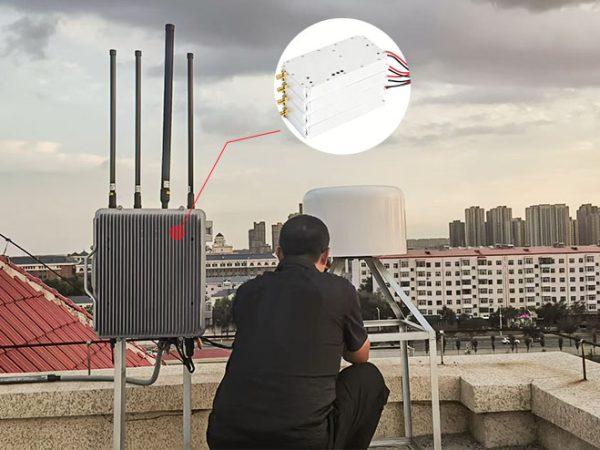
Heilongjiang Weather Center Completes Anti-Drone System Upgrade with Three High-Power Drone Jammer Modules

Tangshan Chem Plant Sealed Drone Gaps With 3 GaN Wideband Modules

How a National Prison Integrated Our Drone Jamming Module Into Their Fixed Counter-Drone System

Integrating Core RF Power: OEM Drone Jamming Module for Oil Refinery Security | Case Study
Send Us a Message
Related Products
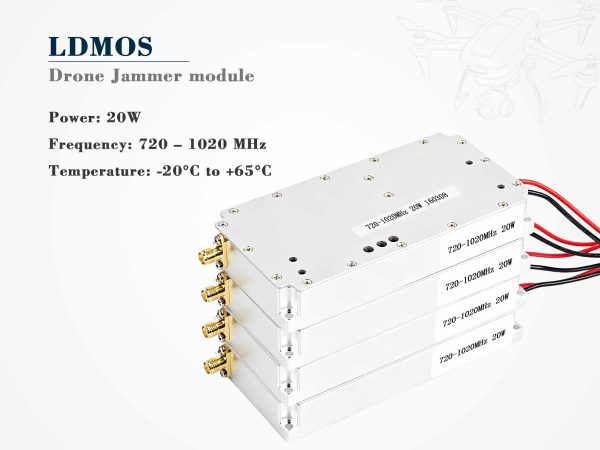
20W 720–1020MHz UAV Jammer Module | LDMOS Analog
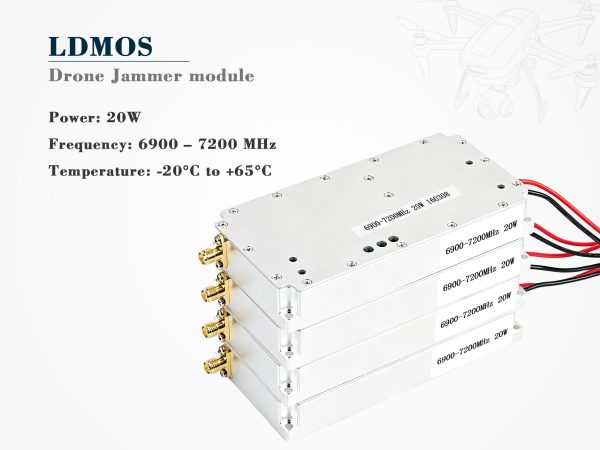
Powerful 20W LDMOS Drone Jammer Module for 6.9–7.2 GHz
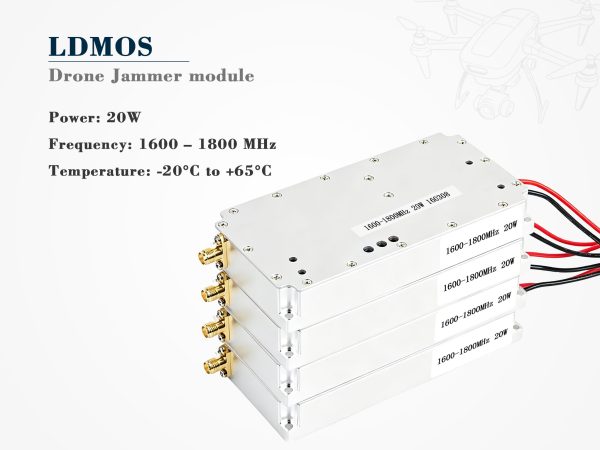
Powerful 20W Anti Drone Module 1600–1800MHz