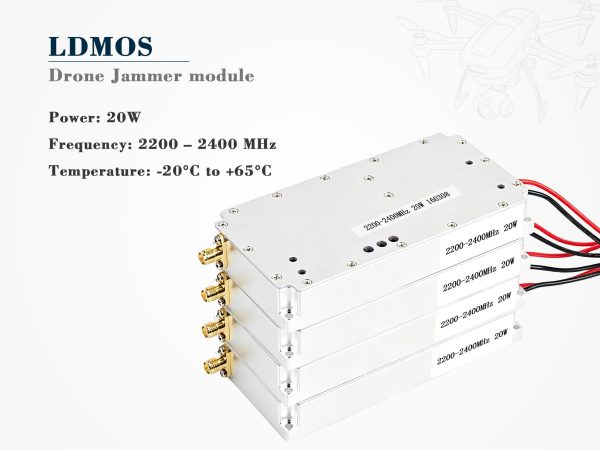
Powerful 20W Drone Jamming Module for 1.8-2GHz
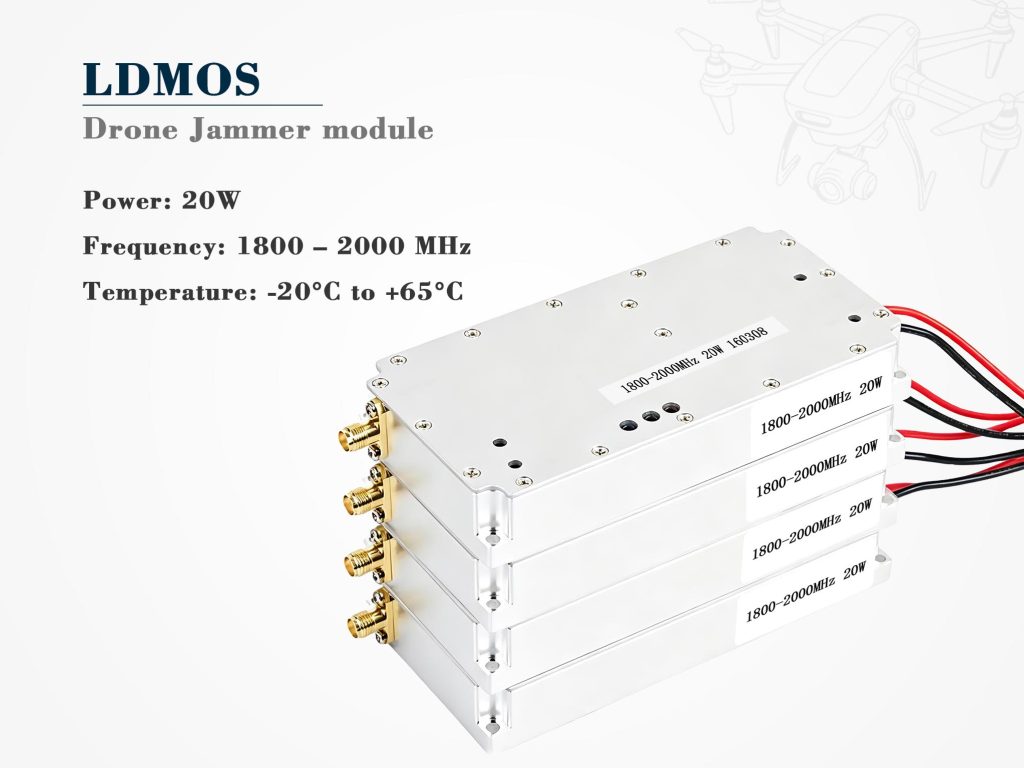
20W drone jamming module: 1800-2000MHz, built-in analog sweep, 24-29V DC, 2.5A, SMA. Compact LDMOS jammer for counter-drone use.
Technical Specifications
| Parameter | Specification | Notes |
| Frequency range | 1800–2000 MHz | Covers UAV control, telemetry, and video links |
| Output power | 20 W (43 dBm) typ. | LDMOS, high linearity |
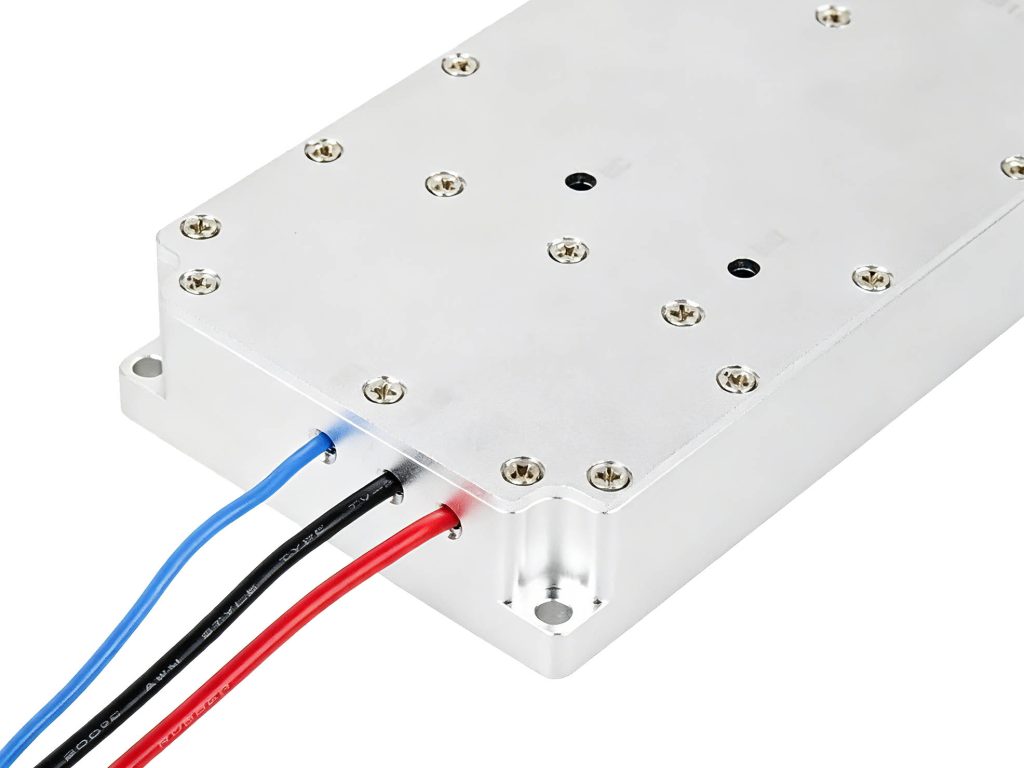
| Supply voltage | 24–29 V DC | Regulated supply recommended |
| Current draw | ≤ 2.5 A | At maximum RF output |
| Modulation source | Built-in high-speed analog sweep | Sawtooth generator, no digital signature |
| Analog scan speed | Configurable, up to ~1 kHz sweep cycle | Internal trimmer adjustment |
| Input / output impedance | 50 Ohm (RF) | SMA female; control logic TTL |
| Protection LEDs | Power (green), VSWR alarm (red) | Indicates high reflected power |
| Operating temperature | -20 to +65 °C | Industrial grade |
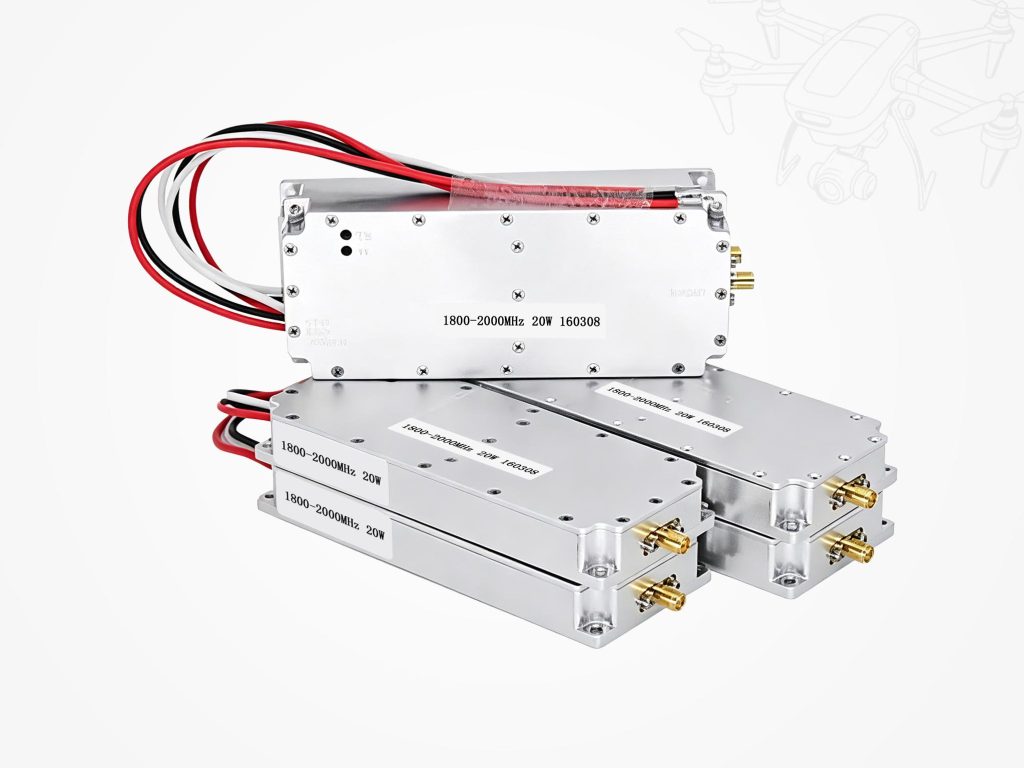
| Dimensions (L×W×H) | 115.5 × 46.5 × 21 mm | Compact flat‑pack |
| Weight | 0.21 kg | Lightweight for mobile deployment |
| Base material | Aluminum alloy, nickel-plated | Excellent heat dissipation and corrosion resistance |
Product Details
Table of Contents
-
Why Choose a 20W Drone Jamming Module?
-
Integrated Analog Sweep Technology
-
Compact LDMOS Design and Thermal Efficiency
-
Simple Control and Rugged Build
-
Applications and Deployment
Why Choose a 20W Drone Jamming Module?
The 20W drone jamming module delivers robust countermeasure capabilities against unauthorized UAVs operating in the 1.8–2.0 GHz band. As consumer and commercial drones become more accessible, the demand for reliable, always-on RF disruption has surged. This module fills that need with pure analog muscle, free of easily detectable digital signatures.
Unlike battery-powered, low-output blockers that struggle beyond a few meters, a 20W drone jamming module builds enough effective isotropic radiated power (EIRP) to establish a meaningful denial zone. Paired with a directional antenna, range extends to several hundred meters, depending on the environment. The onboard LDMOS final stage keeps DC‑to‑RF efficiency above 40%, so less energy turns into waste heat and your power supply stays cooler under continuous duty.
Integrated Analog Sweep Technology
Inside the shield can, a high-speed analog sawtooth generator sweeps the full 1800–2000 MHz window continuously. This is crucial: many modern drones employ frequency‑hopping spread spectrum (FHSS), switching channels in microseconds. The 20W drone jamming module doesn’t rely on a pre‑loaded hit list of channels. Its analog source visits every frequency in the band, catching hops that digital look‑up tables would miss.
The VCO and loop filter have been carefully tuned to maintain low phase noise during the sweep. The result is a coherent jamming waveform that overloads drone receivers quickly, yet remains agile enough to deny both the control uplink and the FPV video downlink simultaneously. A trimmer inside allows you to fine‑tune the sweep rate to match the threat profile, from slow-drifting DIY platforms to fast‑hopping commercial off‑the‑shelf models.
Compact LDMOS Design and Thermal Efficiency
At just 115.5 × 46.5 × 21 mm and 0.21 kg, this 20W drone jamming module fits easily into tight enclosures, portable counter‑UAS backpacks, or fixed‑site radar cabinets. The amplifier chain uses a single LDMOS transistor mounted directly on a nickel‑plated aluminum baseplate. This construction pulls heat away from the junction instantly, letting the module run at full 20 W without forced air—only natural convection is required indoors or in shaded outdoor boxes.
We included a protection LED that flashes red when the reflected power pushes the VSWR beyond safe limits. That small addition has saved countless final‑stage transistors in the field, especially during antenna mismatch events caused by icing or accidental disconnection.
Simple Control and Rugged Build
Deploying the 20W drone jamming module is straightforward. Supply 24–29 V DC, then either apply a +5 V logic signal to the control pin or leave it floating to activate the jammer. Ground that same pin to turn it off instantly—no complicated serial commands or boot sequences. An SMA female bulkhead connector provides the RF output, and a green LED confirms the module is powered and transmitting.
The output match keeps the VSWR ≤ 2.0 across the entire band, so nearly all of the generated 20 W reaches your antenna. Tested from ‑20 to +65 °C, the module tolerates everything from desert heat to freezing winter deployments. For installations requiring remote monitoring, the built‑in alarm output can feed a system status panel or a camera‑based watchdog.
Applications and Deployment
Typical use cases for a 20W drone jamming module include perimeter defense of critical infrastructure, VIP convoy protection, and integration with radar‑guided C‑UAS platforms. Use it with our high‑gain panel antennas for directional jamming, or connect an omnidirectional antenna when wide‑area denial is the priority.
Important: Always verify local regulations before operating any RF jammer. In the United States, the FCC strictly prohibits unauthorized use of signal jamming equipment (FCC Jammer Enforcement). Many government, military, and law enforcement agencies do operate such modules under proper authorization. The 20W drone jamming module was engineered specifically for these professional scenarios, providing a reliable, repeatable building block for licensed counter‑drone operations.
Frequently Asked Questions
Case Studies
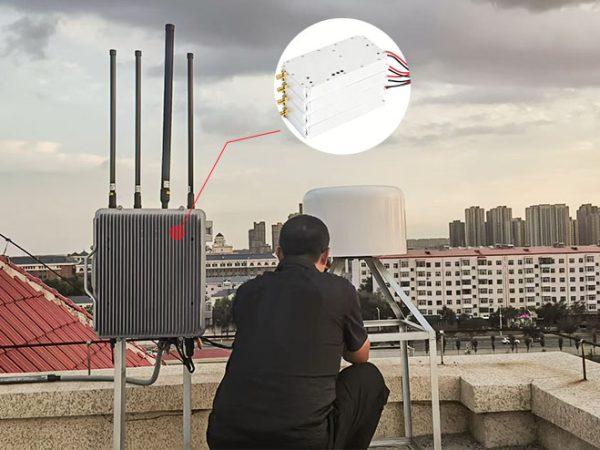
Heilongjiang Weather Center Completes Anti-Drone System Upgrade with Three High-Power Drone Jammer Modules

Tangshan Chem Plant Sealed Drone Gaps With 3 GaN Wideband Modules

How a National Prison Integrated Our Drone Jamming Module Into Their Fixed Counter-Drone System

Integrating Core RF Power: OEM Drone Jamming Module for Oil Refinery Security | Case Study
Send Us a Message
Related Products
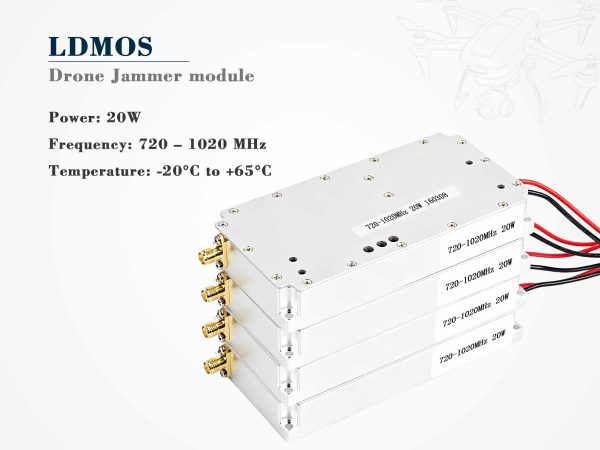
20W 720–1020MHz UAV Jammer Module | LDMOS Analog
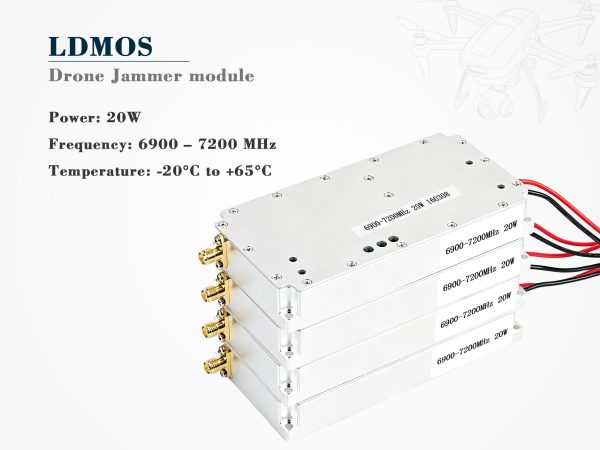
Powerful 20W LDMOS Drone Jammer Module for 6.9–7.2 GHz
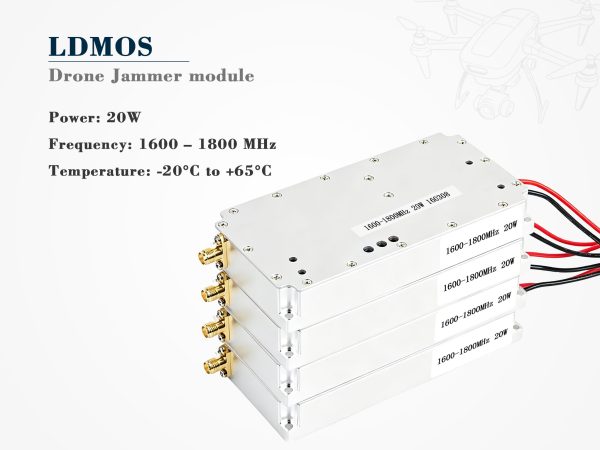
Powerful 20W Anti Drone Module 1600–1800MHz