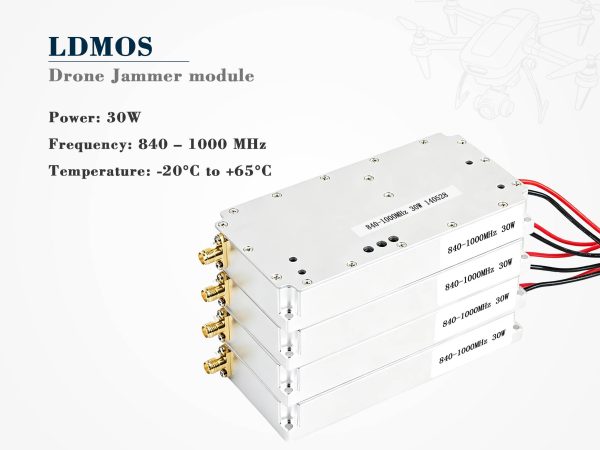
30W 1550-1620MHz LDMOS Drone Jammer Module – Compact GPS Blocker
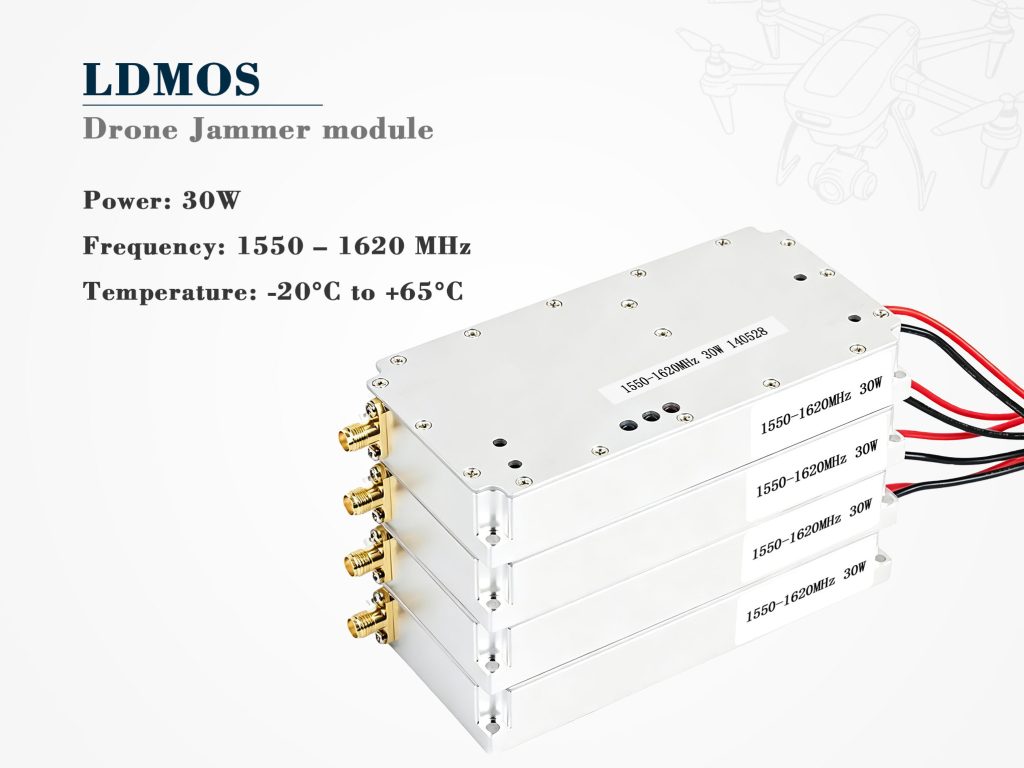
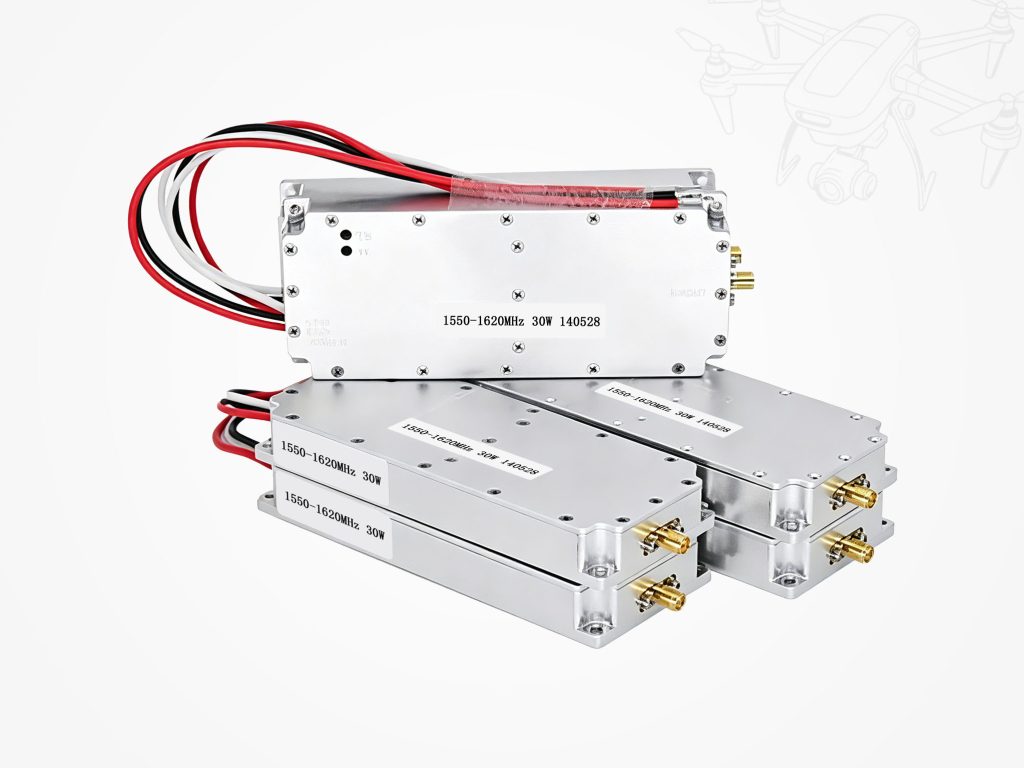
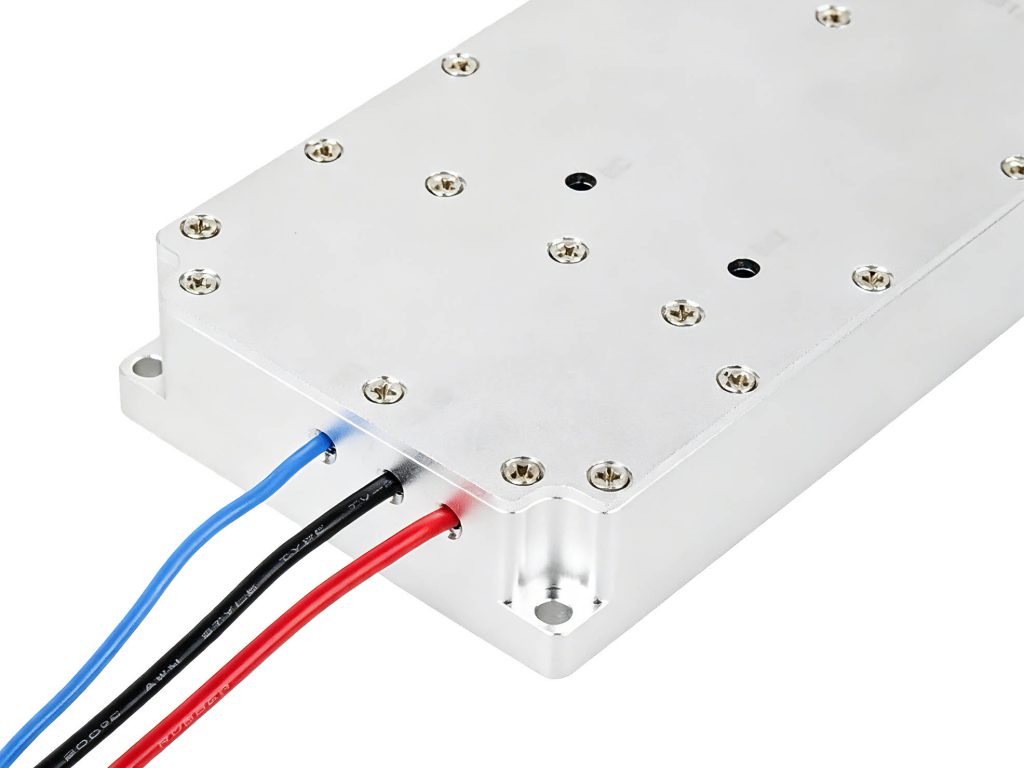
30W drone jammer module covering 1550-1620MHz for GPS/GNSS jamming, 24-29V, 3.2A, built-in high-speed sweep source, SMA output, 115.5×46.5×21mm, 0.21kg. Ideal for counter-UAS and perimeter protection.
Technical Specifications
| Parameter | Specification | Notes |
| Frequency range | 1550 – 1620 MHz | Covers GPS L1, GLONASS G1, Galileo E1 |
| Output power | 30W (typical) | Measured at 28V, CW mode |
| Supply voltage | 24 – 29 V DC | Nominal 28V recommended |
| Current draw | ≤ 3.2 A | At full output, 28V |
| Modulation source | Built‑in high‑speed sweep generator | Sweep rate configurable on request |
| Analog scan speed | Customisable (contact for details) | Default set per order |
| Input / output impedance | 50 Ω | SMA female output; internal input |
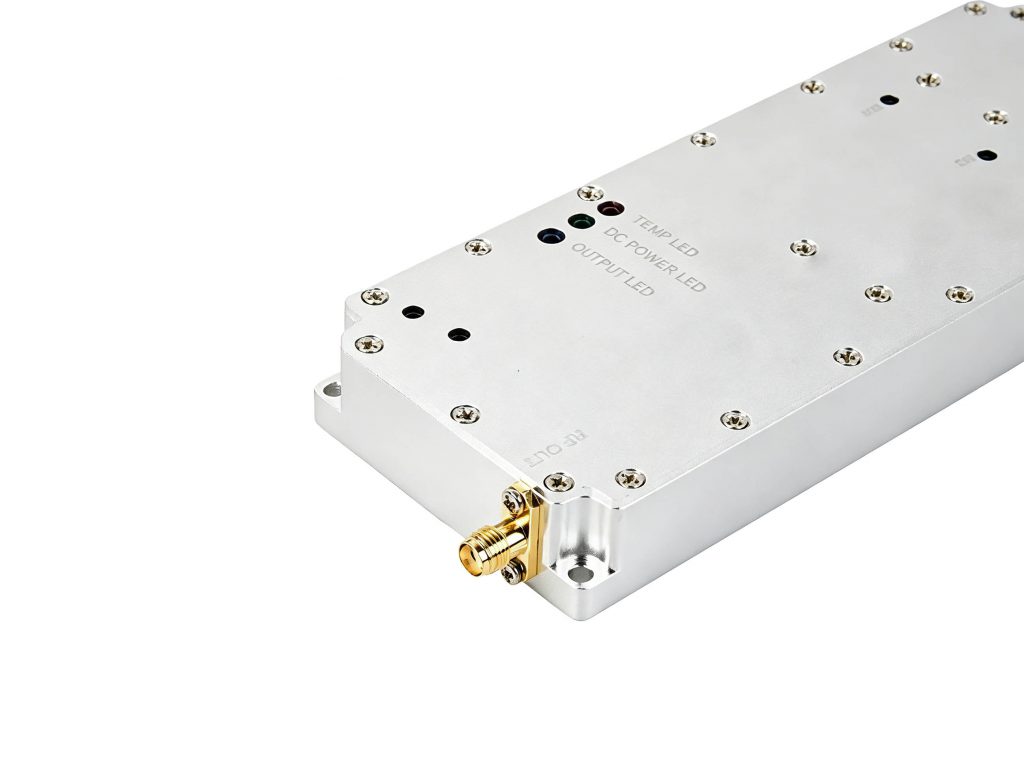
| Protection LEDs | over‑temp fold‑back built‑in | - |
| Operating temperature | -20 ~ +65 °C | Ambient, with adequate heatsinking |
| Dimensions (L×W×H) | 115.5 × 46.5 × 21 mm | Excluding connectors and pins |
| Weight | 0.21 kg | Approximate net weight |
| Base material | Aluminium alloy | Milled housing, natural finish |
Product Details
Targeting the GPS Band
Most consumer and many military drones rely on GPS/GNSS signals for navigation and position holding. The L1 band – centred around 1575MHz – is the primary downlink for civilian GPS. This drone jammer module hones in on that vulnerable spot, covering the full 1550‑1620MHz range that includes GPS, GLONASS, and Galileo signals. With 30W of output power from a compact LDMOS amplifier, you can effectively overwhelm satellite navigation receivers within several hundred metres, forcing drones to lose their position lock and either hover erratically or trigger failsafe landings. Unlike broadband noise that wastes energy across unused spectrum, this targeted approach concentrates all your jamming power exactly where it hurts – the navigation link. It’s a surgical tool for scenarios where you don’t want to blanket the entire UHF band, but need reliable disruption of autonomous flight paths.
Efficient Power in a Tiny Package
Don’t let the size fool you – this drone jammer module measures just 115.5×46.5×21mm and weighs a mere 0.21kg, yet it delivers a solid 30W RF output. Running on a DC supply of 24‑29V, it draws a maximum of 3.2A at full tilt, which translates to about 75‑80W input power. With an efficiency of ≥40%, it’s surprisingly frugal for a linear amplifier, meaning less heat to manage and longer battery life if you’re building a portable jammer. The output VSWR is kept ≤2.0, ensuring stable operation even with slight antenna mismatches. The SMA female connector is lightweight and widely compatible, making it easy to integrate with small directional patch antennas or omni‑dipoles. For portable or handheld units, this low weight and modest current draw are game‑changers – you can run it from a small lithium‑ion pack without needing a heavy power supply.
Built‑in Sweep and Simple Control
Inside the drone jammer module, a high‑speed sweep generator produces a continuously varying waveform that smears energy across the entire 1550‑1620MHz slot. This sweeping interference is far more effective than a fixed carrier because GPS receivers use spread‑spectrum techniques; a moving tone forces the correlator to constantly re‑acquire, quickly draining its tracking loops. The sweep characteristics are factory‑tuned, but we can adjust them on request to match specific jamming tactics or to avoid interfering with adjacent communication bands. Control is straightforward: a TTL‑compatible enable pin lets you turn the RF output on and off remotely. Apply +5V or leave it floating to enable; ground it to disable. This makes it easy to pulse the module in a duty cycle, reducing average power consumption and heat generation while still achieving the desired effect. You can also drive it with an external controller for synchronised bursts across multiple modules.
Mounting and Integration
The aluminium housing is milled from a solid block, providing both shielding and a thermal path. The base plate is flat, and we’ve included four mounting holes (not shown in the spec but standard on the physical unit) for secure attachment to a heatsink or chassis. Given the 30W output, we recommend a modest heatsink with passive cooling for continuous operation – a 50×50×30mm finned block is usually sufficient. For burst operation at low duty cycles, you might even get away with just the bare housing. The SMA connector sits on one short edge, and the DC input (with a standard two‑pin header) and control pin are on the opposite side, allowing tidy cable management. At 0.21kg, it adds negligible weight to a mast‑head or drone‑mounted payload, though we must stress that jamming from a flying platform requires careful filtering to prevent self‑interference.
Real‑World Deployment Tips
In practice, this drone jammer module shines as a spot‑jammer for GNSS. Many users pair it with a circularly polarised antenna to match the satellite signals, achieving maximum effective radiated power. Keep the DC leads short – at 3.2A, voltage drop is minor but still worth considering. The internal protection isn’t shown with LEDs on this compact version; instead, we’ve built in over‑temperature fold‑back and reverse‑polarity protection silently. If the module gets too hot, it will reduce drive automatically, so you won’t fry the LDMOS. For field use, we suggest a weather‑proof enclosure if exposed to rain, as the housing is not IP‑rated. Also, always test with a dummy load first – a sudden open circuit at 30W can cause a voltage spike that might damage the output transistor, though the built‑in VSWR protection does offer some resilience. With sensible handling, this little powerhouse will give you years of reliable service, whether you’re securing a VIP convoy or protecting a temporary event site.
Frequently Asked Questions
Case Studies
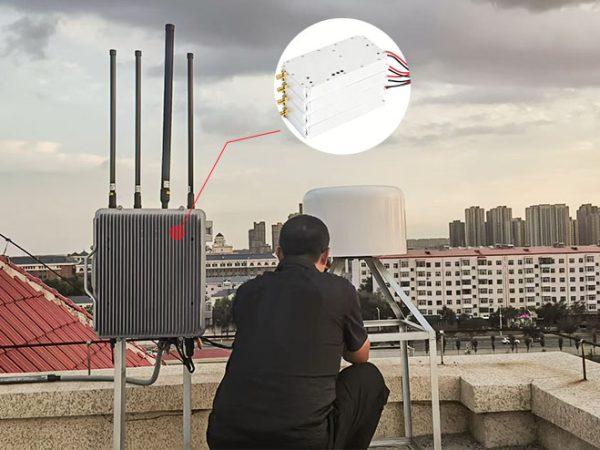
Heilongjiang Weather Center Completes Anti-Drone System Upgrade with Three High-Power Drone Jammer Modules

Tangshan Chem Plant Sealed Drone Gaps With 3 GaN Wideband Modules

How a National Prison Integrated Our Drone Jamming Module Into Their Fixed Counter-Drone System

Integrating Core RF Power: OEM Drone Jamming Module for Oil Refinery Security | Case Study
Send Us a Message
Related Products
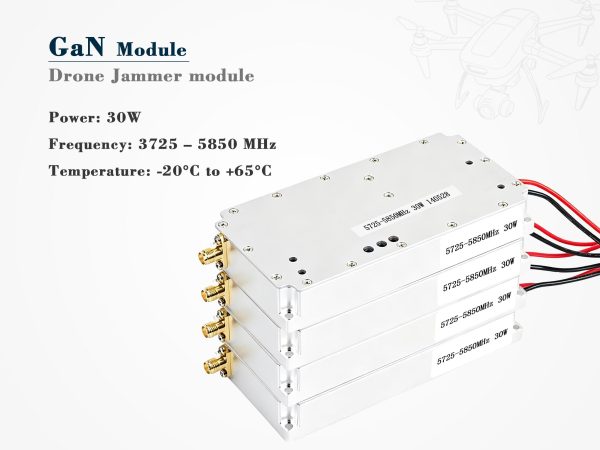
30W 5.8 GHz GaN Drone Jammer Module | 5725–5850 MHz
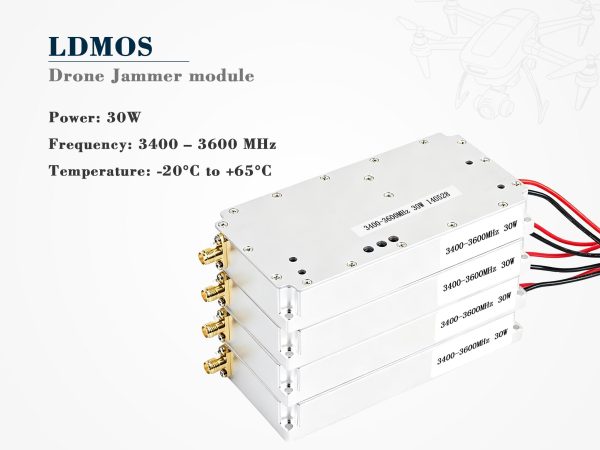
30W LDMOS Jamming Module for 3400–3600 MHz Drone Defense
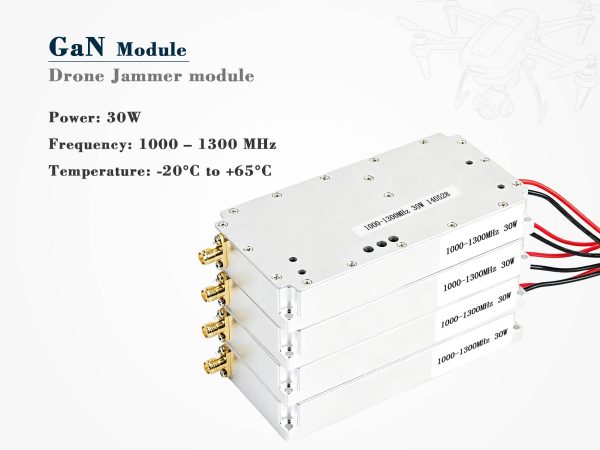
30W Anti-Drone Jamming Module: Compact 1000-1300MHz GaN Solution