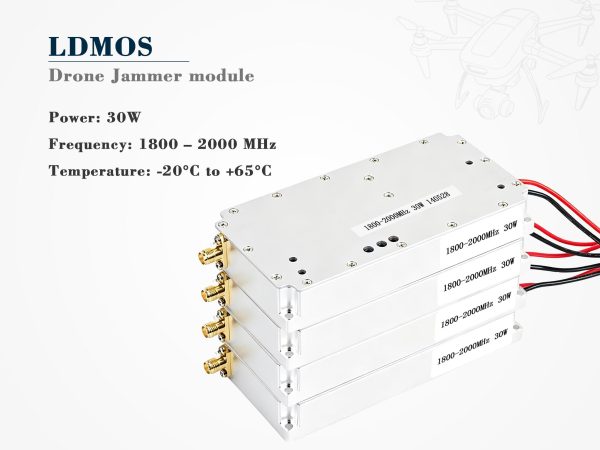
30W LDMOS Jamming Module for 3400–3600 MHz Drone Defense
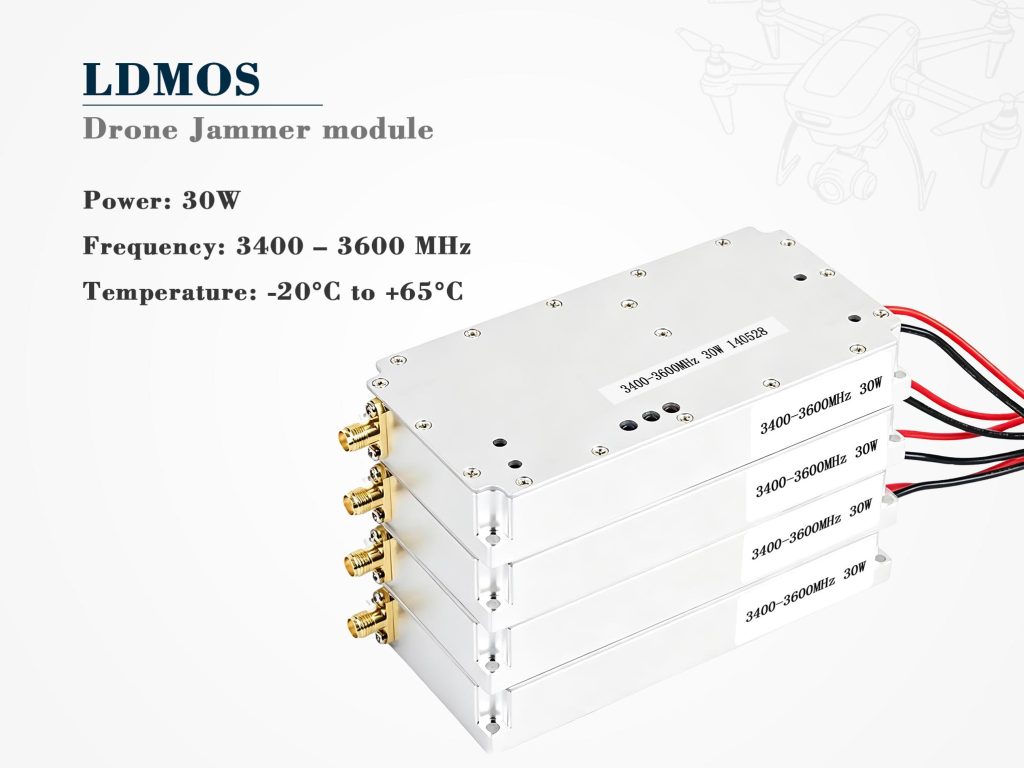
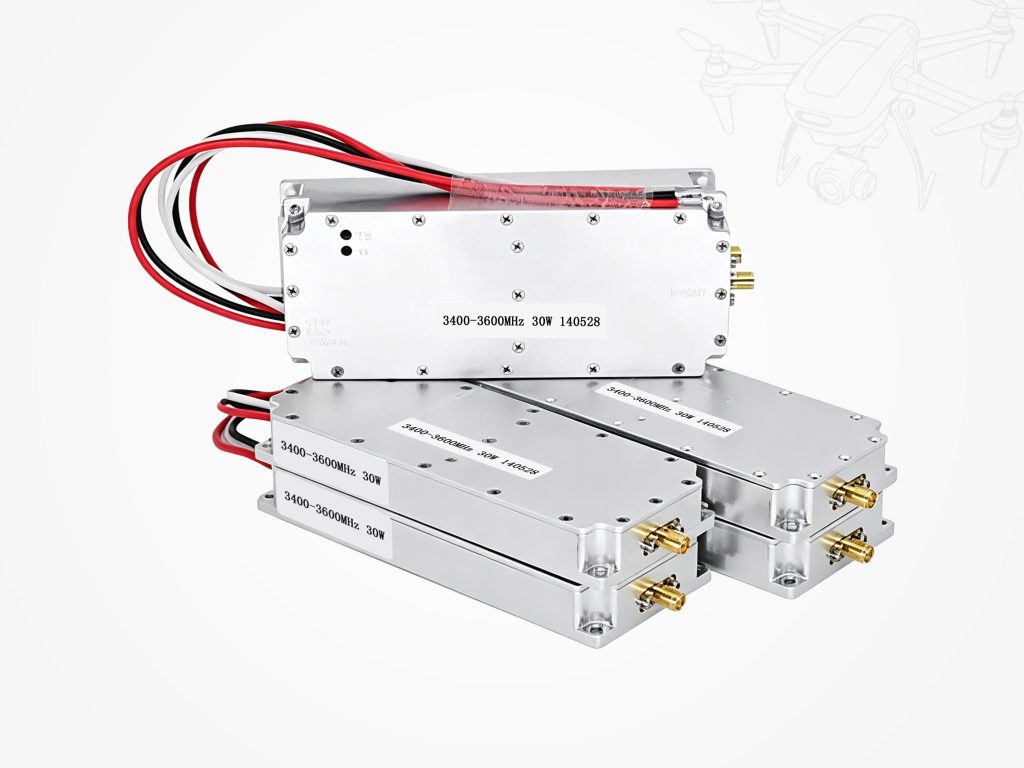
30W LDMOS jamming module covering 3400-3600 MHz with built-in high-speed sweep source, 24-29 VDC input, SMA output, and compact 115.5x46.5x21mm design.
Technical Specifications
| Parameter | Specification | Notes |
| Frequency range | 3400–3600 MHz | Analog sweep source built in |
| Output power | 30 W | Continuous RF output |
| Supply voltage | 24–29 VDC | Regulated DC input |
| Current draw | 3.2 A max | At full output |
| Modulation source | Built-in high-speed analog sweep | No external DDS needed |
| Analog scan speed | Adjustable via control logic | Broadband noise-like waveform |
| Input / output impedance | 50 Ω | SMA female output |
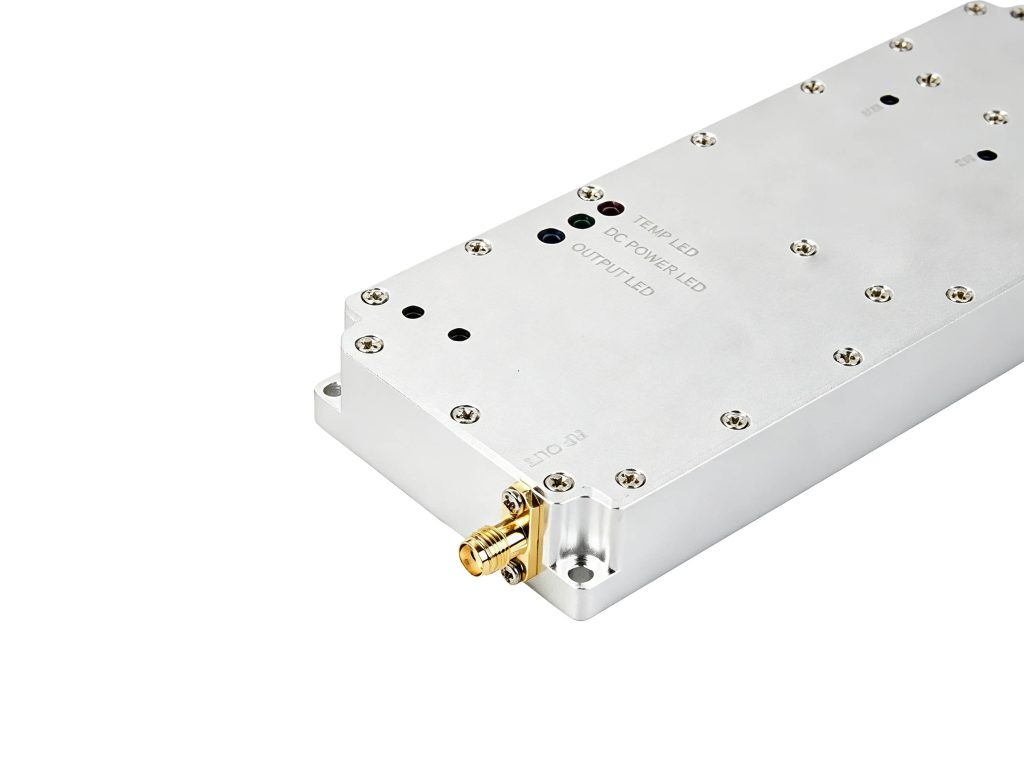
| Protection LEDs | Power, overvoltage, overtemperature | Visual fault indication |
| Operating temperature | -20°C to +65°C | Extended range |
| Dimensions (L×W×H) | 115.5 × 46.5 × 21 mm | Compact module |
| Weight | 0.21 kg | Lightweight for mobile use |
| Base material | Metal-backed PCB / aluminum base | Heatsink mounting recommended |
Product Details
The 30W LDMOS jamming module is a fully integrated analog interference source designed for counter-UAS applications in the 3400–3600 MHz band. It combines a high-speed sweep generator, driver stage, and final LDMOS amplifier in a single compact assembly, delivering 30 W of continuous RF output while drawing only 3.2 A from a 24–29 VDC rail. The module accepts TTL-level on/off commands and provides LED status for power, overvoltage, and overtemperature conditions.
LDMOS Advantages
Unlike older bipolar designs, this 30W LDMOS jamming module uses a laterally diffused metal-oxide-semiconductor final stage. That choice improves thermal stability, power gain, and efficiency under mismatch conditions. With typical efficiency of at least 40%, the module generates less waste heat, which matters in enclosed or fanless drone-defense installations. The output VSWR is specified at ≤2.0, so it tolerates antenna detuning in field use.
Built-In High-Speed Sweep Source
The internal analog sweep source covers 3400–3600 MHz without an external DDS or signal generator. Users can set the sweep rate through integrated control logic; the module then produces a continuous noise-like jamming waveform across the full band. Because the source and amplifier share one PCB, phase drift and cable losses are minimized. This architecture also keeps the total size to 115.5 × 46.5 × 21 mm and weight to 0.21 kg.
Electrical Interface and Control Logic
Supply voltage is 24–29 VDC, with maximum current draw of 3.2 A. The on/off control uses a simple logic line: +5 V or floating turns the module on, while grounding the control pin disables it. The RF output connector is SMA female, and the module includes protection LEDs for power, overvoltage, and overtemperature events.
Power Supply Considerations
When deploying the 30W LDMOS jamming module, use a regulated DC source capable of at least 3.5 A continuous to avoid voltage sag during modulation peaks. Ripple should be kept below 100 mV. A low-ESR capacitor near the DC input helps stabilize output power. If the supply exceeds 29 V, the overvoltage LED will trigger and the module may shut down to protect the final stage.
Applications and Deployment
This 30W LDMOS jamming module suits portable drone countermeasure sets, fixed-site perimeter protection, and vehicle-mounted jammer arrays. It can be combined with directional antennas to create a denial zone in the 3.4–3.6 GHz range used by some UAV data links. The analog architecture produces fast broadband coverage without digital processing latency, making it useful where reaction time matters. Operating temperature spans -20°C to +65°C.
Mechanical and Thermal Notes
The module’s base material and compact footprint allow direct mounting to a heatsink or chassis. At 40% efficiency, roughly 45 W of heat must be dissipated at full output, so adequate thermal interface material and airflow are recommended.
Quick Deployment Checklist
To bring the 30W LDMOS jamming module online, mount it on a heatsink with thermal paste, connect a 50-ohm antenna rated for at least 30 W, apply 24 V, and leave the control pin floating or pull it to +5 V. Verify that the power LED is on and no fault LEDs are lit. The SMA female output should never be operated without a load, as reflected power can damage the amplifier even with the module’s VSWR tolerance.
Final Integration Summary
For integrators who need a reliable 30W LDMOS jamming module, this unit reduces RF design time by combining the source, amplifier, and control circuitry in one block. A single 24 V supply, a TTL control line, and an SMA antenna are all that is required to bring up a basic jamming function. The module operates from -20°C to +65°C. For teams comparing compact analog jammers, the 30W LDMOS jamming module offers a practical balance of power, size, and control simplicity.
Frequently Asked Questions
Case Studies
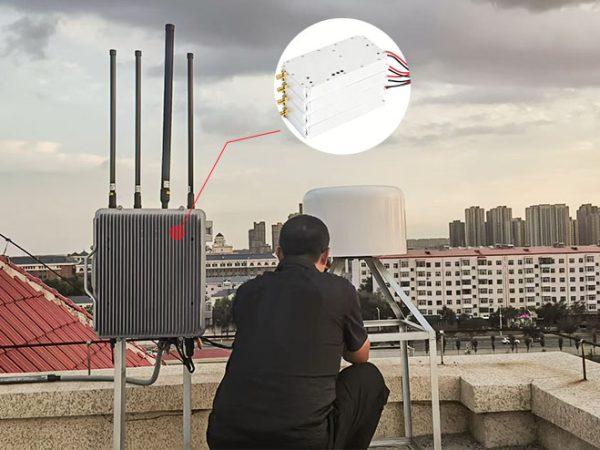
Heilongjiang Weather Center Completes Anti-Drone System Upgrade with Three High-Power Drone Jammer Modules

Tangshan Chem Plant Sealed Drone Gaps With 3 GaN Wideband Modules

How a National Prison Integrated Our Drone Jamming Module Into Their Fixed Counter-Drone System

Integrating Core RF Power: OEM Drone Jamming Module for Oil Refinery Security | Case Study
Send Us a Message
Related Products
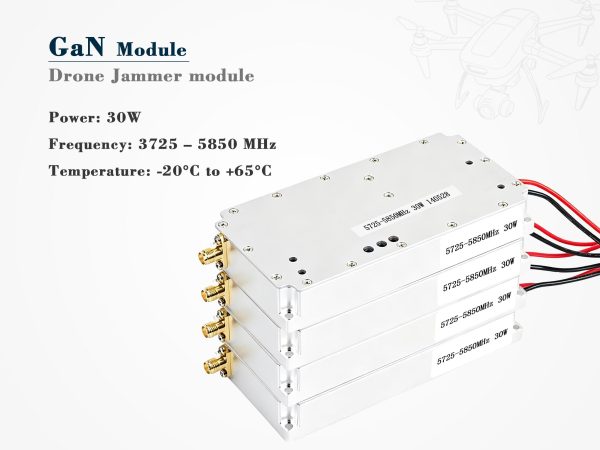
30W 5.8 GHz GaN Drone Jammer Module | 5725–5850 MHz
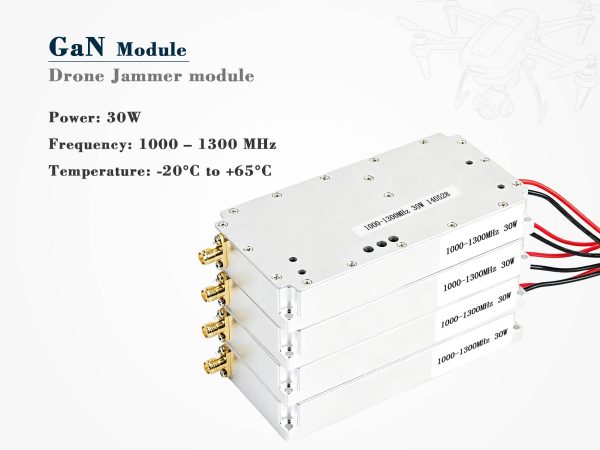
30W Anti-Drone Jamming Module: Compact 1000-1300MHz GaN Solution
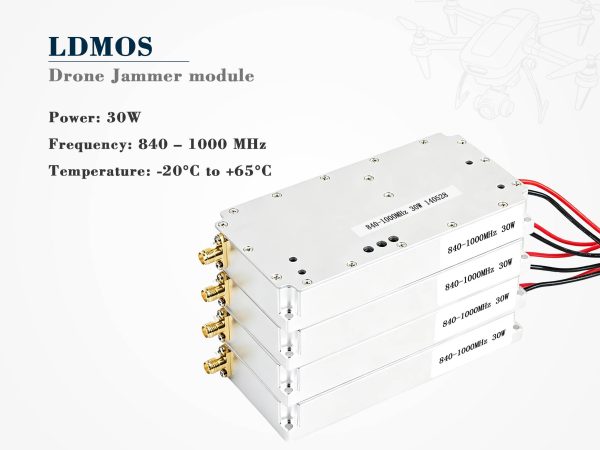
30W Anti UAV Module 840-1000MHz LDMOS Analog Jammer