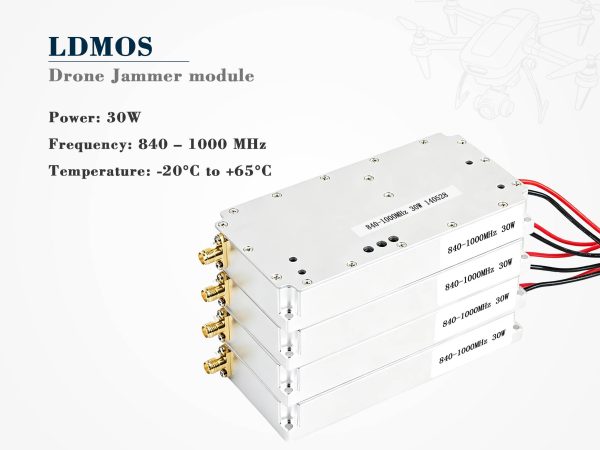
30W Drone Jamming Module 870-960MHz
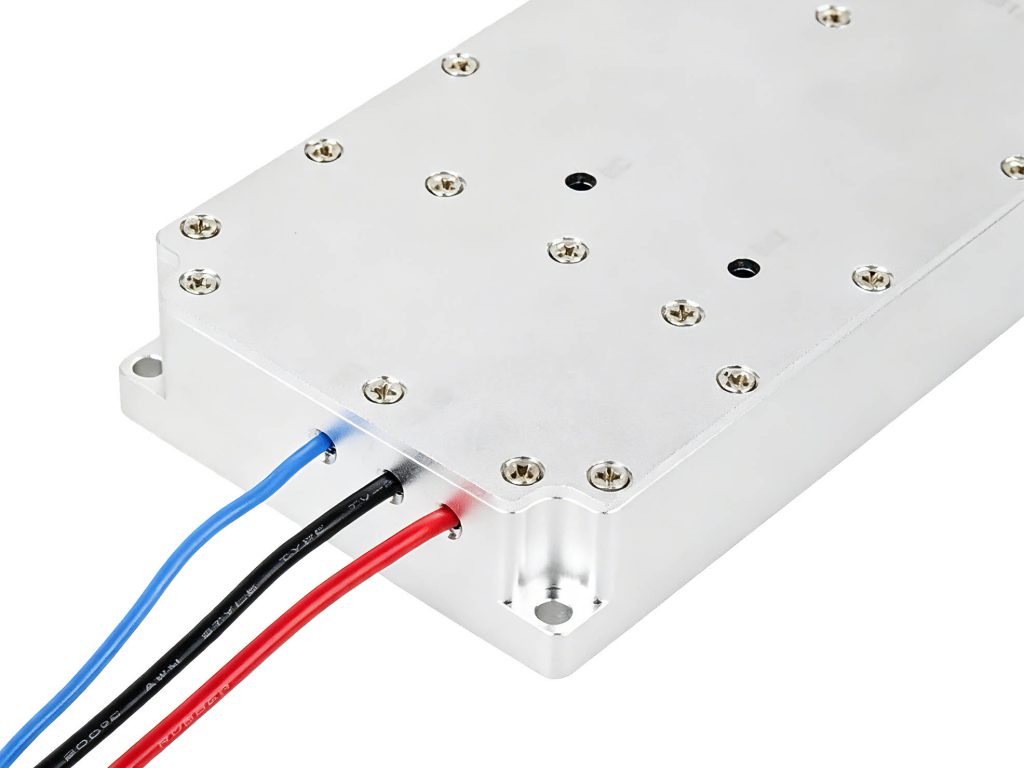
30W drone jamming module (870–960MHz), built-in high-speed sweep source, 30W output, 24–29V DC, ≤3.2A, SMA female, 210g. Compact LDMOS sub-1GHz counter-UAS solution.
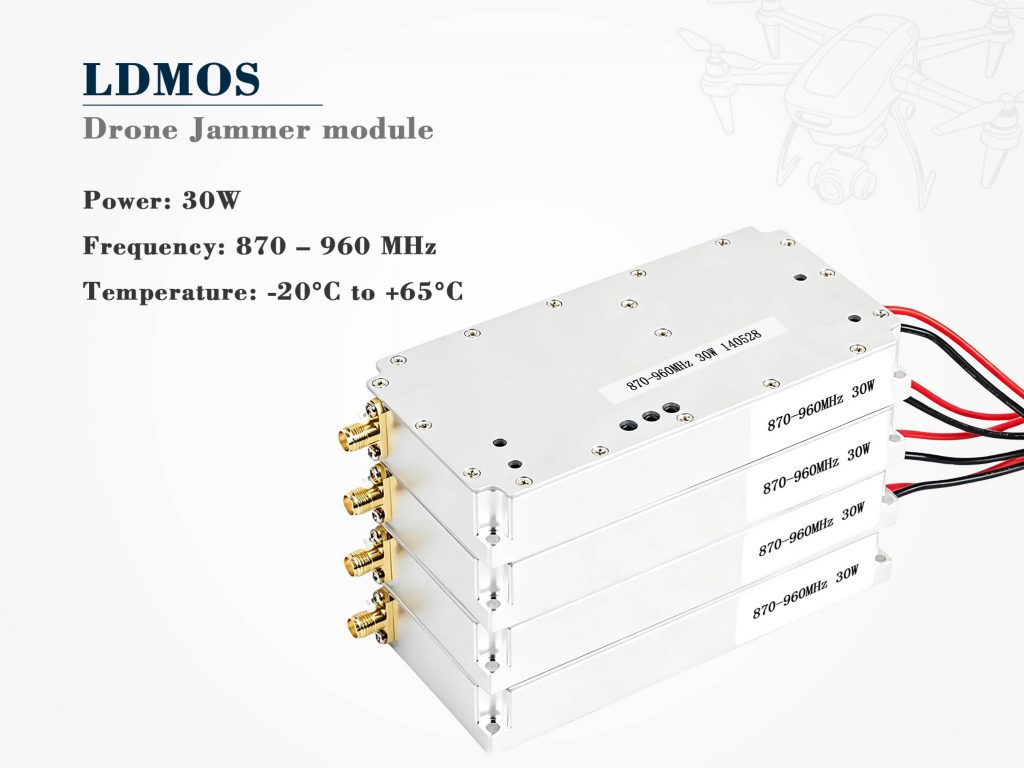
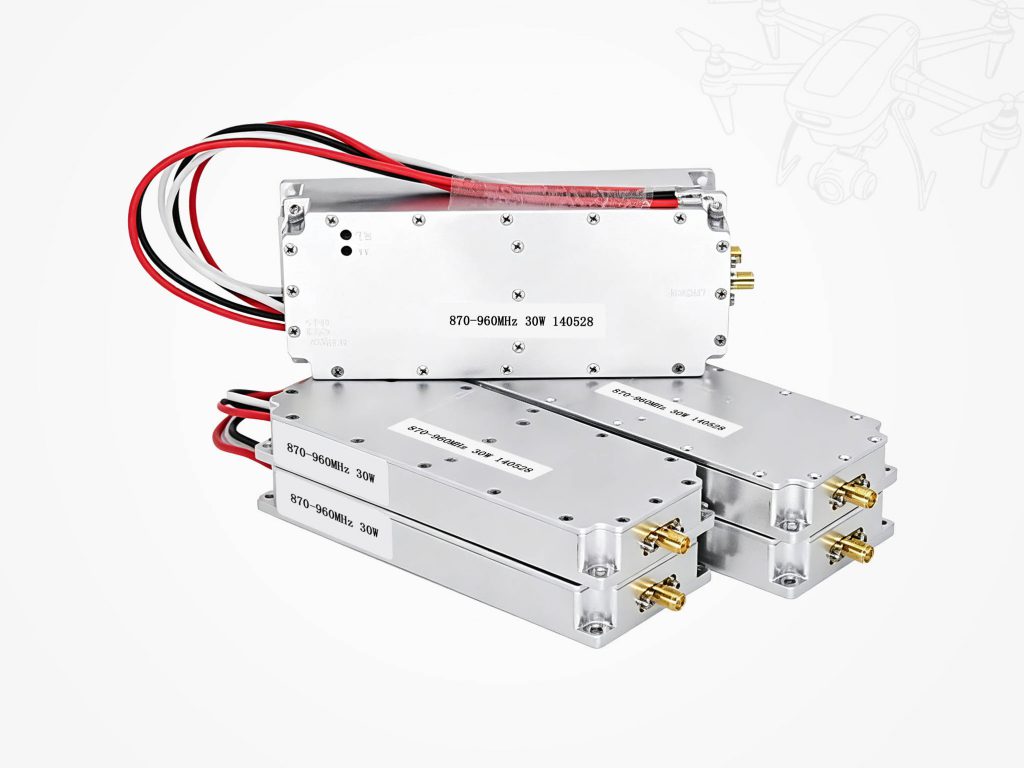
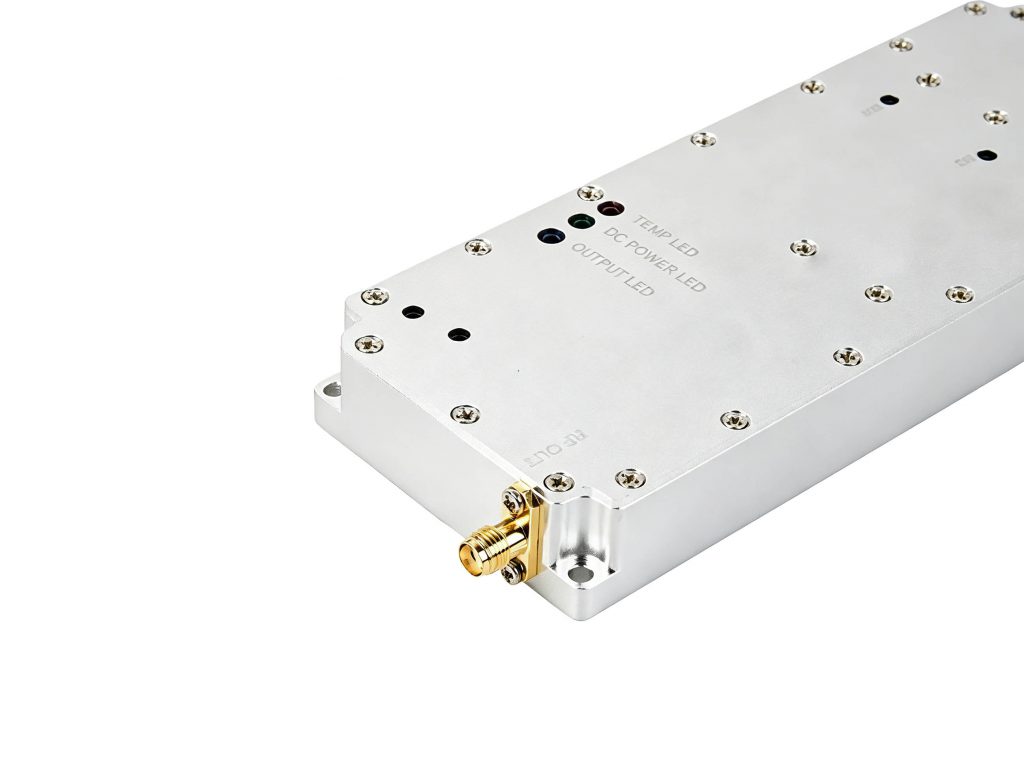
Technical Specifications
| Parameter | Specification | Notes |
| Frequency range | 870 – 960 MHz | Instantaneous swept coverage |
| Output power | 30 W (approx. 44.8 dBm) | At SMA female connector, VSWR ≤2.0 tolerated |
| Supply voltage | 24 – 29 V DC | Nominal 28 V recommended |
| Current draw | ≤ 3.2 A | At full 30 W output, efficiency ≥40% |
| Modulation source | Built-in high-speed sweep generator | Sweep rate factory-set, customizable on request |
| Analog scan speed | High-speed preset | Configurable for specific hopping patterns |
| Input / output impedance | 50 Ω | SMA female connector |
| Protection LEDs | N/A | TTL control: +5 V or float = ON, GND = OFF |
| Operating temperature | -20 to +65 °C | Baseplate should be heat-sunk for continuous duty |
| Dimensions (L×W×H) | 115.5 × 46.5 × 21 mm | Compact aluminum housing, mounting holes provided |
| Weight | 210 g (0.21 kg) | Module only |
| Base material | Aluminum alloy chassis / heat spreader | Lightweight with adequate thermal mass |
Product Details
Sub-1GHz drone links are making a quiet but decisive comeback. While the industry fixates on 2.4 and 5.8 GHz, plenty of serious UAV platforms lean on the 868–915 MHz ISM neighborhood for command, telemetry, and even compressed video — precisely because it travels further and bends around obstacles better. If your counter-drone blanket stops at 1 GHz, you’re leaving a door wide open. This 30-watt LDMOS drone jamming module spans 870 to 960 MHz and was built to slam that door shut without adding bulk or draining batteries.

Why This Drone Jamming Module Earns Its Place in a Kit
Think of it as a purpose-built disruptor for the lower UHF band. Inside the compact 115.5 × 46.5 × 21 mm aluminum housing sits a high-speed sweep generator already tuned to cover the full 90 MHz span. Toggle the TTL control pin high (or just leave it floating) and the module immediately starts painting dense sweeps across 870–960 MHz. Ground the same pin and it goes silent. That’s it — no serial bus, no configuration software, no external waveform generator.
The final stage is built around LDMOS, which thrives in this frequency range. Efficiency sits at 40% or better, meaning less of your DC budget turns into waste heat and more ends up as useful RF energy at the SMA female port. With a maximum current draw of 3.2 amps on a 24–29 V rail, a modest Li-ion or LiPo pack can keep it running through multiple jamming bursts, making the module a realistic choice for man-portable and pole-mounted systems where swapping batteries every few minutes isn’t an option.
Integration That Doesn’t Get in the Way
Anyone who has spent time integrating RF modules knows the pain of complicated interfaces. This drone jamming module sidesteps that entirely. The on/off control is a single TTL-compatible pin: supply +5 V or leave it open-circuit to activate, pull to ground to shut down. It can be driven directly by a microcontroller GPIO, a manual toggle switch, or a relay driven by a radar or spectrum analyzer’s alarm output. There’s zero boot time, so the moment your detection system triggers, the module is already sweeping the band.
The 50-ohm SMA female output mates with practically any antenna the drone-defense world uses. A 900 MHz sleeve dipole gives you broad azimuth coverage for convoy or perimeter use. Swap to a modest yagi or log-periodic and you can push the effective range out dramatically without cranking up the output power.
Thermal Notes for Field Use
A 30-watt power stage with ≥40% efficiency means roughly 45 watts of heat need to go somewhere under worst-case operation. The aluminum housing acts as both a structural frame and a heat spreader. For intermittent use — the most common scenario in counter-UAS missions — simply bolting the module to a metal bracket or enclosure wall is often enough. If your operation demands continuous-on jamming, mount the base to a finned heatsink and ensure some airflow. The module will operate reliably from -20°C up to +65°C, so outdoor deployment in harsh weather isn’t off the table.
Where It Fits in a Counter-Drone Architecture
This drone jamming module is not a replacement for a full-band spectrum blanket — it’s a targeted tool for the sub-1GHz threat. Pair it with a 2.4 GHz unit and a 5.8 GHz unit, and you’ve covered the three most active drone frequency bands without the cost and power burden of a single ultra-wideband amplifier chain. The low-profile form factor also makes it straightforward to embed multiple units in a single enclosure, each dedicated to its own band, activated sequentially or simultaneously as the threat evolves.
Frequently Asked Questions
Case Studies
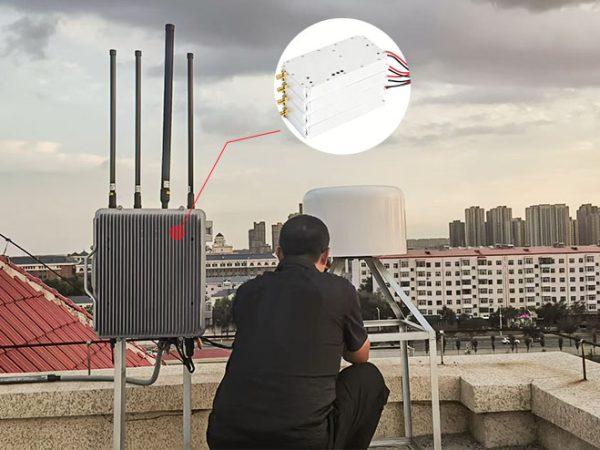
Heilongjiang Weather Center Completes Anti-Drone System Upgrade with Three High-Power Drone Jammer Modules

Tangshan Chem Plant Sealed Drone Gaps With 3 GaN Wideband Modules

How a National Prison Integrated Our Drone Jamming Module Into Their Fixed Counter-Drone System

Integrating Core RF Power: OEM Drone Jamming Module for Oil Refinery Security | Case Study
Send Us a Message
Related Products
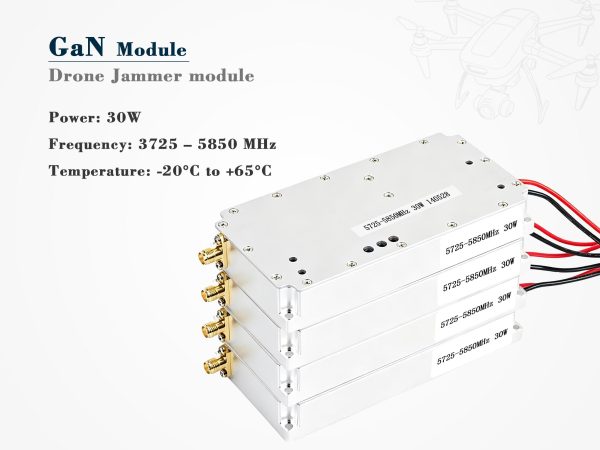
30W 5.8 GHz GaN Drone Jammer Module | 5725–5850 MHz
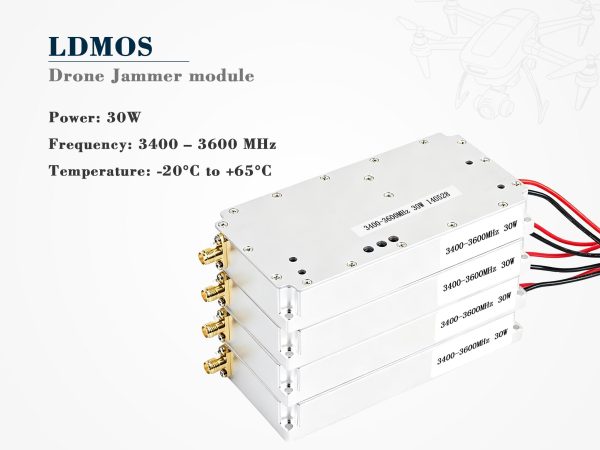
30W LDMOS Jamming Module for 3400–3600 MHz Drone Defense
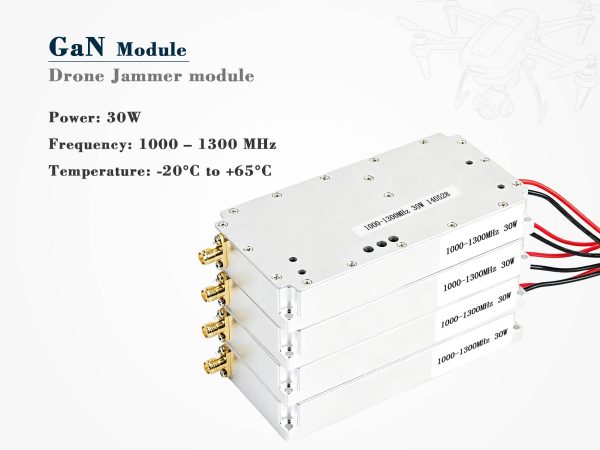
30W Anti-Drone Jamming Module: Compact 1000-1300MHz GaN Solution