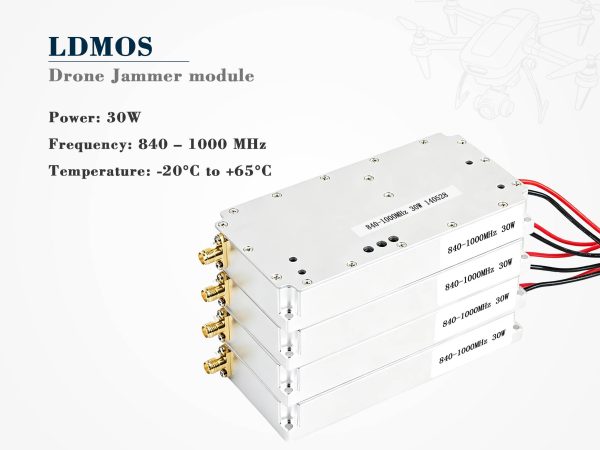
30W Drone Jamming Module 1800-2000MHz with Analog Sweep
High-power 30W jamming module covers 1800-2000MHz, integrates an analog sweep source, operates at 24-29V DC, and weighs just 0.21kg. SMA output, compact 115.5x46.5x21mm form factor.
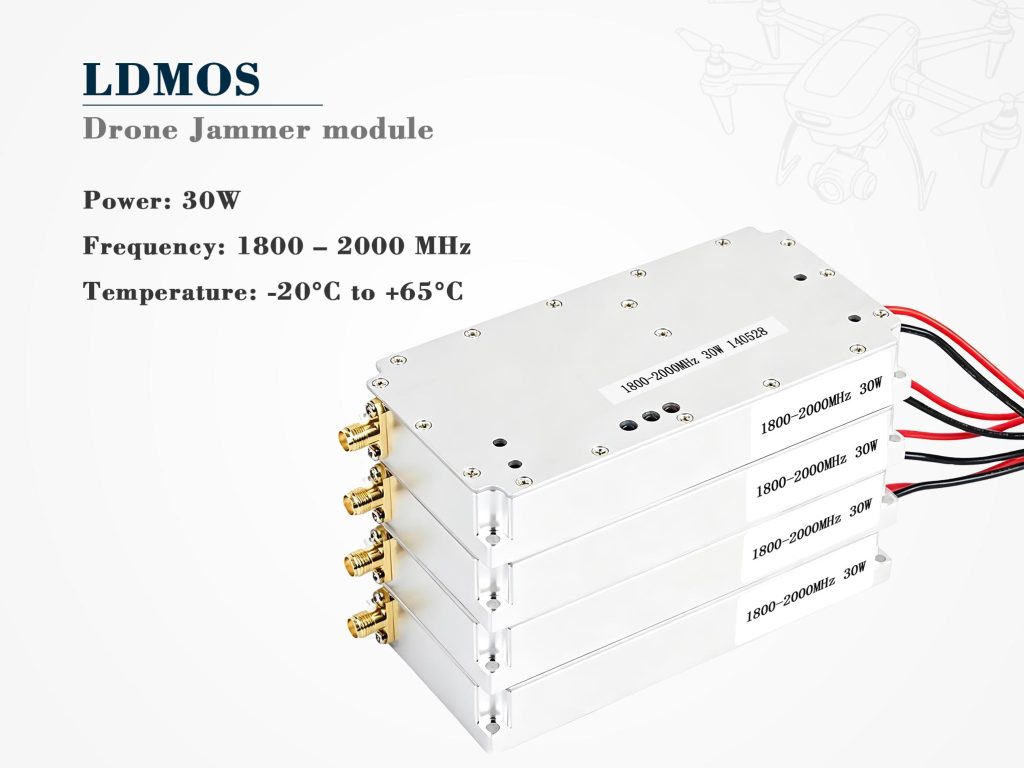
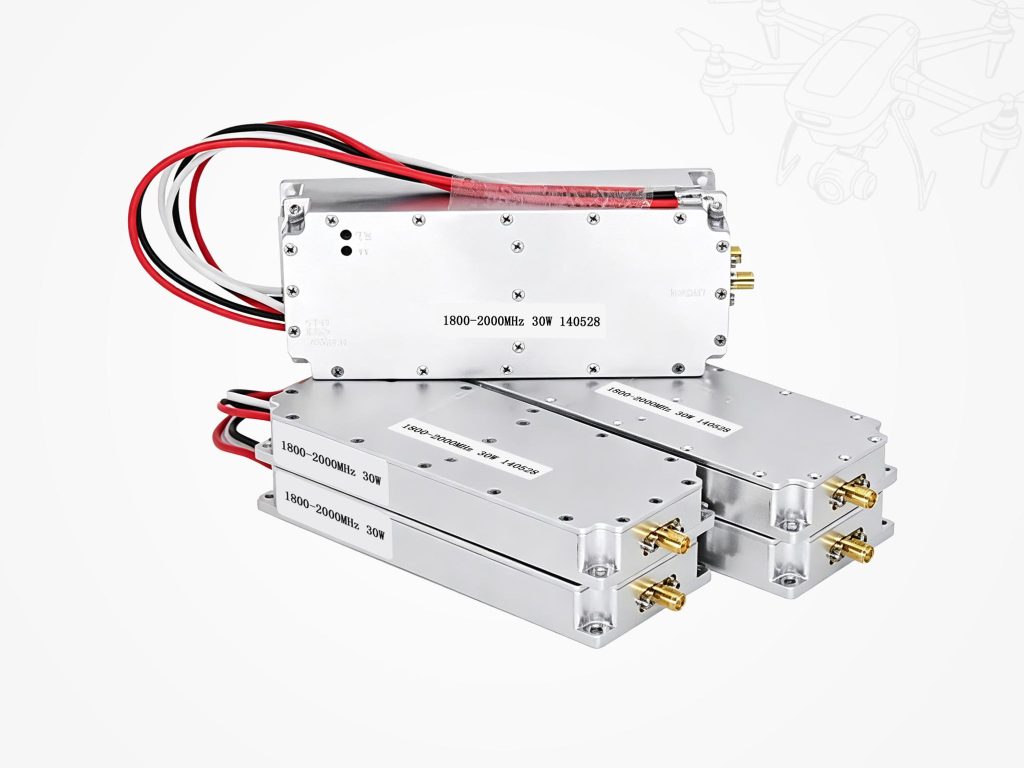
Technical Specifications
| Parameter | Specification | Notes |
| Frequency range | 1800–2000 MHz | Covers popular drone control and video bands |
| Output power | 30 W typical | Continuous RF output, P1dB referenced |
| Supply voltage | 24–29 V DC | 28 V nominal recommended |
| Current draw | ≤3.2 A | At full output power, 28 V supply |
| Modulation source | Built-in analog sweep generator | No external signal generator needed |
| Analog scan speed | Fast, configurable sweep rate | Default sweep covers full band continuously |
| Input / output impedance | 50 Ω | SMA female output connector |
| Protection LEDs | Power (green), VSWR warning (red) | Immediate visual status feedback |
| Operating temperature | -20 to +65 °C | Baseplate temperature range |
| Dimensions (L×W×H) | 115.5 × 46.5 × 21 mm | Compact, easy to integrate |
| Weight | 0.21 kg | Lightweight for mobile and handheld systems |
| Base material | Gold-plated aluminum alloy | Excellent thermal conductivity and corrosion resistance |
Product Details
When you need reliable broadband disruption in a compact footprint, this 30W jamming module steps up without hesitation. It’s purpose-built to handle the 1800–2000 MHz window where many commercial drones still operate their control and video links. Instead of piecing together separate signal sources and amplifiers, you get an all-in-one block that simplifies integration and keeps your bill of materials clean.
What Makes the Integrated Approach Different
Most stand-alone power amplifiers expect a clean, modulated input from an external signal generator. That adds cabling, potential mismatch headaches, and extra points of failure. Here, the high-speed analog sweep source lives on the same board as the LDMOS final stage. The result is a 30W jamming module that generates its own swept interference signal internally. The sweep is fast, continuous, and covers the full band, so you don’t have to worry about dead spots. Because the source and amplifier share a tight layout, you also get better phase consistency and fewer losses at the interconnects.
The benefit for system integrators is straightforward: one less box to source, one less cable to secure, and a much smaller overall enclosure. When every cubic centimeter matters in a man-portable counter-drone system or a vehicle-mounted turret, shedding unnecessary volume pays off immediately.
Built Around a Hardened LDMOS Final Stage
At the core of the design is a rugged LDMOS transistor that delivers a solid 30 W of continuous RF output across the entire 1800–2000 MHz band. Under typical operating conditions with a 28 V supply, current draw stays at or below 3.2 A, and efficiency hangs above 40%. That might not sound extraordinary until you consider the broad instantaneous bandwidth and the analog sweep running full time. Many wideband amplifiers dip in efficiency at band edges, but this 30W jamming module is biased to maintain consistent performance edge to edge, which helps with thermal management and power budget planning.
Thermal relief comes from a gold-plated aluminum baseplate that pulls heat straight into your cold plate or heatsink. With a baseplate temperature range of -20°C to +65°C, the module fits outdoor and indoor scenarios without complicated cooling gymnastics. Of course, at full power in the upper end of the temperature range, a good thermal interface becomes essential, but the mechanical design makes it easy to mount flat and tight.
Control Logic That Simplifies Field Use
Nobody wants to bring a microcontroller along just to turn an amplifier on and off. This module keeps it dead simple: apply +5 V or leave the control pin floating to enable RF output, pull it to ground to shut down. That kind of logic plays nicely with toggle switches, relay outputs, or a basic GPIO line. There’s no complex serial protocol to implement, no firmware to update. In high-stress field situations, simple is robust.
A pair of onboard protection LEDs gives you immediate visual feedback. One indicates DC power presence, the other acts as a VSWR warning. If an antenna gets damaged or disconnected, the warning LED lights up before the LDMOS stage takes a hit. This small detail has saved more than a few modules during rapid deployments. Combined with an output VSWR tolerance of ≤2.0, the 30W jamming module forgives moderate load mismatches without folding back or oscillating.
Analog Sweep Performance in the Real World
The built-in source sweeps across the full 1800–2000 MHz range with a fast, configurable rate. While the exact sweep speed can be tailored for specific jamming profiles, the default behavior creates a dense interference blanket that makes frequency hopping difficult. The swept nature also prevents the module from locking onto a single tone; it constantly moves, which is particularly effective against spread-spectrum control links.
Because the sweep is purely analog, there’s no latency from a DDS engine or a processor loop. That means the 30W jamming module reacts in real time to its own internal ramp, maintaining a smooth, glitch-free spectrum fill. The absence of digital spurs is a meaningful advantage when you’re trying to raise the noise floor without creating predictable patterns that a smart receiver could notch out.
Physical Integration Points
Measuring just 115.5 mm by 46.5 mm by 21 mm and weighing 0.21 kg, the module slots into tight spaces without fuss. The SMA female output connector is standard and mates with most common coaxial assemblies. Keep the RF path short and use high-quality cable to preserve the full 30 W at the antenna. DC and control lines connect through a simple interface, so wiring stays tidy.
When you’re building a multi-band counter-drone system, you often need several modules covering different frequency ranges. The slim profile of this 30W jamming module allows side-by-side mounting in a 19-inch rack or a pelican case arrangement. Stack a 2.4 GHz unit and a 5.8 GHz unit next to it, and you’ve covered the major drone bands with a uniform, maintainable hardware set.
Day-to-Day Reliability
Field gear lives a hard life. Beyond the VSWR protection and temperature-hardened design, the module benefits from a straightforward LDMOS architecture that isn’t fussy about supply sequencing. Power it with a clean 24–29 VDC source, make sure the heatsink is adequate, and it delivers consistent output for thousands of hours. The efficiency above 40% also means less wasted heat and lighter battery loads, which matters when you’re humping gear across uneven terrain.
Serviceability is another quiet strength. Because the sweep source is integrated, troubleshooting boils down to checking DC input, control logic state, RF output, and the antenna load. There’s no chain of external components to diagnose. That simplicity often translates into fewer failures and quicker recovery in the event something does go wrong.
For anyone developing an anti-drone solution, test range instrumentation, or a security blanket for sensitive sites, having a self-contained 30W jamming module that covers 1800–2000 MHz with an analog sweep source removes a lot of the usual headaches. It’s not a laboratory curiosity; it’s a production-ready block that drops into a larger system with minimal fuss, doing one job well.
Frequently Asked Questions
Case Studies
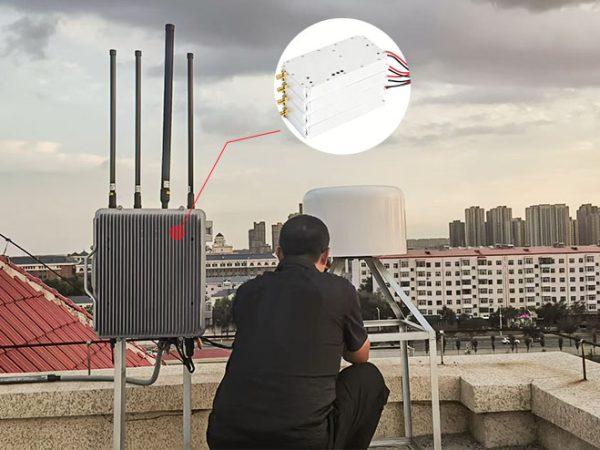
Heilongjiang Weather Center Completes Anti-Drone System Upgrade with Three High-Power Drone Jammer Modules

Tangshan Chem Plant Sealed Drone Gaps With 3 GaN Wideband Modules

How a National Prison Integrated Our Drone Jamming Module Into Their Fixed Counter-Drone System

Integrating Core RF Power: OEM Drone Jamming Module for Oil Refinery Security | Case Study
Send Us a Message
Related Products
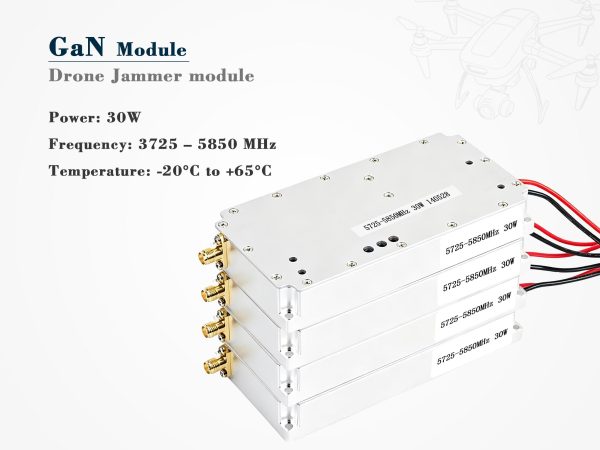
30W 5.8 GHz GaN Drone Jammer Module | 5725–5850 MHz
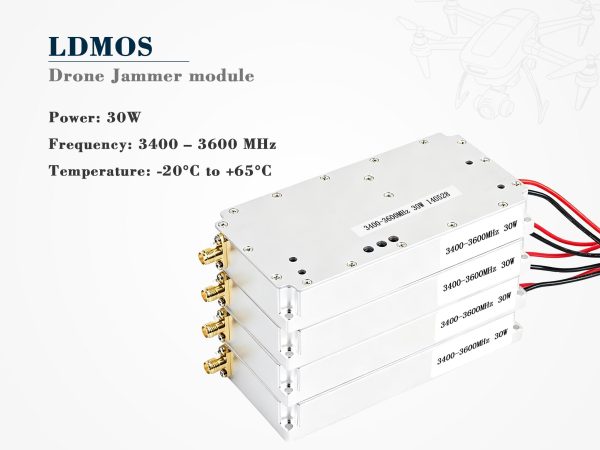
30W LDMOS Jamming Module for 3400–3600 MHz Drone Defense
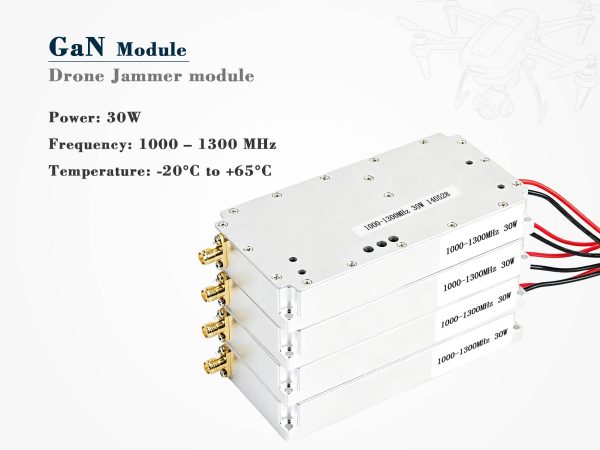
30W Anti-Drone Jamming Module: Compact 1000-1300MHz GaN Solution