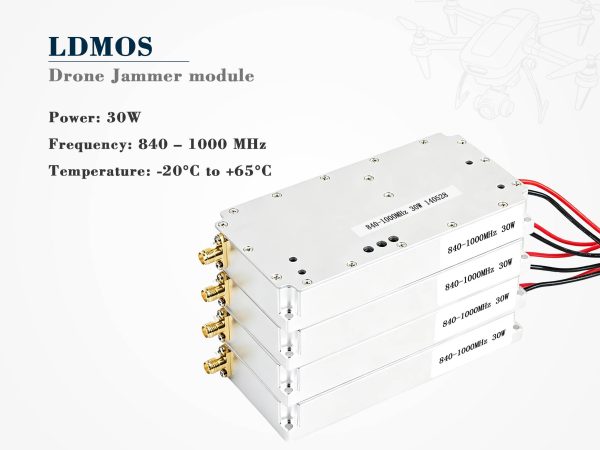
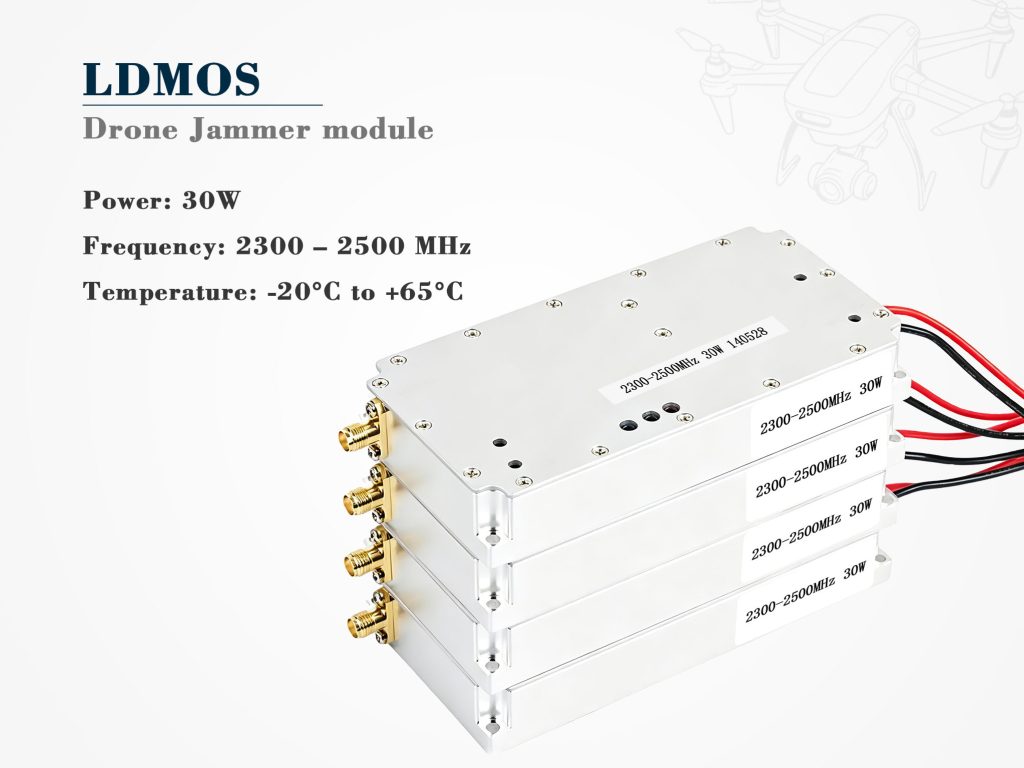
30W 2300-2500MHz LDMOS Drone Jammer Module – 2.4GHz Band Shield
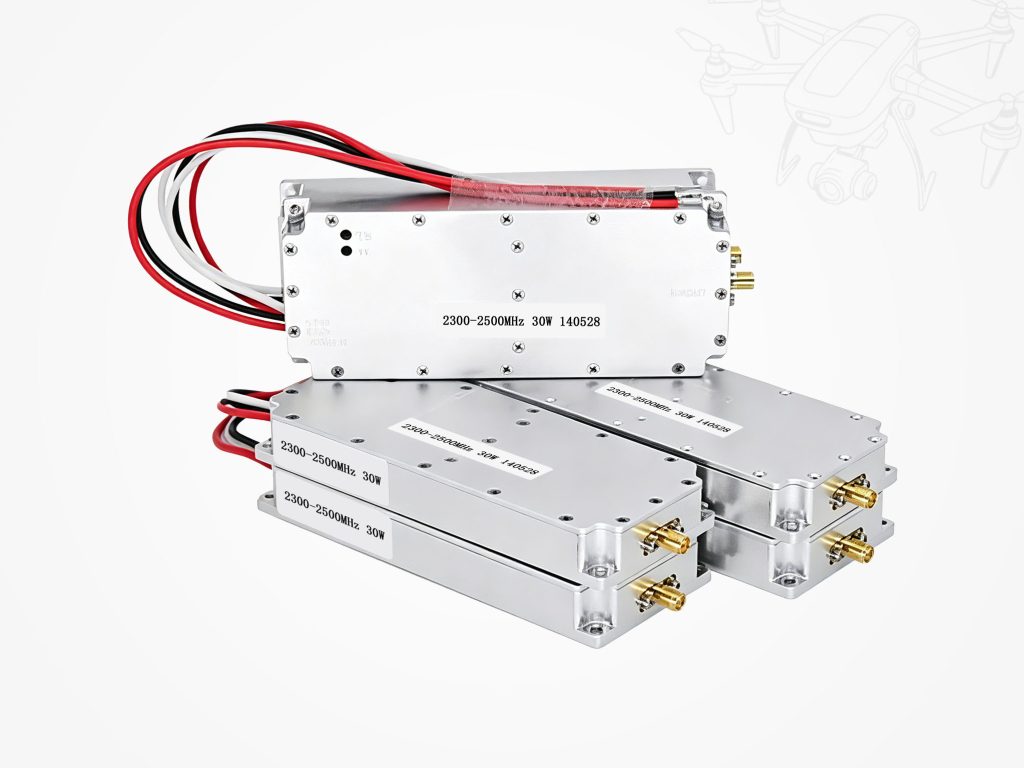
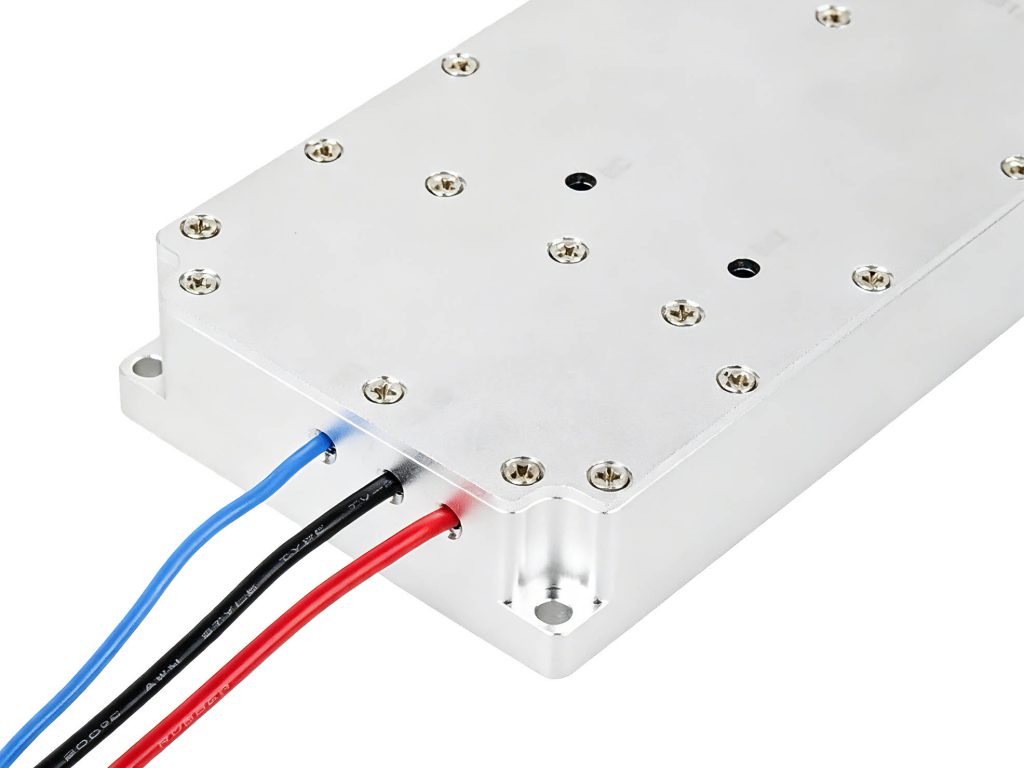
30W drone jammer module for 2300-2500MHz, 24-29V, 3.2A, built-in sweep source, SMA output, 115.5×46.5×21mm, 0.21kg. Ideal for disrupting 2.4GHz-band UAV control and video links.
Technical Specifications
| Parameter | Specification | Notes |
| Frequency range | 2300 – 2500 MHz | Covers 2.4GHz ISM and adjacent UAV bands |
| Output power | 30W (typical) | Measured at 28V, CW mode |
| Supply voltage | 24 – 29 V DC | Nominal 28V recommended |
| Current draw | ≤ 3.2 A | At full output, 28V |
| Modulation source | Built‑in high‑speed sweep generator | Sweep rate configurable on request |
| Analog scan speed | Customisable (contact for details) | Default set per order |
| Input / output impedance | 50 Ω | SMA female output; internal input |
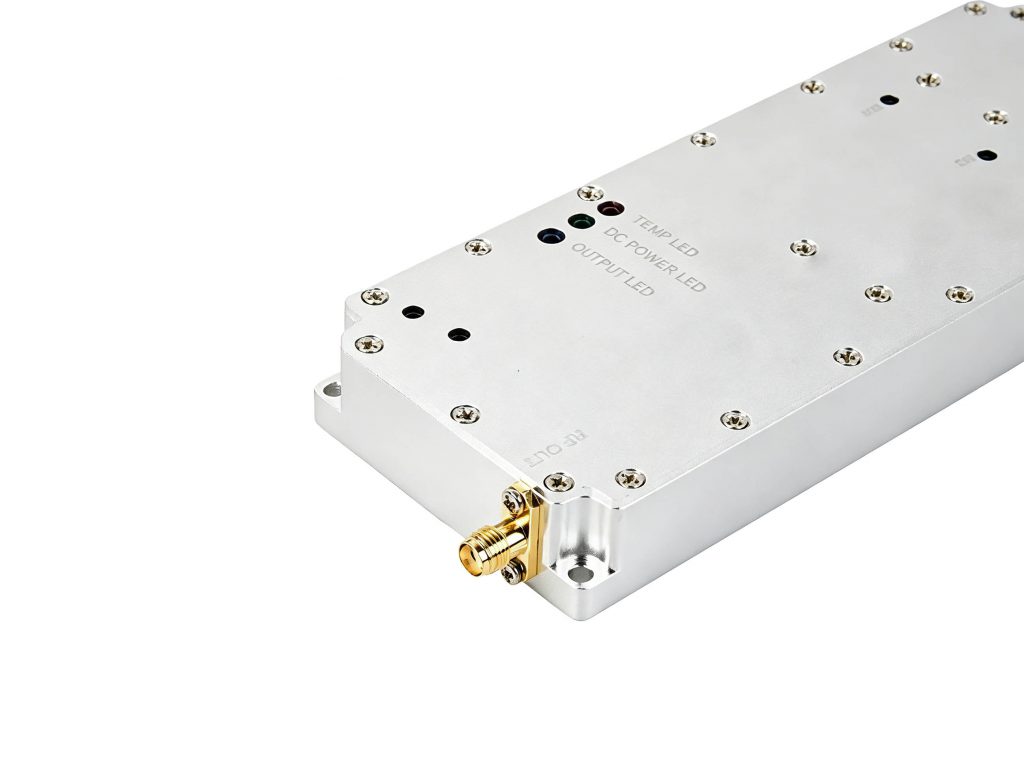
| Protection LEDs | over‑temp fold‑back built‑in | - |
| Operating temperature | -20 ~ +65 °C | Ambient, with adequate heatsinking |
| Dimensions (L×W×H) | 115.5 × 46.5 × 21 mm | Excluding connectors and pins |
| Weight | 0.21 kg | Approximate net weight |
| Base material | Aluminium alloy | Milled housing, natural finish |
Product Details
The 2.4GHz Battleground
If there is one frequency band that has become synonymous with drone operations, it is the 2.4GHz spectrum. From consumer quadcopters to professional survey UAVs, the vast majority of off-the-shelf drones rely on this band for both control and real-time video transmission. Our 30W drone jammer module takes direct aim at this crowded airspace, covering the full 2300 to 2500MHz range. This spans not only the standard 2.4GHz ISM band but also adjacent frequencies used by some advanced flight controllers and telemetry modules. By delivering a clean 30W of LDMOS power directly into this spectrum, the module effectively saturates the receiver inputs of any nearby drone, severing the pilot’s command link and freezing the video feed in its tracks. For security teams and defence contractors, having a dedicated 2.4GHz solution is non-negotiable, and this 30W drone jammer module delivers exactly that capability in a form factor that fits into almost any deployment scenario.
Electrical Performance and Thermal Behaviour
Under the hood, this 30W drone jammer module operates from a 24 to 29V DC supply, drawing a maximum of 3.2A when running at full tilt. With a typical efficiency exceeding 40%, the module converts around 75-80W of DC input into 30W of RF output – respectable numbers for a linear LDMOS design. The output VSWR is rated at ≤2.0, providing a comfortable safety margin even if your antenna is not perfectly tuned. The SMA female connector is a practical choice, offering low insertion loss and compatibility with a wide range of antenna cables and adapters. When it comes to heat, the milled aluminium housing acts as a substantial heat spreader. For sustained operation, we recommend attaching a passive heatsink – something in the range of 50×50×30mm with fins – to keep the module comfortably within its -20 to +65°C operating range. Many users choose to pulse this 30W drone jammer module at 30-50% duty cycles, which allows the housing to shed heat effectively even without forced airflow.
Sweep Source and Enable Logic
The interference pattern is generated by an internal high-speed sweep oscillator that continuously moves across the 2300-2500MHz band. This sweeping action is far more disruptive to modern digital links than a static carrier, as it forces the drone’s receiver to constantly reacquire and re-sync, overwhelming its error-correction algorithms. The sweep rate is factory-programmed but can be adjusted to suit specific threats – faster sweeps for frequency-hopping systems, slower sweeps for fixed-channel links. Control is refreshingly simple: a TTL-compatible enable pin lets you toggle the RF output on and off remotely. Apply +5V or leave the pin floating to enable transmission; ground the pin to disable it. This feature is particularly useful when integrating the 30W drone jammer module into larger counter-UAS systems where multiple bands need to be activated in sequence or in response to specific triggers. The straightforward logic also makes it easy to interface with PLCs, microcontrollers, or manual switch panels.
Compact Dimensions and Integration Flexibility
Measuring just 115.5mm long, 46.5mm wide, and 21mm tall, this 30W drone jammer module is remarkably compact for its power class. At 0.21kg, it adds negligible weight to handheld jamming guns, tripod-mounted systems, or vehicle installations. The aluminium enclosure is milled from a solid block, providing both RF shielding and a flat, thermally conductive base. The SMA output connector is positioned on one short edge, while the DC input and control pins are on the opposite side – a thoughtful layout that keeps cable routing neat and organised. Mounting holes are provided on the underside, allowing secure attachment to chassis plates, heatsinks, or custom brackets. Whether you are building a multi-band jamming array or a standalone portable unit, the compact form factor of this 30W drone jammer module leaves ample room for batteries, cooling fans, and ancillary electronics.
Practical Deployment Advice
Before taking this module into the field, always test into a 50Ω dummy load to verify operation and check for any reflected power. While the output VSWR protection offers some tolerance, a sudden open circuit at 30W can still stress the output transistor. For maximum effective range, pair the module with an antenna that matches the drone’s polarisation – circular polarisation often works well for 2.4GHz UAV links. In our own tests, a 6dBi panel antenna delivered consistent link disruption at 300-400 metres line-of-sight; with higher-gain antennas, distances can be extended considerably. Keep DC supply leads as short and thick as possible – at 3.2A, voltage drop can become an issue with long, thin cables. The module does not include visual status LEDs (a concession to its compact size), but it does feature silent over-temperature fold-back and reverse-polarity protection. When the internal temperature exceeds the safe threshold, the output gracefully reduces until the module cools down. For outdoor use in wet conditions, we suggest enclosing the unit in a weatherproof housing, as the aluminium shell is not IP-rated. With sensible handling and proper thermal management, this 30W drone jammer module will provide dependable service in fixed defence installations, mobile response vehicles, and portable counter-UAS kits alike.
Frequently Asked Questions
Case Studies
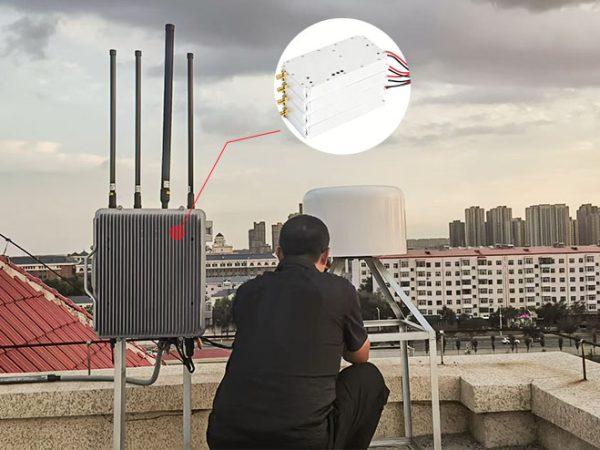
Heilongjiang Weather Center Completes Anti-Drone System Upgrade with Three High-Power Drone Jammer Modules

Tangshan Chem Plant Sealed Drone Gaps With 3 GaN Wideband Modules

How a National Prison Integrated Our Drone Jamming Module Into Their Fixed Counter-Drone System

Integrating Core RF Power: OEM Drone Jamming Module for Oil Refinery Security | Case Study
Send Us a Message
Related Products
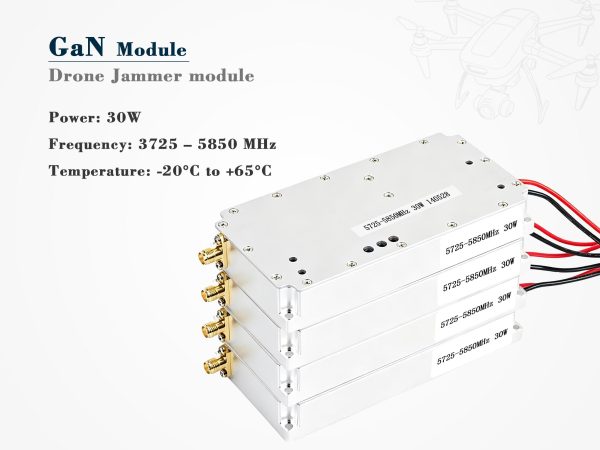
30W 5.8 GHz GaN Drone Jammer Module | 5725–5850 MHz
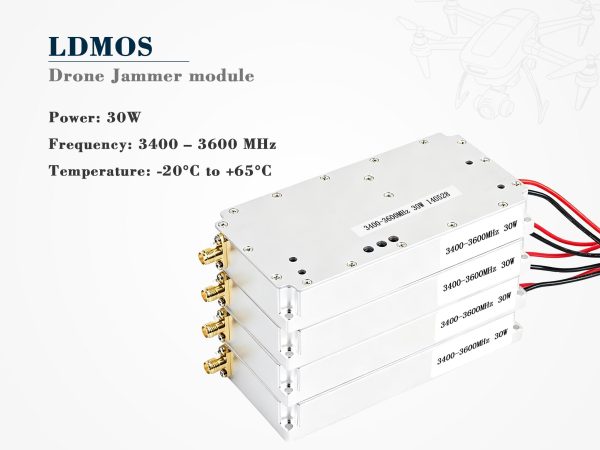
30W LDMOS Jamming Module for 3400–3600 MHz Drone Defense
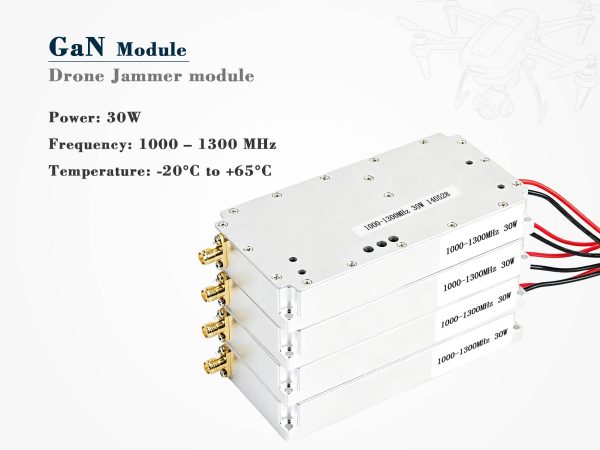
30W Anti-Drone Jamming Module: Compact 1000-1300MHz GaN Solution